
A floor grinder is the better primary tool for removing thick epoxy, while shot blasting is faster across large open floors with thin coatings.
For a mixed project, grind the perimeter and difficult areas, then use shot blasting in the open field only if the coating, contamination, and required surface profile permit it.
Decision Criteria for Epoxy Removal
Coating thickness, floor area, contamination, access, and the replacement system determine the method. For most garage and commercial projects, the contractor uses mechanical diamond grinding to remove the cream layer and loose concrete and leave a uniform scratch pattern with open pores that coatings can adhere to [S2].
The two methods also differ physically. Diamond grinding uses rotating tooling to abrade and cut the surface, while shot blasting propels steel shot at high speed, recovers the abrasive, and removes dust during the pass [S5]. Both can prepare concrete for a new epoxy system, but neither automatically produces an acceptable surface without correct tooling, extraction, cleaning, and profile control.
Use this practical sequence:
1.
2. Measure the open field, perimeter, corners, obstructions, and access to suitable power.
3. Select the surface profile required by the specified replacement coating rather than choosing the machine first.
4. Trial the selected method in a representative area and check the result before treating the full floor.
5. Remove grinding debris and dust, inspect for loose material, and verify the surface before epoxy application.
Grinding Removes More, Shot Blasting Covers More
Diamond grinding is the stronger choice for thick epoxy, urethane concrete, moisture-mitigation coatings, tacky adhesive, heavy thinset, and hard edges.
Grinding also levels uneven floors and reaches close to walls. Planetary grinders can remove high spots and ridges, use different diamond grit to produce CSP 1–3 and, in some cases, CSP 4, and work wet or dry [S4].
Shot blasting is the stronger choice for a large, open floor that needs rapid, uniform removal. One contractor stated that shot blasting can prepare as much as 30,000 sq ft per day, while another described it as generally faster over large open areas [S3][S5].
Use Both Methods When the Floor Has Two Different Work Zones
The most efficient method for an epoxy removal project is often a sequence, not a single machine. A practical split is to use shot blasting across the unobstructed field for production and a grinder along walls, corners, columns, drains, and other areas the blaster cannot reach [S5].
Reverse the sequence when thick epoxy must first be ground away and the open field still needs profiling.
Choose Grinding for Removal, Edges, and Leveling
Choose a floor grinder when the epoxy is thick, the slab is uneven, the edges need close access, or the replacement coating demands a controlled low-to-medium profile.
Hand grinding remains an option for small areas and edges, but the work is physically demanding. Shot blasting is faster than grinding, while large planetary grinders can smooth and level largely uneven floors [S3].
Choose Shot Blasting for Speed and Uniform Field Profile
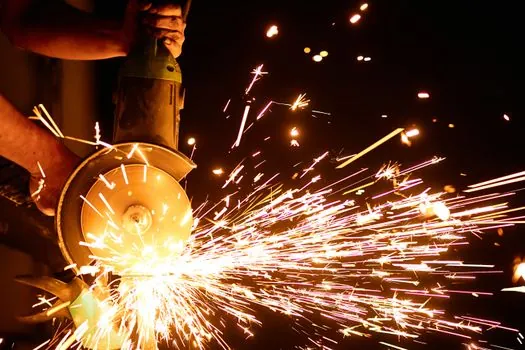
Choose shot blasting when the floor is large and open, the existing coating is thin, the objective is rapid removal over thousands of square feet, and the replacement system accepts an aggressive texture. Shot blasting removes coatings by impact, cleans the exposed concrete, and leaves a uniform textured surface with open pores for bonding [S2][S5].
The method has practical constraints. It is difficult to operate close to walls, so edge grinding remains necessary [S3]. Equipment may require a 480 V site supply or a generator, whereas smaller grinders can operate without that arrangement [S3]. Larger planetary grinders may require 230 V or 480 V three-phase power, adding another logistical constraint [S4].
Shot blasting also does not dial down effectively for a low-profile sealer. High points left by aggressive blasting may remain exposed or become vulnerable to water and foreign-material penetration [S3]. If the new system is a thin sealer, use grinding unless the blasting specification and trial area demonstrate that the resulting profile is acceptable.
Contamination, Safety, and Installation Limits
Existing contamination can reverse the method preference. Shot blasting is favored for heavy petroleum, animal-fat, cooking-oil, or grease contamination because it removes contaminated surface material rapidly [S2]. Grinding can spread or drive contaminants into pores, so heavily contaminated concrete may require abrasive blasting rather than merely smoothing over the contamination.
Vacuum-assisted grinding reduces airborne dust but does not remove the need to clear grinding debris. Conversely, shot blasting is described as dust-free in operation because the shot and dust are recovered, although equipment containment and site conditions still require control [S3]. Grinding crews should use effective extraction; large work areas also require coordination of power, access, and cleanup.
For coating selection, the Concrete Surface Profile, or CSP, is the central acceptance reference. CSP 1 represents a lightly etched surface and CSP 10 an extremely rough surface [S4]. Epoxy mortar and urethane mortar systems often require CSP 3 or higher, while thin sealers need a lower profile [S2][S3]. The replacement coating manufacturer’s written profile requirement should override general rule-of-thumb advice.
For specification development, ASTM D7234-05 addresses pull-off adhesion strength of coatings on concrete and is the standard referenced for assessing the effect of preparation on adhesion [S2]. Do not treat mechanical preparation alone as a bond guarantee: surface cleanliness, moisture condition, repair of damaged concrete, and compatibility with the specified primer remain separate acceptance criteria.
Recommended Workflow by Project Type
For a residential garage with approximately 140 sq ft of epoxy, start with a vacuum-assisted grinder because the area is small, perimeter access matters, and mobilization of a production blaster may cost more than the work saved [S1]. For a 30,000 sq ft warehouse with thin coating and open access, shot blasting the field and grinding the perimeter is the more logical production sequence [S3][S5].
For thick mil epoxy, use PCD or other purpose-selected grinding tooling until the heavy coating is removed, then choose between continued grinding and field blasting according to the required profile [S1]. For decorative epoxy, favor grinding because the process can remove high spots and reduce the visual telegraphing of blasting rows [S2][S4].
The best floor-grinder and shot-blast decision is therefore straightforward: grind when removal, leveling, and edge control dominate; blast when speed, uniformity, and contamination removal dominate; combine both when the floor contains distinct field and perimeter conditions. The acceptance test is not the machine name but a clean, sound, correctly profiled substrate that meets the written requirements of the replacement system.