
Ride-on floor grinders are the stronger choice for large, open areas because they increase operator productivity while reducing walking effort.
Walk-behind grinders remain more practical for narrow access, tight layouts, residential work, and applications where the machine must pass through standard doorways.
Decision thresholds for walk-behind and ride-on grinders
Use ride-on equipment when the work area is sufficiently open to accommodate its operating pattern and the production schedule justifies the higher capital cost. Walk-behind machines are better when access routes are narrow, the layout contains many obstacles, or the work is divided into smaller sections. [S3]
The supporting rule is straightforward: select the largest machine that can safely work in the available space. Larger floor-cleaning machines can carry more water and use larger batteries, extending the interval between refills and recharging [S3]. For concrete grinding, machine width also determines how much working area an operator can cover on each pass, so route geometry must be checked before purchase or rental.
Ride-on floor-cleaning machines offer a 64% increase in productivity versus powered walk-behind machines [S3]. This is a cleaning-industry comparison rather than a grinder warranty, but it demonstrates the operating economics that also govern grinding and polishing projects.
Walk-behind grinder operating profile
A walk-behind concrete grinder is normally the lower-complexity choice for garages, basements, restricted floor plans, and isolated work zones. Commercial walk-behind examples include 26-inch machines, while ride-on alternatives include the 60-inch ROG-60 model [S4].
Walk-behind grinders provide forward motion without requiring the operator to push a full-size manual machine, reducing fatigue relative to handheld tools [S3]. For compact residential work, machines using 7-inch or 10-inch discs are described as more portable than larger ride-on platforms [S8]. The wider commercial machine may remove more material per pass, while dual-head walk-behind grinders can remove up to 0.5 inch of material in one hour under the cited operating example [S1].
Choose this configuration when the floor contains doorways, columns, stored material, ramps, or irregular edges that would interrupt a larger machine. Walk-behind equipment is also the more defensible option for a garage or basement because operators can work section by section and reposition without setting up a large ride-on platform.
Ride-on grinder operating profile

Ride-on grinders cover large, uninterrupted slabs with less operator walking, making them the practical option for warehouses, factories, retail floors, and multi-bay concrete installations. A concrete-polishing project completed with ride-on trowel-based equipment covered 35,000 square feet in slightly more than 3 days, including training and operational stops [S2].
That project is a documented operating example, not a universal production guarantee. The same source presents a production comparison in which 2 machines completed 100,000 square feet in 7 days, compared with 33 days for 2 large-format planetary grinders [S2]. The result depends on the process, machine configuration, tooling, operator experience, preparation condition, and project constraints.
Ride-on grinder selection should therefore be based on repeatable coverage and labor hours, not only nameplate width. Confirm that the turning radius, doorway clearance, aisle width, and material-transfer routes support the platform. For a separate decision between single-disc and planetary machine architecture, see Single Disc vs Planetary Floor Grinder Selection.
Cost, access, and production comparison
Ride-on equipment wins on labor efficiency for a large, open floor, while walk-behind equipment wins on access and capital cost. Ride-on floor-cleaning equipment offers a 64% increase in productivity versus powered walk-behind machines [S3].
Walk-behind power trowels are considerably less expensive than planetary grinders, reducing the entry cost for concrete-polishing work [S2]. However, that lower purchase price does not settle a large-project decision by itself. A 35,000-square-foot ride-on trowel project finished in slightly more than 3 days, but the operator had to learn the ride-on power-trowel system during the work [S2]. Training time, transfers, charging or fuel, and setup must be included in the comparison.
The practical matrix is therefore four criteria wide: ride-on offers greater coverage per labor hour and lower operator fatigue; walk-behind offers easier passage through openings and lower purchase cost; ride-on requires more clear floor area and operator training; walk-behind requires more passes and labor hours on a large open slab. For cleaning rather than grinding, a stand-on scrubber is the intermediate option, offering more productivity than a walk-behind and a smaller footprint than a ride-on, although some operators report more fatigue from prolonged standing [S3].
Matching the grinder to the work scope
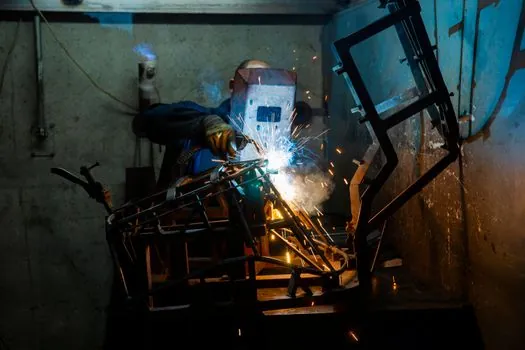
Use ride-on equipment for continuous slabs larger than the individual walk-behind work zone, provided access is unobstructed. This applies to warehouse polishing, large-scale floor preparation, and production grinding where maintaining a steady pass rate across hundreds or thousands of square feet is essential [S2][S4].
Use walk-behind equipment for garages, basements, narrow passages, congested production areas, and projects with frequent interruptions [S8]. A self-propelled walk-behind design can preserve operator control where a ride-on machine cannot turn or cannot leave the work area without obstructing traffic.
Do not treat either configuration as a substitute for a scarifier. A grinder removes or refines the concrete surface with diamond tooling, whereas a scarifier mechanically abrades the slab with cutting drums or teeth. If the job calls for profiling, deep removal, or aggressive surface preparation, the floor grinder and concrete scarifier must be evaluated as different equipment classes rather than by width alone.
Constraints, failure modes, and operating controls
The main failure mode is selecting a ride-on machine by coverage rate while ignoring access. A large platform can become ineffective if the operator must dismantle it, move it by another method, or repeatedly reposition it around obstructions. Validate the complete route, including the narrowest doorway, corner turns, elevator or ramp limits, and floor loading conditions before commitment. [S2]
Tooling and operating condition can change productivity as much as machine size. Diamond tooling must match the intended removal or polishing stage, and worn or inappropriate tooling can reduce work rate and produce an inconsistent profile. The cited comparison of a 35,000-square-foot project took slightly more than 3 days while including all stops required for operator training [S2]. Treat training, attachment changes, cleanup, and access interruptions as schedule items rather than assuming uninterrupted cutting time.
For a grinding specification that separates aggressive removal from fine polishing, Floor Grinder RPM for Coarse Grinding and Fine Polishing provides the relevant operating distinction. Confirm machine power, tooling compatibility, dust-control arrangements, and attachment availability with the supplier before mobilizing either class.
Procurement and acceptance checks
A ride-on purchase should pass a site trial covering the intended route and representative abrasive condition. A walk-behind rental should pass the same test when the area contains multiple obstructions. For concrete work, record the number of passes, tooling sequence, actual square feet completed per shift, and labor hours needed to reach the specified finish [S1][S2].
Use square footage, access width, and labor cost as separate decision variables. A 26-inch walk-behind and 60-inch ride-on grinder demonstrate that platform size varies materially between product families [S4], but operating width alone does not establish total project cost. Include operator training, productivity loss from staging, diamond-tool consumption, dust extraction, fuel or electricity, maintenance, and the number of machines required.
For large, clear floors, the ride-on route is the baseline recommendation because it minimizes operator walking and can recover its premium through labor savings. Retain the walk-behind route when access constraints dominate or the project is too small to amortize ride-on ownership. A short production trial on the actual slab remains the most defensible final acceptance test.