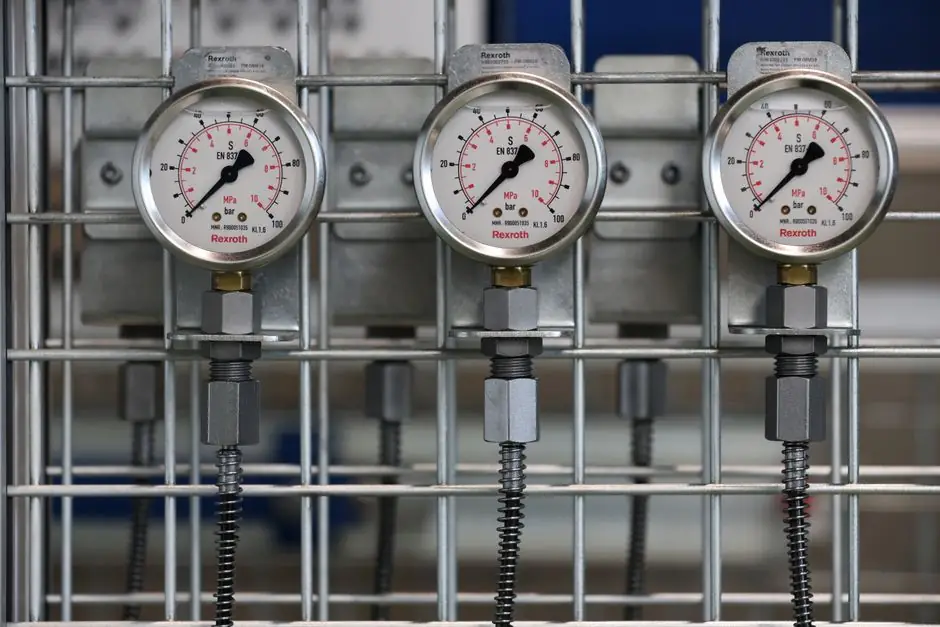
A flush diaphragm pressure sensor is the default choice for slurry lines above 5% solids by weight, because the sensing face sits flush with the inner pipe wall and leaves no crevice for media to pack into [S2][S3]. Threaded process connections remain acceptable only on clean, low-solids, low-viscosity services below roughly 100 mPa·s, where their compact envelope and lower cost justify the trade-off [S8].
On abrasive mining slurries, a piezoresistive flush cell with a 20-70 micrometre metallic separating diaphragm can be punctured by hard particles in weeks; switching to a ceramic-capacitive flush element typically extends service life by a factor of three to five on the same duty [S3]. For hydraulic-fluid monitoring on a diaphragm-pump skid handling mining media, the flush G1/2 PL15 ceramic sensor delivers pressure plus media temperature over IO-Link from a single 1/2 in. port, removing the second thermowell [S1].
Why Threaded Ports Fail on Slurry
A conventional threaded pressure port contains a pressure-channel bore between the process thread and the sensing diaphragm; this bore is the trap that destroys instruments on slurry duty [S3]. In liquids carrying solids above about 1% v/v, that channel plugs, the reading lags or pins, and the sensor can be mechanically damaged as the plug solidifies against the diaphragm [S3][S4].
Threaded NPT or G connections also introduce crevices at the male/female seat, which is exactly where crystallising, coagulating, or settling media build up. Process engineers using diaphragm seals on slurry service routinely add a flushing ring with 1/8 in. or 1/4 in. connections to push clean water through the seal cavity, trading one maintenance task (cleaning) for another (flush-water supply and disposal) [S7]. On abrasive mining tailings, a flushing ring without a flush diaphragm is still a stop-gap, not a fix [S4].
How Flush Diaphragm Sensors Are Built
A flush diaphragm pressure transducer mounts its sensing face flush with the inner wall of the pipe or vessel, with no pressure-channel bore behind the diaphragm, so there is no dead volume to clog [S2][S5]. When the sensor is installed in a flat mating flange or welded boss, the wetted surface becomes a continuous extension of the pipe wall, which makes clean-in-place (CIP) straightforward and eliminates cross-contamination between batches [S3].
Two cell architectures dominate the flush product family. Piezoresistive flush cells use a silicon strain gauge embedded in silicone oil behind a thin metallic separating diaphragm, typically 1.4435 (AISI 316L) stainless, optionally in nickel alloy or titanium; they cover spans from below 100 mbar up to several hundred bar, but the 20-70 micrometre separating membrane is vulnerable to hard particle impact [S3]. Ceramic-capacitive flush cells use a resistance bridge on a thin ceramic plate glass-bonded to a ceramic base, sealed to the housing with an O-ring; the ceramic face resists both abrasion and most chemical attack, and the housing can be 316L, higher alloy, or titanium [S3].
Decision Matrix: Flush Diaphragm vs Threaded on Slurry Duty
Use the table below as a fast triage. Numbers are drawn from the cited sources and are conservative mid-range values; your specific gravity, particle size, and velocity will move them. [S1]
Solids tolerance: threaded ports fail above roughly 1% v/v free solids; piezoresistive flush cells tolerate soft particles below about 100 micrometre; ceramic-capacitive flush cells handle hard, sharp particles up to several millimetres in slow-moving service [S3]. Dead volume: threaded ports have a measurable cavity; flush diaphragms are zero dead volume by design [S2][S3]. Typical pressure span for pump-side service sits in the 10-100 bar window, well within both architectures [S3]. Temperature drift: piezoresistive silicon drifts more at elevated temperature than ceramic-capacitive cells, so for process temperatures above 120 °C the ceramic option also wins on stability, not just abrasion [S3]. Cost: a flush G1/2 ceramic cell with IO-Link commands a 2-3x price premium over a commodity 1/2 in. A piezoresistive flush pressure transmitter avoids the crevices of conventional threaded ports and the separate diaphragm-seal flushing-ring assembly typically fitted to protect instruments from debris [S3][S7][S8].
Where Threaded Sensors Still Win
For clean gas, low-viscosity hydraulic oil, or potable water below 100 mPa·s with no entrained solids, a male or female threaded pressure sensor remains the right call: smaller envelope, simpler installation, and lower unit cost [S5][S8]. Where size constraints prevent direct in-line mounting, a female port sensor threads into a static pressure port or stud and gives a compact footprint that a flush weld-in boss cannot match [S5].
Threaded sensors also pair naturally with diaphragm seals when the process media is hot, corrosive, or sanitary, and the seal becomes a chemical barrier rather than an abrasion barrier; this is the configuration where the threaded port stays clean and the seal does the protecting [S7]. For high-shock or pulsating duty on clean hydraulic fluid, the threaded sensor's higher natural frequency versus a heavily loaded seal stack is another legitimate reason to stay threaded [S5].
Slurry Use Cases in 2026
Filter-press holding-pressure control in ceramic production is a canonical flush-diaphragm slurry duty: the sensor reads cake condition through abrasive glaze water, and the flush ceramic face survives the solids where a threaded metallic-diaphragm cell would fail within one or two press cycles [S1]. On diaphragm-pump hydraulic and process-side monitoring for mining slurries, the same flush ceramic sensor with IO-Link reads both pressure and temperature from a single G1/2 port, eliminating a separate thermowell in the pump head [S1].
For level measurement in a thickener or clarifier, the hydrostatic head of water-equivalent slurry at 10 m corresponds to roughly 1 bar, and the flush diaphragm sits below the sludge blanket without fouling, which a side-mounted threaded sensor would do within days [S3]. Hygienic food, paint, and pigment lines that pig the pipe use flush sensors because the pig passes the wetted face without catching, a benefit cited directly by RELius Farbenwerke when specifying the PL15 for paint tank pigging stations [S1].
Failure Modes and Limits to Plan For
Even a flush ceramic cell has limits: impact from a metal chip or stone larger than the diaphragm's unsupported span can crack the ceramic plate, and the failure mode is then a full bridge break, not a graceful drift [S3]. A flush piezoresistive cell on slurry that swings in temperature is exposed to two compounding risks, membrane puncture from particles and silicon drift from heat, so the instrument engineer must choose ceramic for hot, abrasive service rather than treating flush geometry as a complete solution [S3].
On viscous, sticky, or crystallising media a flush diaphragm alone is not enough; the process connection must be installed in a vertical-down orientation or with a self-draining boss, and CIP nozzles must cover the diaphragm face, or the flush benefit is lost to a coating layer that biases the reading [S3]. For dynamic pressure measurement above 1 kHz on pulsating slurry lines, the additional oil-filled cavity of a remote diaphragm seal degrades frequency response, so direct flush mounting is preferred over a seal-protected threaded port [S3]. For comparison guidance on similarly harsh selection problems, see this spec-driven RMG vs RTG yard-equipment review and this pivoted Z vs vertical bucket elevator routing breakdown, which apply the same criterion-based triage to other abrasive-service equipment.
Spec Checklist Before You Buy
Confirm the maximum particle size and shape in your slurry, not just the percent solids, because a 3 mm rounded sand grain behaves very differently from a 3 mm flake of mica. Specify 1.4435 / AISI 316L as the minimum wetted material and move to a nickel alloy (Alloy C276 / C22) or titanium only if a chloride or low-pH review demands it [S3]. Ask the vendor for the separating-diaphragm thickness on piezoresistive cells and the unsupported ceramic diameter on capacitive cells, both of which set the impact-energy tolerance.
For a flush pressure sensor on slurry service, require a dead-space-free, front-flush process connection in G1/2, G1, or a flanged DN25/DN50 boss, with a wetted ceramic-capacitive cell, IO-Link or 4-20 mA + HART output, and an IP67 housing rated for wash-down [S1][S3]. Validate the installation with a hydrostatic test at 1.5x working pressure before commissioning, and budget for a sacrificial flush ring only if the medium is also crystallising, in which case refer to a pressure gauge cal-plan rather than treating the flush geometry as self-cleaning [S3][S7]. Track two signals in 2027: the move of ceramic-capacitive flush cells below the 1.5x price multiple of piezoresistive units, and the wider rollout of IO-Link pressure profiles that publish both pressure and media temperature from a single flush port, as already shipped in the PL15 family [S1].