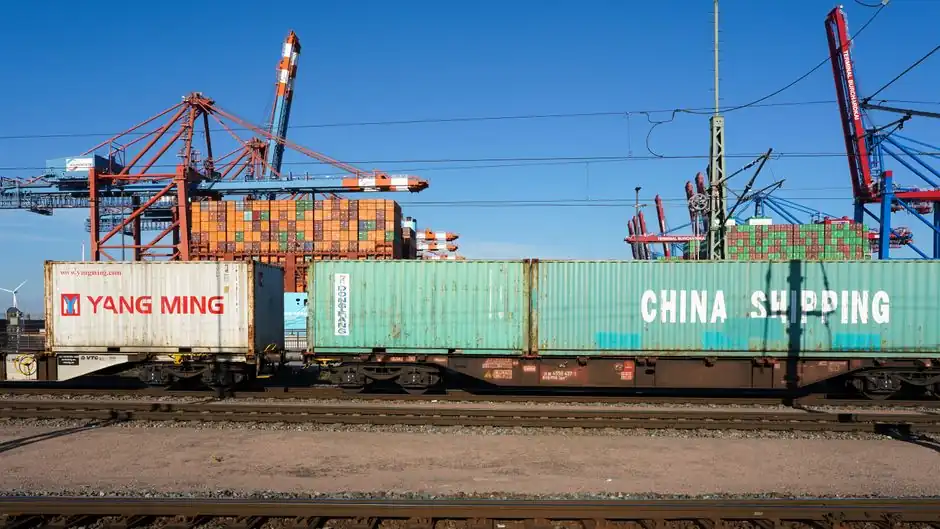
RMG cranes handle heavier lifts and run on fixed rails for higher, more repeatable cycle speeds, while RTG cranes sacrifice raw capacity for free mobility on rubber tires across the yard surface [S1][S2][S7].
The two classes serve the same container-handling function in a terminal, but their support structure, travelling mechanism, power system, automation ceiling and civil-works footprint diverge enough that the wrong choice locks a yard into decades of suboptimal moves per hour [S2][S5].
Definition, Scope and Operating Envelope
A rail-mounted gantry crane runs on ground-mounted steel rails and is usually fed by busbar or cable reel power, which removes onboard diesel exhaust and supports continuous-duty operation across the block [S5]. RMG outriggers use high-rigidity box-section steel with tight deformation limits, suited to large spans, high stack heights and millimetre-grade positioning under automated cycles [S5].
A rubber-tired gantry crane sits on a multi-axle tire set with independent drive motors or hydraulic drives plus steering mechanisms, so it can traverse standard truck lanes, shift between blocks and reconfigure a yard without rail civil works [S3][S5]. RTG ground pressure and stability, however, depend on a firm, well-maintained yard surface; soft or uneven pavements force lower stack heights and slower travel [S3]. For a broader view of the equipment class, see the gantry crane reference.
Selection Criteria: Yard Geometry, Volume and Power
Three criteria decide the class before any spec sheet: yard geometry, annual container moves, and the terminal's electrification plan. RMG fits fixed, well-organised stacking areas with rail tracks already poured, where cranes can stream moves through long, repeatable aisles [S1]. RTG fits irregular layouts and sites where the operator expects to relocate, expand or re-stack blocks without re-laying rail [S1][S3].
Volume thresholds matter: RMG is the workhorse at high-density, high-throughput terminals because the rail system supports heavier lifts and tighter cycle times, while RTG covers medium-capacity lifts where flexibility outweighs peak moves-per-hour [S1]. Power source is the third filter; RTG is most often diesel today, with hydraulic-hybrid and fully electric (cable reel or busbar) variants available, whereas RMG is designed from the ground up as a fully electric, fixed-power machine [S3][S5].
Head-to-Head Comparison Across Four Decision Criteria
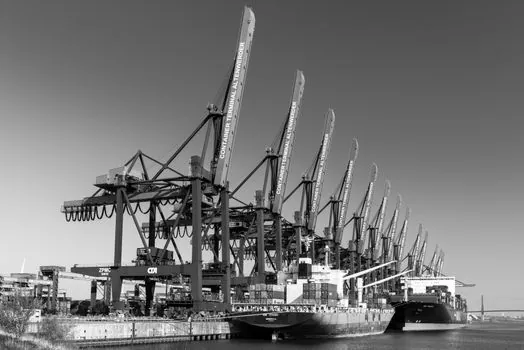
Against four procurement criteria, RMG and RTG line up as follows [S1][S3][S5][S7]:
1) Load capacity: RMG handles heavier container stacks, up to high-cube 1-over-5 or denser configurations typical of automated block layouts, while RTG is limited by tire load rating and balance under motion, and is best matched to medium-capacity lifting [S1].
2) Mobility and flexibility: RTG moves freely across truck lanes and between blocks with no fixed path, giving the highest layout flexibility; RMG is confined to its rails, which constrains the block plan but delivers a faster, more repeatable cycle inside that envelope [S3][S7].
3) Power and emissions: RMG is electric by default, with no onboard diesel exhaust on the operating envelope, which suits indoor or low-emission terminals; RTG is diesel-dominant today, with hybrid and electric RTG options now standard catalogue offerings from major OEMs [S3][S4][S5].
4) Civil works and capex: RMG requires rail foundations, busbar trenches and longer commissioning, driving higher upfront civil cost; RTG needs only a serviceable paved surface, which lowers initial civil spend and shortens the deployment timeline [S1][S3][S5].
On automation ceiling, RMG is the easier path to fully automated container handling because the rail constrains motion and simplifies position feedback; RTG is mostly semi-automated or remote-controlled today, with full autonomy still limited by free-navigation on open yard surfaces [S5].
Power Systems: Diesel, Hybrid, Electric and the Genset Question
Most RTG cranes in service remain diesel-powered: an engine drives a generator set that supplies the hoist motors, drive system and crane operator controls, with millimetre-level accuracy on every move [S3]. Hydraulic-hybrid RTG captures braking energy and reuses it for hoists, while fully electric RTG variants draw from busbar or cable reel and eliminate on-board diesel exhaust, a common retrofit path at ports facing emissions caps on yard equipment [S3][S5].
RMG cranes are designed as fixed, electric machines and pair naturally with shore-power style supply, which is why automated greenfield terminals standardise on RMG [S5]. For terminal planners comparing prime movers, the diesel vs natural gas data center genset breakdown lays out the same duty-cycle, emissions and fuel-handling logic that drives RTG hybrid retrofits, since the engine-sizing and runtime arithmetic transfers directly to yard equipment duty profiles.
Use Cases, Failure Modes and Limits
RMG is the right call at large container terminals, rail-linked intermodal yards and logistics parks where a fixed-stack block, high cube density and full automation are on the roadmap; under those conditions the rail constraint becomes an asset, not a limitation [S5]. RTG is the right call at smaller terminals, multi-user depots, empty-container yards and any site where the operator cannot guarantee a fixed block geometry, including brownfield expansions that must share pavement with trucks and reach stackers [S3][S7].
The limits to remember: RTG cycle time drops on uneven ground and forces lower stacking density, so a soft surface quietly caps throughput even with a new crane on order; RMG cannot grow with the yard once rails are set, so any later block expansion outside the rail envelope requires a new crane or a costly rail extension [S1][S3]. Tire wear, steering-mechanism maintenance and diesel exhaust treatment are the dominant RTG operating-cost lines, while RMG operating cost is dominated by rail inspection, busbar systems and electrical infrastructure upkeep [S1][S3].
Sourcing, Standards and Procurement Signals
For procurement, validate three things before signing: span and stack height matched to the highest-density block in the yard, lifting class (typically 40t/45t under hook for 1-over-4 or 1-over-5 high-cube blocks) and the power-supply interface, including genset, busbar or cable-reel rating [S1][S5]. Major OEM lines, including Konecranes' RTG container-handling equipment range, are documented as semi-automated or remote-controlled, which is a useful baseline when benchmarking bids [S4].
For an operator building a yard layout that mixes container moves with heavy haulage or reach-stacker traffic, the truck-mounted crane selection logic explains the same crane-class trade-offs in a road-going context and pairs well with an RTG specification. Next nodes to track are electrified RTG retrofits replacing diesel generator sets and any new RMG automated-block tenders tied to rail-linked intermodal terminals, both of which are the clearest leading indicators of where the 2026-2027 yard-equipment cycle is heading [S3][S4][S5].
Detailed specification references: tank container.