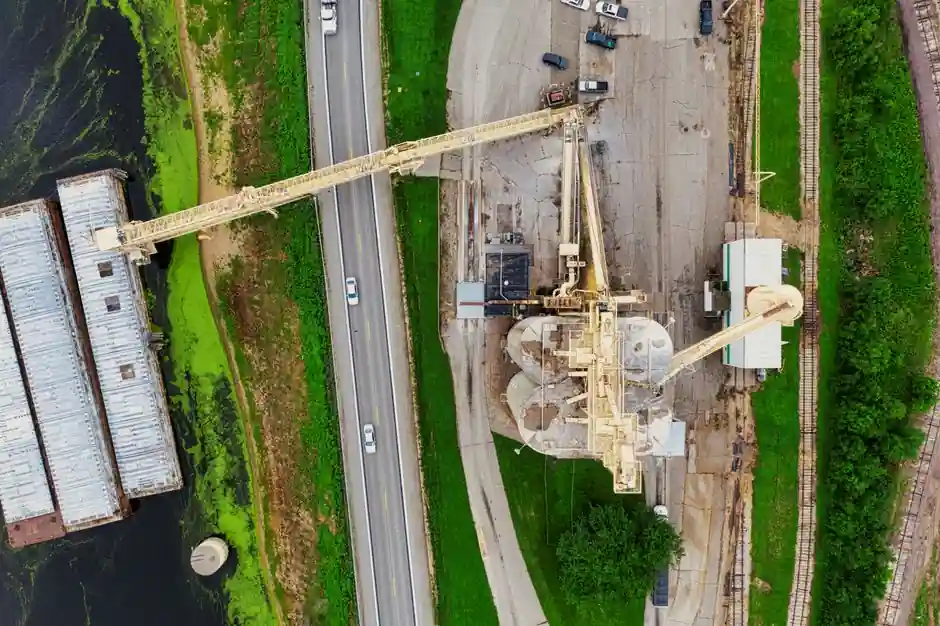
In a pivoted-bucket Z-type conveyor, each bucket pivots on its mount to stay level through a horizontal-to-vertical-to-horizontal path, letting a single machine replace multiple conveyors in a tight plant footprint [S1]. In a conventional vertical bucket elevator, the buckets are fixed to a belt or chain and run in a single straight vertical loop, with discharge at the head pulley [S1][S4].
The practical consequence is routing vs. lift height. The Z layout trades maximum elevation for a compact L-shaped or Z-shaped envelope, typically used when upstream and downstream equipment sit on the same floor but the process must climb over or around obstructions. The vertical layout accepts the taller headhouse required for a grain terminal or cement plant in exchange for the highest continuous throughput per square metre of footprint [S4][S5].
Geometry and Bucket Mounting
Pivoted-bucket Z conveyors use buckets that pivot on the carrying element, which keeps the bucket mouth roughly level through the horizontal feed-in, the inclined or vertical lift, and the horizontal discharge-out sections [S1]. This geometry is the structural reason a Z unit can take product in at floor level on one side of a machine and discharge it at an elevated height on the opposite side, without an intermediate transfer [S2][S3].
Vertical bucket elevators use buckets rigidly bolted to a belt or chain, and the casing is a straight vertical trunk with a boot section at the bottom and a head section at the top [S4]. The boot feeds material by gravity or by an inlet screw, and the head discharges by either centrifugal throw at high speed or by positive/continuous discharge at lower speed, which is the engineering basis for the four common sub-types: centrifugal belt, centrifugal chain, continuous (gravity) discharge, and positive-displacement [S4].
Throughput and Capacity Range
Documented Z-type elevator capacity sits in a controlled, mid-range band: the MMCTECH CVZ series is published at 11,000 to 33,000 lb/h (4,990 to 14,970 kg/h) for seeds, grains, pulses, and oilseeds [S3]. That range reflects the gentle, horizontal-feed design, which limits volumetric fill per bucket compared to a high-speed centrifugal elevator throwing free-flowing material [S3][S4].
Vertical bucket elevators cover a much wider capacity envelope because the only limit is belt or chain width, bucket size, and running speed. Industrial sources group their use cases into mining, agriculture, grain, food processing, chemical and pharmaceutical, and recycling, and within those sectors vertical units are the workhorse for moving large quantities of bulk material with minimal human intervention [S4]. A grain terminal is the textbook example: a pit-fed vertical elevator scoops from a receiving pit and discharges into an elevated conveyor that feeds a silo [S4].
Installation Footprint and Plant Fit
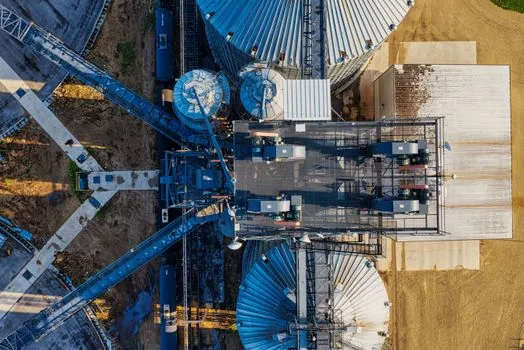
Vertical Z conveyors are described as offering a more user-friendly installation process compared with the more intricate setup required for bucket elevators, because the Z layout collapses what would otherwise be a feed conveyor, a vertical elevator, and a discharge conveyor into a single integrated unit [S2]. For a retrofit or a greenfield plant where the inlet and outlet elevations are both fixed by existing hoppers or machines, the Z frame lets the OEM match horizontal intake and discharge reaches on a unit-by-unit basis [S3].
A straight vertical elevator demands a tall headhouse and a deep boot pit, with the casing typically requiring reinforced steel towers or building columns, which adds civil cost. Where ground area is constrained and headroom is plentiful, the vertical layout is the cheaper structural answer; where ceiling height is constrained but floor area is open, the Z layout wins [S2][S5].
Product Handling and Hygiene
Z-type conveyors are positioned for gentle handling of friable or contamination-sensitive products: wheat, barley, corn, oats, rice, planting seeds, pulses, and oilseeds are explicitly named as suitable, and the typical installation pattern is a receiving hopper to a seed cleaner, then to a grader or gravity separator, then to an optical color sorter, and finally to weighing and packaging [S3]. Stainless-steel construction is offered alongside carbon and galvanized steel for food-grade or washdown environments [S3].
Vertical bucket elevators span both gentle and aggressive handling depending on speed. Centrifugal belt elevators run at high speed and throw the product on discharge, which suits small, granular, free-flowing, and relatively tough materials such as grain and mineral powders [S4]. Continuous (gravity) discharge units run slower and lay the product out of the bucket into a chute, which is the gentler option for larger or more friable lumps [S4].
Decision Matrix: Which One to Specify
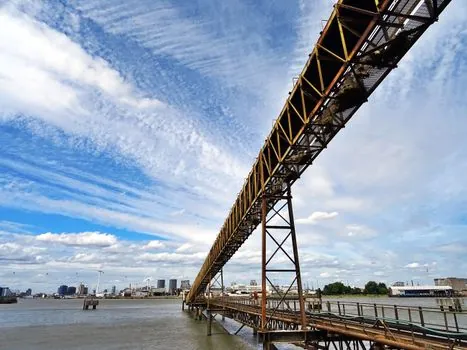
Pick a pivoted-bucket Z-type conveyor when the inlet and outlet are at different elevations on opposite sides of a machine, the product is friable or hygiene-sensitive, and the required capacity sits in the 5,000 to 15,000 kg/h range with horizontal feed-in and feed-out [S2][S3]. Pick a vertical bucket elevator when the goal is maximum throughput in a small footprint, the discharge point is a single elevated head pulley, the product tolerates either centrifugal throw or positive discharge, and the plant can accept a tall casing and a deep boot [S4][S5].
For mixed lines such as a coating line with limited headroom, the comparison logic is similar to other routing decisions, for example the accumulation strategy described in this power-and-free vs monorail selection guide, where the layout constraint of the building, not raw equipment capacity, drives the specification. If the building can take a vertical casing, specify a vertical bucket elevator; if it cannot, the pivoted Z frame is the engineered workaround [S2][S3].
Limitations, Failure Modes, and Standards Anchors
Z-type units are not optimised for very high tonnage because the pivoting joint and the horizontal run both cap the volumetric fill rate of each bucket, and the published MMCTECH CVZ series tops out at roughly 33,000 lb/h (about 15,000 kg/h) [S3]. Vertical centrifugal elevators can fail by product degradation at the head pulley if the speed is set too high for friable feed, and by premature belt wear if the bucket-loading profile lets material backflow into the boot [S4].
General best-practice references for both machine families cover routine inspection intervals, belt or chain tension checks, and bearing service, but the public sources in scope do not cite a single harmonised ISO or ASME code number that covers pivoted-bucket Z conveyors specifically. For a bulk-handling specification, the safer path is to lock the casing material, surface finish, and bucket food-grade compliance to documented project specifications and to require the OEM to publish capacity at a stated bulk density and particle size, rather than assume a generic standard covers the exact Z frame geometry [S3][S4].
Trackable signals for the next 1-2 quarters: additional CVZ-style capacity data with verified per-model motor power and bucket volumes from MMCTECH, and any new manufacturer-side comparison sheets that publish head-pulley speed, bucket fill factor, and bulk density together for both vertical and Z-type units. For plants evaluating gentler options, the same routing-versus-throughput logic that drives pivoted-bucket selection is also visible in the industrial vs commercial Ethernet switch decision, where constrained building infrastructure forces a different equipment envelope than the raw-spec best fit.
The underlying component specifications are covered under dry type transformer, and vertical lift module.