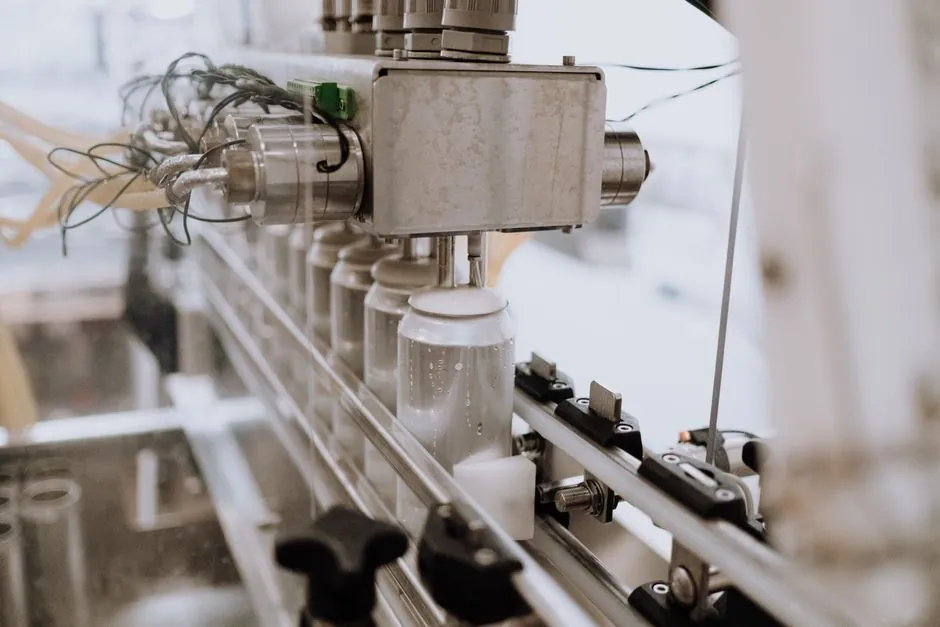
Food processing plants that wash down equipment daily with hot water, caustic cleaners, and sanitising agents now specify stainless steel 304 or 316 housings with solid or food-grade grease lubrication, after industry guidance flagged premature failure of standard sealed steel roller bearings in washdown zones as the top maintenance cost driver in 2025 [S1] (2026-02-16).
Stainless variants carry a typical price premium of 2-4x over equivalent carbon-steel units, but the spec window is narrowing around 316 grade for high-chloride washdown, polymer-cage alternatives for moderate loads, and H1-registered incidental-contact lubricants for any unit that sits in or above the product zone [S1] (2026-02-16). Chinese forging and bearing suppliers in Shandong and Wuxi now stock standard 304 variants across radial, tapered roller bearing, and thrust geometries to feed OEM and replacement demand [S2] (2026-07-19), [S4] (2026-08-07).
Material and lubrication criteria for wet, washdown, or corrosive zones
Engineered polymer bearings in PEEK, acetal, or PTFE are now common on low-load guide rollers, idler pulleys, and conveyor side rails where the load is below roughly 1 kN per unit, which eliminates grease entirely from those nodes [S1] (2026-02-16).
Lubricant choice is treated as a food-safety decision, not a maintenance one: USDA H1-registered food-grade grease is mandatory in any bearing where contact with product is possible, and many plants now migrate to NSF H1 certified solid-lube (PTFE-based) inserts in heavily washed or steriliser-exposed units to extend re-lube intervals to 6-12 months [S1] (2026-02-16). For reference, bearing forging suppliers in Liaocheng stock 304, 316, and 440C stainless input stock to support both small-batch replacement and OEM contract runs [S2] (2026-07-19).
Type-by-type comparison: deep-groove, sealed, tapered, and split variants
Sealed-for-life deep-groove ball bearings remain the workhorse for fan, mixer, and pump shafts in secondary (non-product-contact) zones, with 2RS rubber contact seals the baseline and 2RZ non-contact shields preferred where high-pressure washdown spray is intermittent [S1] (2026-02-16). Solid lube inserts and stainless shields are specified where the seal lip itself is a contamination ingress path, which is the dominant failure mode in citrus-juice and dairy plants.
Tapered roller bearing units appear in larger gearboxes, dough mixers, and screw conveyors handling reactive loads, with 300-series stainless variants covering most hygienic applications; carbon-steel tapered units are still used in dry grain handling where the dust load and ambient humidity stay low [S1] (2026-02-16). Spherical roller and crossed roller guide formats show up on palletiser axes and pick-and-place heads, where the load angle varies; standard steel versions are accepted in machine rooms, and stainless or polymer versions are required only when the axis is exposed to the product envelope [S1] (2026-02-16). Comparison summary for selection meetings: deep-groove sealed on cost and availability, stainless deep-groove on corrosion, polymer on cleanability with a 1 kN load ceiling, tapered/stainless on heavy radial+thrust loads.
Sealing, cleanability, and the IP69K washdown test
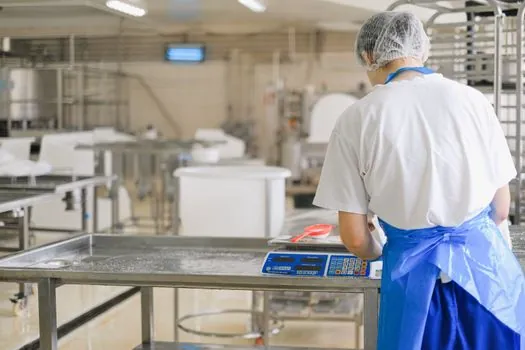
IP69K-rated stainless bearing housings are increasingly specified for new European and North American meat, dairy, and beverage lines, because the test exposes the unit to 80°C water at 80-100 bar from multiple angles and is the practical proxy for daily high-pressure cleaning cycles [S1] (2026-02-16). Housings with smooth, domed tops and machined radii (no corner crevices) are preferred for CIP (clean-in-place) reach, since flat-gusseted castings trap product residue and biofilm even with the bearing inside.
Stainless steel end-caps and shaft collars sized to the bearing OD also fall into the washdown spec window, with flange-forged 304 collars from Shandong and Wuxi suppliers common as the matching interface part for roller bearing assemblies on conveyor shafts [S2] (2026-07-19), [S4] (2026-08-07). For shafts where the bearing is mounted inside a stainless pillow block, the bearing itself can often be a lower-cost carbon-steel unit, with the housing providing the corrosion barrier, provided that the seals are intact and re-lube intervals are respected.
Temperature, load, and speed envelopes for hygienic service
Standard food-grade grease (aluminium-complex or calcium-sulfonate thickener) is rated for roughly -20°C to +150°C continuous service, while PFPE (perfluoropolyether) H1 grease extends that to about -30°C to +250°C for bakery, retort, and sterilisation-tunnel bearings [S1] (2026-02-16).
6205 to 6206) when substituting stainless in a heavy-load conveyor drive [S1] (2026-02-16). Polymer bearings, by contrast, are limited to roughly 1 m/s surface speed, which is fine for conveyor side rollers and guide rails but rules them out for high-speed mixers and fans.
Vendor sourcing landscape, stainless stock, and replacement lead time
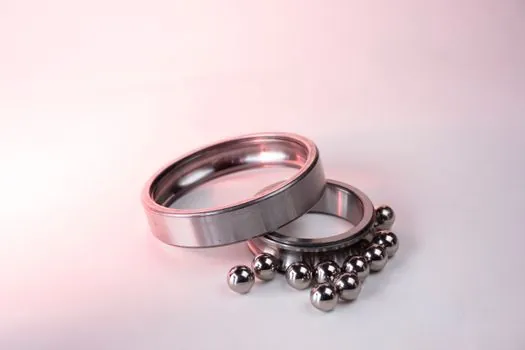
Domestic Chinese stainless bearing capacity is concentrated in Shandong (Liaocheng) and Jiangsu (Wuxi), with suppliers offering both full stainless roller bearing assemblies and the input forgings (rings, flanges, thrust races) needed for in-house assembly [S2] (2026-07-19), [S4] (2026-08-07). Wuxi-area stock catalogues now include the WSBC 23028 CA/W33 spherical roller pattern as a reference example for heavy-load stainless-when-specified food-grade equivalents, with typical lead times of 2-4 weeks for production batches versus 6-10 weeks for European equivalents [S4] (2026-08-07).
Crossed-roller slewing and thin-section units from manufacturers in Henan cover robotic pick-and-place, packaging, and palletising lines where the bearing is essentially the joint; these follow the same material logic (stainless where washed, sealed steel where sheltered) and are quoted with custom bore and bolt-pattern options [S5] (2026-08-07). Standard ball and tapered roller bearing catalogues from the same Chinese supplier base also support OEM contract runs for European and North American food machinery builders, with full stainless 304/316 options across most metric series [S3] (2026-08-08).
Failure modes, when stainless is NOT the answer, and total cost framing
Stainless 440C races work poorly under shock load, contamination, and marginal lubrication, because the softer matrix cracks faster than through-hardened chrome steel; in flour mills, grain elevators, and sugar handling, the dust load and abrasive wear make sealed carbon-steel tapered units the more reliable and lower-cost choice despite the rust risk in wash-down pockets [S1] (2026-02-16). Polymer bearings similarly fail when specified above their 1 kN load ceiling or above 1 m/s surface speed, which can produce a thermal runaway and a single-event failure that contaminates the line.
For procurement teams weighing the 2-4x stainless premium, the credible payback is documented at 12-24 months in heavy-washdown zones (dairy, meat, beverage) where the baseline carbon-steel unit fails every 4-8 months; in dry zones, the payback does not close and the spec should fall back to sealed, greased, food-grade-lubricated carbon-steel units [S1] (2026-02-16). A cost line that often gets missed is the rebuild cost: when a stainless bearing fails, the surrounding shaft and housing are typically salvageable; when a carbon-steel bearing fails, water ingress and rust can take the shaft with it, which alone can justify stainless on critical conveyor and mixer lines [S1] (2026-02-16).
Selection checklist and signals to track through 2026
For related heavy-duty service notes across non-food process industries, see this roller bearing selection guide for steel mills.