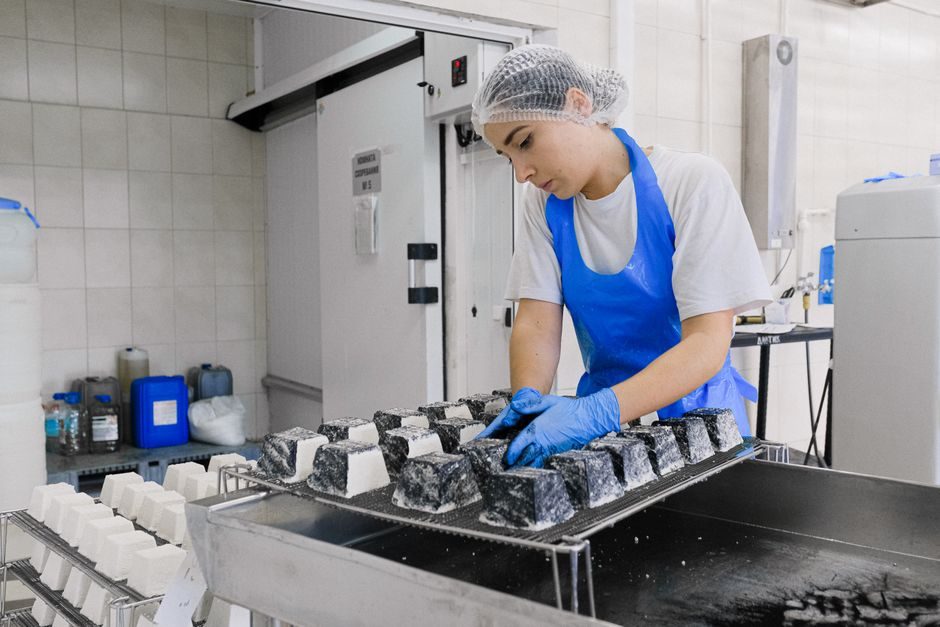
A typical food processing equipment manufacturer operates across stainless-steel fabrication, hygienic open-frame design, dry-ingredient pneumatic and mechanical handling, and custom further-processing line integration, with application coverage spanning dairy, bakery, snacks, pet food, nutraceuticals, and poultry [S1][S4][S6].
The supply base is fragmented by vertical: dry-ingredient blenders, mixers, and pneumatic conveyors dominate powder/food plants, while stainless-steel further-processing lines dominate poultry, red meat, and ready-meal facilities, and specialist integrators bridge PLC/HMI controls and bulk-bag unloading on shared lines [S1][S6][S7].
Material Selection: Stainless Steel Grades and Surface Finish Bands
AISI 304 and AISI 316 stainless steels remain the dominant food-contact alloys for cutting, forming, conveying, and storage vessels, with 316L preferred where chloride exposure or repeated CIP chemical attack is expected [S4]. JF Equipment, a South African stainless-steel processing OEM with over 25 years of operation, builds exclusively in stainless steel for poultry, food, and material handling lines, anchoring its build philosophy to weld-finish and passivation discipline [S4].
Surface roughness is a hard spec, not a polish preference: hygienic design literature on open food processing equipment treats Ra ≤ 0.8 µm on product-contact surfaces as the working threshold for cleanability, with electropolishing used to reduce Ra further on welds [S2]. Frame, guard, and non-contact panels typically accept 2B or grain finishes at lower cost, with the contact-side weld area controlling hygiene performance. Material upgrades to 316/316L generally add 15–25% to stainless content cost versus 304 in tender comparisons, though the gap narrows on high-alloy plate and pipe.
Hygienic Design and Open Equipment Geometry
Hygienic design of open food processing equipment is governed by the principle that product is exposed to the environment throughout the process, so every frame member, fastener, and bearing must be excluded from the product zone or fully sealed [S2]. Woodhead's chapter on open equipment (Moerman and Lorenzen) frames the design rules around sloped self-draining surfaces, radii ≥ 3 mm at internal corners, and the elimination of horizontal ledges where condensate can pool [S2].
Frame geometry choices split equipment into closed (sealed) and open categories, and the regulatory load rises sharply for open lines: airborne contamination, lubricant drips, and operator-contact points all become routine audit findings under GFSI-style schemes [S2]. European OEMs selling into dairy and bakery frequently specify EHEDG-cleanable geometries; North American snack and pet-food plants often accept 3-A sanitary standards on closed transfer but lean on USDA-FSIS-listed construction for meat and poultry contact surfaces [S2][S4].
Dry-Ingredient Handling: Conveying, Milling, and Mixing Stages
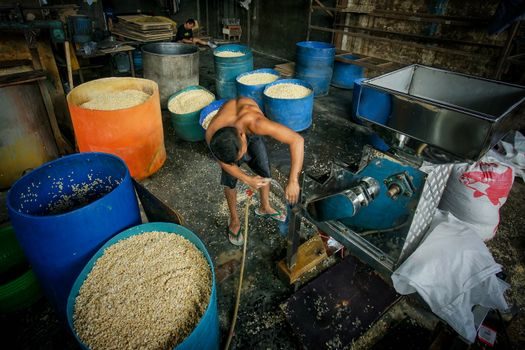
Dry-ingredient OEM scope covers six functional blocks: receiving (truck/railcar unloading, bag break stations, bulk bag unloaders), conveying (vacuum/pressure dilute and dense phase, mechanical screws, bucket elevators), storage (silos, hoppers, filter receivers), milling (air-classified, impact, fluidized-bed jet, cryogenic, roller), mixing (high-shear in-tank, inline pump, pneumatic blender, Vacucam-style liquid/powder wet-out), and dosing (loss-in-weight, gravimetric, volumetric tube feeders) [S1].
Process flow on a typical snack or nutraceutical line runs: bulk bag unload → vacuum dilute-phase pneumatic transfer → filter receiver → loss-in-weight feeder → batch mixer → milling → pneumatic dense-phase to packaging, with CIP skids handling wash cycles on liquid/mixing islands [S1]. Inline HEPA filtration on pneumatic lines is a near-default for food-grade dust, and dust hazard analysis (DHA) is increasingly part of OEM scope rather than a customer-side deliverable [S1]. Cryogenic milling with liquid nitrogen is reserved for heat-sensitive, fatty, or sticky powders, where room-temperature milling would smear or degrade the product [S1].
Further-Processing Line Equipment: Forming, Cooking, and Inspection
Further-processing OEMs (Nothum, Lingwood, JF Equipment) deliver custom line equipment for forming, coating, cooking, slicing, optical sorting, UV-C disinfection, and robotic loading into downstream packaging [S6][S7]. Nothum has built custom further-processing machines for over 50 years, automating manual tasks that have historically been hand-cuts and hand-breading stations on breaded-product lines [S6].
Lingwood's application catalogue maps typical process steps — coring, de-watering, peeling, dicing, slicing/shredding, washing, UV-C disinfection, weighing, mixing, bagging — to equipment selections, with optical sorting and foreign-body removal specified as standard on retail-ready vegetable and salad lines [S7]. Line-side robotics and automation now show up on most greenfield further-processing builds, replacing hand-loading to fryers, freezers, and cartoners, with PLC/HMI integration handled as part of the OEM scope rather than as a separate integrator [S6][S7].
Selection Criteria Comparison Across Equipment Types
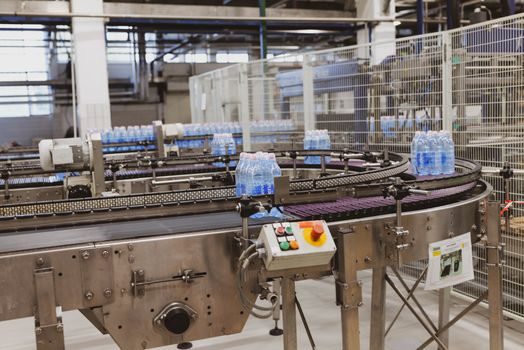
Specifying food processing equipment comes down to four decision axes: food-contact material grade, hygienic geometry (open vs closed, Ra finish, drainability), CIP capability (clean-in-place vs manual wash-down), and integration scope (skid-mounted subsystem vs full turnkey line with controls) [S1][S2][S6]. The table below lines the main equipment categories against those axes using what's verifiable in the research.
Dry-ingredient pneumatic and mixing skids (HAF-style scope) score high on integration (PLC, HMI, dust collection, DHA) and CIP for liquid-handling islands, but are typically not in direct food-contact geometry on pneumatic air-side surfaces [S1]. Stainless further-processing lines (Nothum, JF Equipment) score high on material grade and hygienic geometry, with CIP as a customer option depending on whether the line is wet- or dry-process [S4][S6]. Specialist hygienic handling systems (Lingwood) sit in the middle, with full 316 stainless on contact parts and frame-level design that meets open-equipment cleanability rules [S2][S7]. Bulk-bag unloaders, screw conveyors, and bucket elevators sit at the lower-cost end of the hygienic axis and frequently appear as standard 304 stainless with non-product-zone frame members in lower-cost stainless [S1].
Standards, Sourcing, and Where the Industry Is Heading
The standards backbone is layered: 3-A Sanitary Standards and EHEDG guidelines govern hygienic design on closed equipment, while USDA-FSIS and GFSI schemes govern construction and audit on meat and poultry lines; on the process-engineering side, ISO 12100 machinery safety and IEC 61131 PLC programming rules govern line integration and controls scope [S2]. Material traceability is increasingly required to EN 10204 3.1 certification on stainless plate and pipe used in food-contact zones, with mill certificates held in the OEM's quality file.
Sourcing paths split geographically: U.S. and European OEMs (Nothum, HAF) cover pneumatic conveying, mixing, and further-processing turnkey scope, while specialist stainless fabricators (JF Equipment) cover regional poultry and material-handling demand in their home markets [S1][S4][S6]. Hyfoma.com indexes 165 process descriptions and European food-company branches, and acts as a referral directory rather than a machine vendor — useful for cross-referencing process flow against equipment type [S5]. The next two trackable signals to watch are the rate at which OEMs absorb optical sorting, UV-C, and robotic loading as standard line items rather than options, and whether inline HEPA and DHA move from project-specific scope to baseline scope on pneumatic lines.
For the relevant spec sheets and selection criteria, see additive manufacturing material, anti static equipment, and multifunction process calibrator.
For related coverage, see Smart Cold Chain Equipment: Automation, AI Control and Spec Bands 2026.