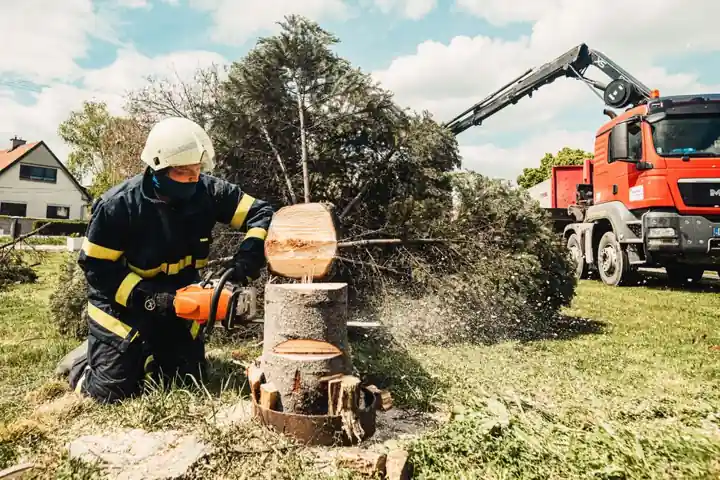
Forestry-spec aerial work trucks in 2026 cluster into three working-height bands: 35-45 ft compact units for residential pruning, 45-59 ft mid-range chipper-body rigs, and 33-45 m (roughly 108-148 ft) specialty booms for tall-tree maintenance [S5][S2]. Dur-A-Lift's Urban Forestry Package, distributed through TruckMax Homestead, anchors the mid-range with two distinct aerial series, the DPM2 (up to 59 ft working height, 31 ft 6 in side reach) and the DTAX2 (up to 50 ft working height, 30 ft side reach, available under CDL) [S1].
Standard arborist bucket trucks sit on Class 5-7 chassis such as the Ford F-550 through F-750 (F-750 Super Duty appears in the 33,000 lb GVWR DPM2-52DP build), with articulating booms carrying 24 in x 24 in to 24 in x 42 in fiberglass baskets rated 350-600 lb [S1][S5]. Diesel power, dual-station proportional controls, and hydraulic outriggers are baseline; selection therefore comes down to reach envelope, dielectric category, basket capacity, and the chipper-body footprint, not engine horsepower.
Working Height and Reach Envelope: The First Spec Gate
Specifying height before boom type is the most common error in forestry truck selection, because reach and side reach diverge sharply between articulating and telescoping architectures [S5]. The DPM2-52DP delivers 59 ft of vertical working height paired with 31 ft 6 in of side reach on a shear-ball-rotated, fully enclosed worm-gear turntable, a geometry that lets the operator arc over a roadside obstacle rather than climb straight up [S1]. The DTAX2-45 trades 9 ft of working height for an under-CDL chassis envelope, useful where crews cross weight-restricted urban bridges or residential streets [S1].
Specialty tree-trim units, including the I-Suzu 33 m platform from Hubei Jiafeng and the HOWO 20 m bucket truck from Hubei Sunny, push working height into 66-108 ft territory with 360-degree continuous rotation and 5/6-speed manual transmissions on 4x2 drivelines [S2][S3]. HOWO's 20 m unit ships with 4X2, 4X4, 6X2, 6X4, 6X6, and 8X4 drive modes available, and the listed 5,995 mm x 2,260 mm x 3,250 mm package keeps the rig inside container-friendly dimensions for export [S3]. For an overview of how these aerial work platforms differ by mechanism and control logic, the aerial work platform encyclopedia entry lays out the broader taxonomy.
Boom Type and Control Architecture Comparison
Three boom configurations dominate forestry, and the right pick is terrain-driven. Articulating booms with lower + upper + jib sections are the standard for residential tree work because the multi-joint geometry threads the basket around branches and structures [S5]. Telescoping booms give greater maximum height for open utility corridors and large commercial sites, at the cost of a tighter working envelope [S5]. Over-center booms swing past 180 degrees and substantially expand the side-reach arc, while non-over-center units are simpler, lighter, and cheaper but limit how the basket can be parked relative to the outriggers [S5].
On the control side, the DPM2 series runs proportional controls, lower override controls, engine start/stop from the basket, continuous rotation, and a 180-degree basket rotator with a 24 in x 42 in fiberglass basket rated 600 lb [S1]. The DTAX2 series specifies a 2,200 PSI rated hydraulic system operating at 2,000 PSI on an open-center circuit, with a 46 kV insulated extension boom option, 24 in x 24 in basket, and 350 lb basket capacity [S1]. HOWO's 20 m and I-Suzu's 33 m both add CAN-bus stepless speed regulation and wireless remote, which is closer to construction-grade European truck lifts than to traditional North American forestry bodies [S2][S3]. For a fuller taxonomy of the carrier-vehicle family these booms mount on, the aerial work truck encyclopedia entry breaks down chassis and outrigger conventions.
Dielectric Rating, ANSI Z133, and the Insulation Decision
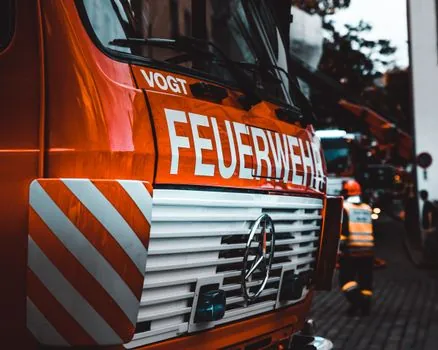
Insulation is not optional for any crew that works within energized-line clearance distances, and the ANSI Z133 arboricultural standard is the governing U.S. reference for safe approach distances to electrical hazards [S5]. Dur-A-Lift offers the Urban Forestry Package in Cat. C or Cat. D insulated configurations, with model codes DPM2-52DP (insulated, Cat. D) and DTAX2-45 / DTAX2-40 (insulated) sitting alongside non-insulated DPM2S and DTAX2S siblings for purely vegetative work [S1]. The DTAX2's 46 kV insulated extension boom insert and 50 kV basket liner option raise the dielectric envelope for utilities work, while the DPM2's fiberglass main and articulating boom options push dielectric capability further up the voltage ladder [S1].
For non-utility pruning, dead-wood removal, and storm-response work, the non-insulated S-suffixed models save weight and cost, and they still carry the same proportional-control and outrigger package as the insulated variants [S1]. Selecting insulated is rarely reversible in the field, so crews that occasionally cross under 34.5 kV distribution lines should spec Cat. C or D from the build sheet rather than retrofit. Buyers comparing forestry bodies to broader utility fleets will also want to cross-reference the dump truck encyclopedia entry, since many chipper-body packages are built on the same Class 7 chassis used for vocational dump bodies.
Basket Capacity, Outrigger Spread, and Stability Math
Basket capacity drives crew size, tooling, and the practical cycle time of each cut. The DPM2's 24 in x 42 in fiberglass basket is rated 600 lb, enough for one arborist with a chainsaw, pole saw, and a stack of rigging line, while the DTAX2's 24 in x 24 in basket at 350 lb is sized for a single operator with hand tools [S1]. HOWO's 20 m unit publishes a 200 kg (roughly 440 lb) platform rating in high-strength stainless steel, which sits between the two Dur-A-Lift tiers and reflects its construction-truck heritage [S3].
Outriggers or torsion bars are mandatory on every forestry unit in this class, and the choice between them affects both travel height and deployment speed. DPM2 outriggers add stability for the longer 59 ft envelope, while DTAX2 outrigger or torsion-bar options let fleet owners trade absolute rigidity for lower stowed travel height, a key concern on the 12 ft 4 in stowed DPM2-52DP build [S1]. Stability is also why the article's adjacent aerial work truck demolition spec path walks through the same outrigger-versus-torsion logic on construction sites, the math is identical, only the debris field is greener.
Chassis, Drivetrain, and Travel-Height Constraints
The chassis underneath determines where the unit can legally and physically operate. North American forestry packages pair with Ford F-750, Dodge RAM, International, or Freightliner commercial chassis, with the 33,000 lb GVWR F-750 Super Duty carrying the DPM2-52DP build shown in the TruckMax inventory [S1]. Chinese-export HOWO and I-Suzu units use 4x2 default drive with optional 4X4, 6X2, 6X4, 6X6, and 8X4 modes, 150-250 hp diesel, 5-15 t payload, and Euro 2 through Euro 6 emission certification depending on destination market [S2][S3].
Stowed travel height is the silent killer of urban forestry routes. The DPM2-52DP comes in at 12 ft 4 in stowed, which clears most U.S. urban tree-canopy corridors but not low railway or parking-structure clearances [S1]. A 95 km/h top speed on the I-Suzu platform and the HOWO's 3,360 mm wheelbase with 5,995 mm overall length place both export units firmly in regional-service territory, not long-haul [S2][S3]. Buyers weighing chassis options should also glance at the truck scale encyclopedia entry, since chipper payloads and water-ballast add-on weights push many forestry rigs past the Class 7 weight thresholds that govern axle-load compliance.
Pricing, Lead Time, and Vendor Profile Comparison
Listed 2026 transaction prices for new forestry aerial units span roughly an order of magnitude. The I-Suzu 33 m platform from Hubei Jiafeng lists at US$25,000-42,000 per piece with one-year warranty, ISO9000 / CCC / TS16949 certification, and Euro 6 emission standard [S2]. The HOWO 20 m unit from Hubei Sunny lists at US$12,480-21,460 with one-year warranty, ISO9000 / CCC / TS16949 / EPA / EEC / RoHS / CE certifications, 50,000 pieces/year stated capacity, and peak-season lead time of about one month [S3]. Dur-A-Lift Urban Forestry Packages are sold through TruckMax Homestead as configured builds on customer-supplied chassis, so pricing follows the chassis and chipper-body spec rather than a published sticker [S1].
Vendor profile matters more than headline price. Hubei Jiafeng is classified as a trading company with limited overseas service infrastructure, no stated inventory, no overseas warehouse, and a current ratio below 1 in the latest reported financials [S2]. Hubei Sunny is a manufacturer/factory in Suizhou with 15 years of stated experience, exporting since February 2018, with FOB / EXW / CFR / CIF terms, ro-ro and bulk-cargo shipping capability, and 30% T/T down with 70% balance against B/L [S3]. For fleet buyers running a side-by-side cost-of-ownership comparison, the I-Suzu's higher entry price is paired with Euro 6 compliance, while the HOWO's lower entry price reflects Euro 2-6 flexibility at the cost of a 200 kg basket rating. The reach truck encyclopedia entry carries a similar cost-versus-certification trade-off table that translates well to fleet procurement.
Selection Criteria: Who the Forestry Aerial Is For, and Who It Is Not

These rigs are built for tree-care contractors, municipal urban-forestry departments, utility line-clearance crews, and right-of-way maintenance teams that need a chipper body and an elevated work platform on a single chassis. They are not the right pick for indoor facilities work, where a tracked scissor lift or a slab-electric articulating boom will outperform them on floor load and emissions, and they are wrong for long-haul logging, where a dedicated forwarder or skid-steer trailer is the lower-cost answer. [S3]
A 60 ft oak over a residential driveway calls for a DPM2-class articulating unit with a 600 lb basket and dielectric Cat. C or D if any 7.2-34.5 kV distribution is within reach, while a rural 30 m poplar trim under open sky can be served by a HOWO 20 m or I-Suzu 33 m export unit on a 4x2 chassis at a third of the price. Three trackable signals through the rest of 2026 are worth watching: Euro 6 / Euro 7 emission transition timing for export units into the EU, ANSI Z133 revision activity around dead-wood and snag-work procedures, and the spread between Cat. C and Cat. D dielectric pricing as fiberglass-boom supply normalizes.