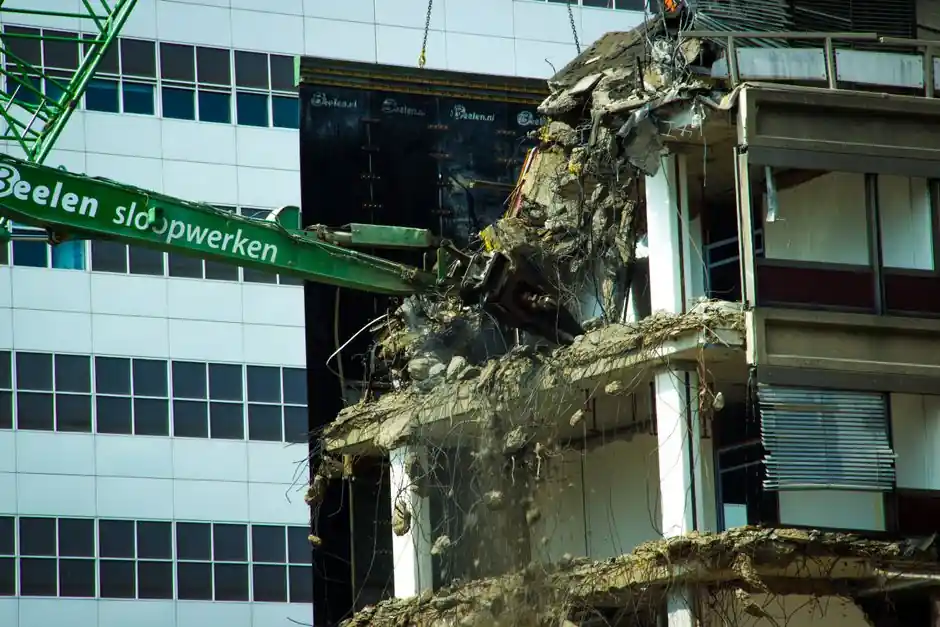
On a structural demolition site, the aerial work truck is normally chosen to position a 2-person crew with a 30-50 kg breaker or torch at 20-31 m, not for personnel-only maintenance work. As of June 2026, the mainstream commercial band sits at 12-36 m working height with FOB prices clustering between US$ 1,200 and US$ 26,680 per unit, and the four spec gates that actually drive field retrofit rates are basket load, working height, boom kinematics, and chassis GVW [S4].
Demolition duty differs from utility line work in three measurable ways: dust and debris load on the boom, vibration feedback into the platform, and the need to position the worker above an unstable façade line. Those constraints rule out light scissor platforms and push buyers toward truck-mounted telescopic or articulating booms on a 4x2 or 6x4 chassis with a minimum 4.5 t GVW. Operators looking for a broader type comparison can also review the aerial work platform family and the related aerial work truck encyclopedia entry before locking a spec.
Working-height band and platform capacity for demolition
For façade strip-out on a 6-8 storey building, 20-31 m is the dominant working-height band, and a 200 kg basket load is the absolute floor once a handheld breaker, oxy-acetylene torch, or 25 kg demolition tool enters the platform. A representative HOWO 31 m unit is 5998x2090x3100 mm overall, curb weight 4,365 kg, total mass 4,495 kg, basket 1600x700x1000 mm in high-strength stainless steel, 360° rotation, 14 m maximum working reach, 200 kg basket load, and a YN4102QBZL engine rated 85 kW through a 6-speed gearbox on a 4x2 left-hand-drive chassis [S1].
Demolition crews that need to clear a 10-15 storey structure step up to a 60 m class machine, where the same vendor stack delivers a 25,000 kg total mass, YCS06270-60 Yuchai engine at 270 hp, Fast 9JS119TA transmission, 8-section Baosteel 960 boom, 360° platform slewing, and a platform rated at 100 / 200 / 300 / 400 kg depending on the working range of 20 / 23 / 26 / 29 m [S2]. For buyers cross-referencing lighter access options, the aerial work platform selection map shows where truck-mounted MEWPs sit against self-propelled booms and scissor lifts.
Boom kinematics on a demolition envelope
Telescopic booms (HOWO 30 m, Safi SC 25, Shandong Beijun 32-36 m) give the best straight-line reach per metre of stowed length and dominate the 25-36 m demolition-cleanup band, where the basket must clear a parapet and reach 5-8 m inward over a void [S4]. Articulating booms trade straight reach for obstacle negotiation and are common where the basket has to reach over a stair core, under a bridge soffit, or around a still-standing column, with the XCMG/BOB-LIFT 4-ton crane-aerial platform combination sitting in this niche at US$ 8,999-26,680 FOB [S4].
Scissor platforms deliver a wide, level work deck but require a flat, prepared footprint, which is rare on a demolition slab littered with rubble; for a 20 m / 500 kg high-rise cleaning variant the deck area is the deciding factor, not the lift envelope, and on a 4-16 m envelope the cost floor is US$ 800-7,525 per unit for an aluminium scissor conversion [S4]. Demolition planners specifying a knockdown sequence should also weigh the reach truck for material clearance at ground level rather than overloading the access platform.
Chassis, outriggers, and ground-load limits
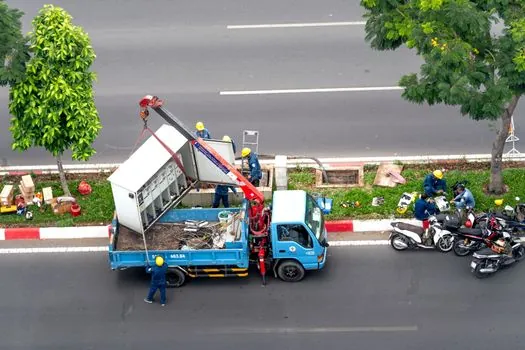
Chassis choice is a hard gate on a demolition site because ground bearing pressure from the outriggers is the first thing the site engineer checks. The HOWO 31 m unit ships with a 4x2 layout, dual hydraulic lifting cylinders for symmetric load distribution, an outrigger level gauge for plumb verification, and a balance valve to prevent load loss, all of which are mandatory on uneven demolition subgrade [S1]. The 60 m SHACMAN-class unit goes further: 4 three-section X-shaped hydraulic legs, individually adjustable, with a 7.7 m horizontal and 7.3 m vertical outrigger span, soft-leg protection, and a bidirectional hydraulic balance valve [S2].
At the 12-18 m end, a Dongfeng DF 145 (CLW5100JGKZ) uses the EQ1101GLJ2 cab with EQB160-20 / YC4E140-20 / YC6J170-21 engines, 160 hp output, 9200x2470x3610 mm overall, 4,500/4,700 mm wheelbase, and 2 t payload, a typical 12-18 m platform truck foundation [S4]. Stepping above 30 m forces a heavier cab; HOWO 30 m hydraulic mobile units use a Sinotruk-class chassis with customisable upper-body configuration while keeping the same personnel-lift envelope as lower tiers [S4]. Ground-protection mat sizing is a common retrofit ask that buyers should price in before delivery.
Compliance, safety devices, and who this is NOT for
Compliance gates on a CE-marked assembled machine and EN ISO 12100 documentation at the supplier level are the two non-negotiable items on every EU-bound demolition spec, alongside boom conformity under the relevant national MEWP rule (GB/T 9465-2018 for units up to 100 m working height, EN 280-1:2022, ANSI/SAIA A92.2, or ISO 16368:2024 depending on jurisdiction) [S3]. The HOWO 31 m unit lists 360° turntable fault alarm, emergency stop, guardrail and safety belt for working at heights, hydraulic-pipe wrapping, outrigger warning lights, a wind-speed detector, and a 304 stainless-steel toolbox, which together cover the typical EN 280 safety-device checklist [S1].
A truck-mounted MEWP is NOT the right tool for an uncontrolled façade collapse zone, for interior slab demolition above a basement, or for hot-work in a confined space with a diesel chassis. Buyers weighing those tasks should look at a self-propelled boom or scissor lift instead, or specify a battery-electric upper boom pack so the machine can work engine-off indoors; the FRP upper-boom option is the primary electrical barrier in Category A bare-hand work on live-line trucks, and the same logic applies when an insulating section is needed for selective demolition near live busbars [S3]. A demolition hammer reference pair helps when sizing the tool weight that goes into the basket.
Selection criteria comparison: telescopic vs articulating vs scissor on demolition
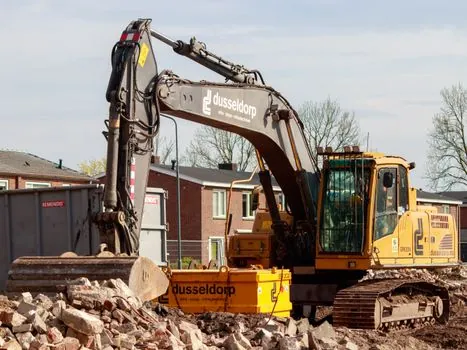
On the four decision criteria that matter for demolition, telescopic and articulating boom trucks score differently: a 30 m telescopic gives the best reach-per-stowed-metre and 200-400 kg platform load but limited obstacle negotiation; a 20-25 m articulating boom clears stair cores and parapets but costs reach and adds 1-2 m of stowed length; a 20 m / 500 kg scissor gives a 4-6 m wide work deck but demands flat, prepared ground and a separate transport leg, so it is rarely a primary demolition tool. FOB cost per metre of working height clusters at roughly US$ 40-700 across the three bands, with telescopic at the low end and large articulating combinations at the top [S4].
Buyers who lock the working-height band first, then the chassis, then the boom geometry consistently report fewer field retrofits, and the same rule applies in demolition where the rework cost of resizing an outrigger pad or re-rating the basket mid-project is a documented line-item risk [S4]. Operators running mixed fleets should also check whether a dump truck class chassis is acceptable on the site access road, because demolition sites frequently post a 12 t axle limit that rules out the 25,000 kg SHACMAN-class 60 m unit unless a permit is in place [S2].
Procurement signals to track into Q4 2026
Two verifiable signals to monitor: (1) the spread between 20-30 m and 32-36 m FOB prices, which has held within a 2-3x band as of June 2026 and is the cleanest indicator of where demand is shifting in the demolition-and-refurb segment [S4]; (2) the rollout of battery-electric upper-boom packs on 20-30 m truck chassis, which is the only configuration currently viable for indoor strip-out and night-shift urban demolition where diesel engine-off operation is now a tender requirement on many EU municipal projects [S3]. Buyers with a 2026 Q4 delivery window should request the outrigger-pad ground-pressure calculation in writing, as it is the single most common cause of site rejection for both the HOWO 31 m and 60 m SHACMAN-class configurations.
Related analysis: ZLP Platform Selection for Steel Construction: Load, Hoist, and Rope Specs.