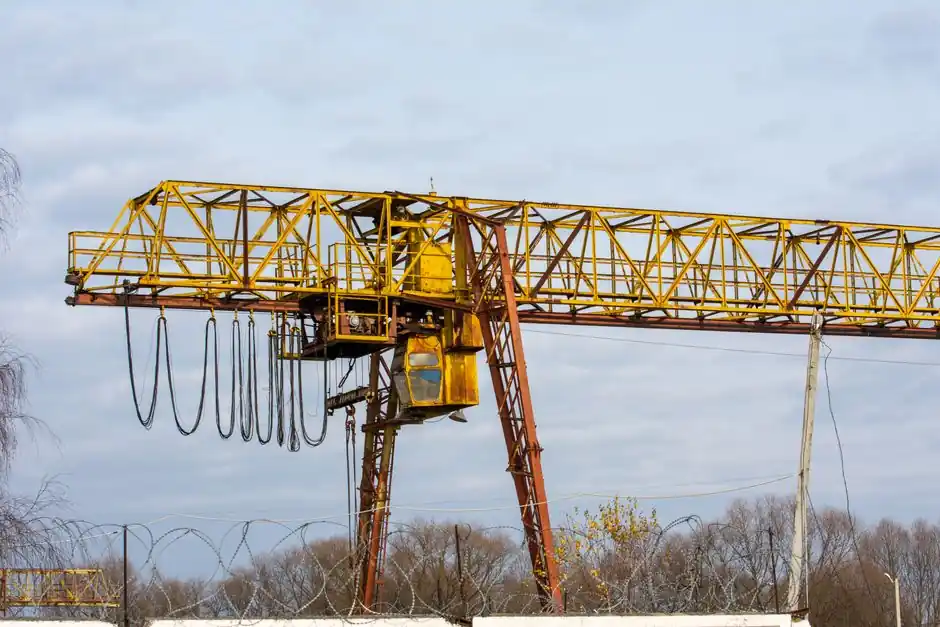
Timber-handling gantry cranes in the 10T–32T span are sized by peak single-lift load rather than average bundle weight, with 10T units reserved for standard lumber bundles and 20T–32T units required for raw log bundles, high-density yards, and port terminals [S1].
Selection in 2026 follows an inverted-pyramid logic: site and load first, structure and girder count second, attachments and duty cycle third, with over-sizing penalised on steel cost, wheel load, and energy use [S1][S5]. Forestry operations, including sawmills, log yards, biomass terminals, and pulpwood transfer stations, sit among the four core use-case families for gantry systems alongside port, rail freight, and bulk cargo yards [S3].
Capacity Bands and the 10T–32T Decision
A 10T gantry crane is sufficient for standard lumber bundles, light-to-medium sawmill output, and controlled yard operations where single-lift loads stay inside predictable limits, per the timber selection guide [S1].
The 20T–32T band is required for heavy log handling, high-density storage yards, port timber terminals, and large-scale sawmill logistics, where single lifts regularly exceed the envelope a 10T unit can clear safely [S1]. Forestry operators should treat attachment dead weight, including grapples, C-hooks, and spreader beams, as part of the net load, because these tools add mass that can absorb 5–15% of nominal capacity if excluded from the calculation [S1].
Single Girder vs Double Girder vs Truss
Single-girder gantry cranes typically cover 2–32T for general yard and industrial service, while double-girder builds are specified where higher duty cycles, longer spans, or heavier hook heights push the envelope past single-girder economics [S3].
Truss-girder construction reduces self-weight and wind load on outdoor rail-mounted units, which matters in open forestry yards where a solid-web girder acts like a sail during storm events. Cantilever variants, where the main girder extends beyond the runway on one or both sides, are typically chosen when the crane must serve a side lane or stack row without extending the rail track [S4]. The trade is straightforward: single-girder is the cheapest path to 10T service, double-girder is the default for 20T–32T continuous-duty timber work, truss is preferred for long-span rail-mounted outdoor units, and cantilever is the right pick only when the working footprint must overhang the rail.
Rail-Mounted vs Portable vs Rubber-Tired
Rail-mounted gantry (RMG) cranes dominate fixed timber yards and port terminals because the rail delivers repeatable positioning, lower rolling resistance, and higher permissible wheel loads than rubber-tired configurations [S1][S3].
Portable gantry cranes, typically 5–20T for light temporary work, suit short-term forestry tasks such as mill maintenance or log pile build-up where the crane relocates every few weeks [S3]. Rubber-tired gantry (RTG) units add yard mobility without rail civil work, which helps mid-size log yards that re-stack frequently but cannot match RMG wheel-load capacity for 32T continuous operation [S3]. For a permanent sawmill or export terminal, RMG is the right answer; for a contractor moving between sites, portable or RTG wins.
Site, Span, and Clearance Criteria
Seven decisions govern portable forestry gantry selection: rated capacity, lift height, clear span, setup method, mobility, power source, and duty cycle, per the 2026 portable buyer's guide [S7].
Outdoor forestry sites add wind loading, drainage, rail foundation stiffness, and operator visibility to that list, and these site conditions shape the support structure, travel route, and installation method [S5]. Buyers often start with the question of indoor bay, outdoor yard, or shared workshop lane, because each environment demands a different leg configuration and clear-height envelope. A semi-gantry, with one leg on the building column and one free-standing leg, is frequently the right call for shared lanes where full gantry width would block adjacent traffic [S5].
Overhead Crane vs Gantry in a Forestry Yard
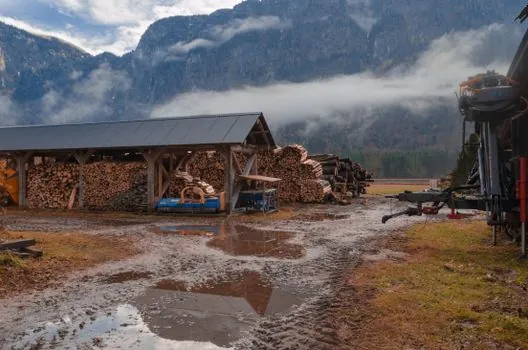
Gantry cranes transfer load through their own legs and travel system, which lets them serve open yards, retrofit spaces, and temporary work zones where runway beams on building columns are not practical [S5].
Overhead bridge cranes remain the better answer inside enclosed production halls where the building can carry runway reactions and the floor below the crane must stay clear for forklift or truck traffic [S5][S6]. For most outdoor timber yards, the question is not gantry versus overhead but rail-mounted gantry versus rubber-tired gantry, and the deciding factor is whether the yard has fixed stacking lanes (rail) or relocates piles frequently (rubber-tired). Forestry operators comparing stationary and mobile lifting should weigh capital cost against operational flexibility, because a mobile crane on a log yard trades positioning accuracy for relocation speed.
Duty Class, Attachments, and Lifting Tools
Lifting attachments (grapples, C-hooks, and spreader beams) add dead weight that must be included in crane capacity calculations; under-counting this mass is a common source of mid-life structural complaints on timber gantries [S1].
Irregular timber loads and log bundles also raise real lifting demand because of uneven weight distribution, so the safety margin must sit above the nominal material weight rather than at it [S1]. Forestry operators running two-shift or three-shift log throughput should specify FEM 2M or higher duty class, because FEM 1A/1B ratings typically derate under continuous log-handling cycles. Spreader beam and C-hook retrofit kits should be matched to the hoist's CMAA service class to avoid duty-class mismatch between the structural frame and the lifting tool.
Failure Modes and Common Mis-Specs

Under-sizing a forestry gantry causes overload stress and unsafe operation, while over-sizing inflates steel structure cost, raises wheel load requirements on the rail foundation, and increases energy consumption across the duty cycle [S1].
Three mis-specs show up repeatedly in forestry tenders: ignoring attachment dead weight, applying average bundle weight instead of peak single-lift weight, and choosing a portable frame for a duty profile that needs a fixed rail-mounted structure. Each of these can be caught by a simple peak-load audit before the purchase order is signed, and the audit is cheaper than a structural retrofit after commissioning. A crawler crane is often the right neighbour on a forestry site for off-rail heavy lifts, but it does not replace the in-yard gantry's stacking and feeding role.
Forests and Mills: Who a Gantry Fits, Who It Does Not
A gantry crane fits any forestry operation that needs repeatable in-yard lifting, fixed stacking lanes, and continuous duty across log piles, lumber bundles, or biomass stacks [S1][S3]. It does not fit short-cycle mobile tasks, off-rail harvest moves, or sites where the building structure can already carry an overhead runway at lower cost [S5][S6].
Buyers should also weigh whether a tower crane or a stacker crane better fits a specific site, because both can overlap with gantry use cases in sawmill or biomass terminals. For most permanent sawmills and export terminals, a rail-mounted 20T–32T double-girder gantry with grapple and C-hook attachments remains the workhorse choice in 2026.
Trackable signals for the next planning cycle: FEM duty-class updates in OEM datasheets for 2026 forestry tenders, and rail-foundation wheel-load data from new biomass terminal builds in Scandinavia and the US Southeast, both of which will tighten the over-sizing penalty on 32T timber gantries. See also this forestry tower crane trade-off guide for fixed-mast comparisons on log-yard sites.