
Forestry lift work, from plantation thinning to sawmill log-yard handling, sits at the edge of conventional tower crane duty: soft subgrade, restricted headroom under canopy, and short, repetitive lift cycles rather than long, sustained high-rise hoisting.
The four commercial tower crane families (hammerhead, flat top, luffing jib, self-erecting) defined in Maxim's 2026-08-11 type guide [S3] and All Crane's 2025-05-22 selection write-up [S4] are all technically deployable, but only one or two typically match a wood-lot duty cycle, and OSHA 1926.1435 governs every erection, climbing, and dismantling step in U.S. forestry construction [S1].
Forestry site constraints versus standard tower crane assumptions
OSHA 1926.1435(b)(3) requires tower crane foundations and structural supports to be designed by the manufacturer or a registered professional engineer, and 1926.1435(b)(4)(i) requires the A/D director to verify the foundation is installed to that design [S1]. On a forestry site, the "foundation" is rarely a poured mat: it is usually a system of timber mats, steel outrigger pads, or driven piles sized for a ground-bearing pressure that may sit well below 50 kPa on wet loam or peat.
1926.1435(b)(5) sets a default plumb tolerance of 1:500 (about 1 inch in 40 feet) when the manufacturer does not specify tighter [S1]. Maintaining that tolerance on a forestry pad that flexes under seasonal moisture change is a recurring inspection task, and it pushes selection toward self-erecting units that can be re-leveled hydraulically on their own base frames rather than fixed-base hammerheads grouted to a permanent foundation.
1926.1435(b)(4)(iii) further requires wind speed not to exceed the manufacturer's recommendation during assembly, climbing, and operation, with a qualified person setting the threshold when the manufacturer is silent [S1]. In a clearing or ridge-top yard, that wind threshold is hit far more often than on a sheltered urban core, so forestry buyers should compare out-of-service wind limits on the nameplate, not just in-service charts.
Type-by-type fit for wood-lot and plantation work
The four tower crane families differ sharply on footprint, headroom, and assist-crane dependence. Maxim's 2026-08-11 comparison table places hammerhead as the high-capacity, open-site workhorse, flat top as the multi-crane airspace option, luffing jib as the tight-urban pick, and self-erecting as the shortest-duration, lowest-capacity choice [S3]. For forestry, that ordering inverts in two places: luffing jib and self-erecting usually beat hammerhead, because canopy and roadside clearance dominate the layout, not raw radius.
Self-erecting tower cranes erect without a separate assist crane, fold out hydraulically, and need the least site prep [S3][S4]. On a forestry thinning contract of 4-8 weeks, with multiple short-duration set-ups along a haul road, that eliminates the 40-80 ton assist crane mobilization that would otherwise eat the schedule. Their lower maximum capacity is rarely the binding constraint, since log bundles, packaged lumber, and chip bins usually sit in the 3-8 ton range that All Crane's guide treats as typical working load for fixed jib machines [S4].
Luffing jib tower cranes trade a fixed horizontal arm for a lattice jib that raises and lowers to change reach, which lets the operator slew over nearby tree lines and stacked log piles instead of requiring a 50-80 m clear swing arc [S3][S4]. On a sawmill log-yard or a roadside deck where the crane shares airspace with stockpile conveyors, that variable-radius geometry is the difference between a workable layout and a non-starter. Flat top models give a similar low-headroom profile for multi-crane shared airspace on a larger landing, but they still need a mobile assist crane to erect, which adds cost on remote sites [S3].
Selection criteria mapped to forestry lift cases

All Crane's 2025-05-22 selection checklist lists project duration, site constraints, load requirements, and total cost of ownership as the four decision drivers [S4], and Black Timber's 2026-07-29 practical guide echoes those same four: load weight, reach, site access, and project duration [S5]. Re-stated for forestry, those four drivers map directly onto the lift cases below.
Case 1, plantation thinning and roadside decking: a self-erecting unit on engineered outrigger pads handles 3-5 ton log bundles at 12-18 m radius, with daily re-positioning along a forest road. Black Timber's 2026-07-29 guide notes that self-erecting units are the right answer for smaller infill sites and short-duration work, exactly the forestry pattern [S5]. Total cost of ownership favors the self-erector because no assist crane is needed and the pad can be re-used.
Case 2, sawmill log-yard or chip-handling terminal: a luffing jib tower crane, typically 8-20 ton working capacity at working radius per Black Timber's 2026-07-29 capacity band for fixed-base tower cranes [S5], handles 6-10 m log sorts and chip-bin fills inside a yard already crowded with conveyors and stockpile stacks. The luffing geometry avoids the clearance conflict that a hammerhead's fixed horizontal jib and pendant lines would create over neighboring stock.
Case 3, multi-crane landing or large timber bridge rebuild: a pair of flat top or hammerhead units, with jib lengths in the 50-80 m range Black Timber lists for tower cranes generally [S5], can share airspace when sited per OSHA 1926.1435(b)(6), which forbids any crane contacting the structure of another but allows them to pass over one another [S1]. Double-tower schemes have been modeled at more than twice the lifting efficiency of a single same-model tower, per the MDPI 2024-06-07 study on dual tower crane selection for prefabricated construction [S2], a useful data point when the forestry lift is closer to a precast yard pattern than a high-rise core.
Across all three cases, the four decision drivers reduce to a single comparison matrix: footprint / headroom / assist-crane requirement / working capacity. Hammerhead scores low on footprint and headroom but high on capacity; flat top is similar with a lower profile; luffing jib wins on footprint and headroom at a small capacity penalty; self-erecting wins on assist-crane independence but loses on capacity and jib length [S3][S4][S5].
Regulatory and safety gates that override the type choice
Once the type is shortlisted, OSHA 1926.1435 enforces three gates that the forestry buyer cannot negotiate around. First, 1926.1435(b)(3) and (b)(4)(i): foundations and structural supports must be engineered and the A/D director must verify installation matches that design [S1]. On soft forestry soils, that usually means a geotech report and a pad-sizing calculation, not a vendor's stock base plate drawing.
Second, 1926.1435(b)(7) on climbing procedures: the employer must follow manufacturer prohibitions and have a registered professional engineer verify that the host structure can sustain the forces imposed through braces, brace anchorages, and supporting floors [S1]. For a forestry tower that will sit on a temporary timber-mat foundation rather than a host building, the equivalent gate is verifying that the mat system and any tied-down anchorage can resist the overturning moment at the manufacturer's maximum in-service wind.
Third, 1926.1435(b)(2) on dangerous areas: for self-erecting tower cranes, employees must not be in or under the tower, jib, or rotating portion during erecting, climbing, and dismantling until the crane is secured in a locked position and the competent person in charge indicates it is safe [S1]. Forestry crews working with felling and skidder equipment in the same footprint must be physically cleared out of that envelope, which is a planning constraint on where the landing sits relative to the felling face.
Limits and failure modes specific to forestry duty
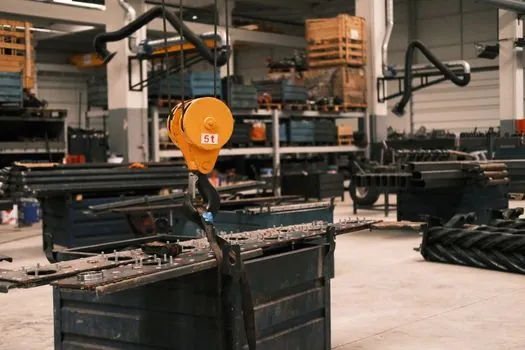
Tower cranes are fixed-position machines optimized for high hook heights, not for the repeated short-radius, high-cycle lifts that a chip-bin or log-sort operation runs. Sany's 2025-11-06 buyer guide recommends fixed or internal-climbing cranes for narrow sites and mobile cranes for open, dispersed sites [S9], which is a useful boundary: a forestry landing that is genuinely dispersed across a large yard is often better served by a truck-mounted crane than by a tower crane, and a long, linear landing with multiple lift points is a better fit for a mobile unit than for any tower.
Counterweight and ballast handling on soft ground is the other silent limit. OSHA 1926.1435(b)(8) requires that equipment not be erected, dismantled, or operated without the proper amount and type of counterweight/ballast, and that any Ballast/Counterweight heavy sections be positively secured [S1]. Forestry buyers should size the assembled machine's maximum outrigger or ballast load against the allowable ground bearing pressure, since counterweight handling on a wet forestry pad is a common root cause of base-foundation tilt incidents.
Lastly, plumb tolerance drift under repeated load cycling is more pronounced on forestry pads than on engineered urban foundations, so 1926.1435(b)(5) compliance (manufacturer's tolerance, or 1:500 default of about 1 inch in 40 feet where unspecified) becomes a daily check rather than an erection-day check [S1]. Operators should plan for a plumb verification at every shift change on a multi-week forestry contract.
Standards and sourcing reference
U.S. forestry construction using tower cranes falls under OSHA 29 CFR 1926 Subpart CC, with 1926.1435 the tower-crane-specific supplement [S1]. Manufacturer procedures remain the primary operational reference per 1926.1403-1926.1406 as incorporated by 1926.1435(b)(1) [S1]. Selection trade-offs across the four tower crane types are documented in Maxim 2026-08-11 [S3], All Crane 2025-05-22 [S4], and Black Timber 2026-07-29 [S5], with multi-crane efficiency benchmarks from MDPI 2024-06-07 [S2] and site-layout guidance from Sany 2025-11-06 [S9].
For concrete and material handling on the same forestry landing, the selection logic for a concrete pump truck or a dump truck feeding the tower crane's bucket will run in parallel, since tower crane selection is rarely a stand-alone decision on a forestry site.
Component reference pages worth checking: tower crane, signal tower light, and crane scale.