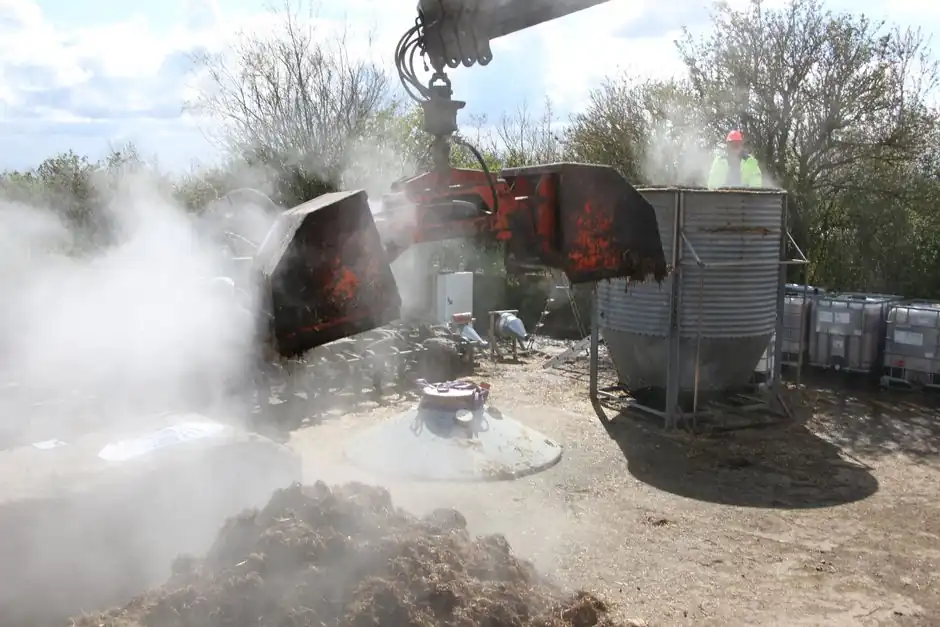
Specifying a diaphragm wall grab for snow removal fails on first principles: a grab is a vertical slurry-trench excavation tool with 2.4–3.8 m clamshell buckets, 210 bar closing hydraulics, and rated clamping forces approaching 800 tonnes, geometry that is incompatible with horizontal plow paths on pavement [S1][S5].
The grab method uses a hydraulic clamshell lowered into a bentonite-slurry-supported trench to excavate panel-by-panel for deep basement, metro, and cut-off walls, with cycle times of 300+ per day and submeter placement accuracy, a profile that has nothing to do with lot clearing, sidewalk plowing, or salt-spreading duty [S5].
What a Diaphragm Wall Grab Actually Does
A diaphragm wall grab excavates rectangular panels, with primary panel lengths in the 3.0 m minimum range and multi-bite assemblies reaching 6.5–8.0 m, inside a slurry-stabilized trench that is later filled with tremie concrete and a reinforcement cage [S2].
Operation is cyclic: the grab descends open under its own weight, closes on the soil at 210 bar within 2–3 seconds, lifts spoil to the surface, and discharges into a hopper, with descent rate controlled at 0.5–1.5 m/s by proportional throttle valves [S5]. Bauer's DHG V hydraulic grab reaches trench lengths up to 3,800 mm and widths up to 1,500 mm; trench cutters, not grabs, are preferred once soil turns hard or depth exceeds grab-efficient limits, with BC cutter rigs having recorded depths beyond 250 m [S1].
Why Grab Geometry Conflicts With Snow Duty
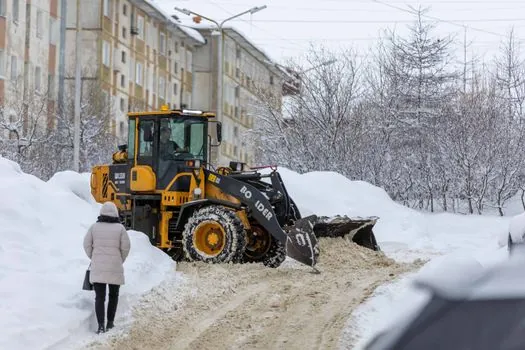
A grab's bite is vertical, 0.5–1.5 m/s descent, rated for dense wet clay and weak rock inside a fluid-filled trench, which is the opposite of the horizontal 1.5–4.0 m/s sweep, low-resistance snow profile, and dry-pavement discharge a plow needs [S5].
Grab weight is similarly mismatched: a 3.2 m unit handling 600 tonnes of spoil per cycle is engineered for static clamping load, not for the 8–25 km/h directional travel a plow truck sustains, and the four-post guide frame that keeps bucket halves parallel in a trench becomes a snag hazard the moment the tool is dragged across asphalt [S1][S5]. For snow work the spec conversation belongs to a different article, see skid steer snow removal: pick flow rate, undercarriage, and cab first for the correct criteria set.
Grab vs Cutter: Where the Grab Still Wins on Its Own Turf
On the trench side, the choice between a grab and a diaphragm pump-fed trench cutter hinges on soil and depth: grabs are preferred in soft to medium soils, cohesive clays, silts, and weak rock at moderate depth, while cutters dominate in hard soil, large depths, and continuous rock where the cutter wheel can out-excavate the cyclic grab [S1][S3].
Selection criteria for the grab method itself, drawn from manufacturer guidance, line up as follows:
Soil condition: cohesive clay, silt, sandy clay, and weak rock favor grabs; hard rock, boulder fields, and very stiff soils force the spec toward a hydrofraise or cutter system, and recent hydrofraise case histories in weak Auckland rock confirm the cutter's role once rock strength exceeds grab-clamping capability [S7]. Trench depth: grabs are typically efficient to roughly 60–80 m; beyond that, BC-type cutter rigs with mud-pump slurry circulation become the practical tool, with documented depths past 250 m [S1]. Panel size: standard 2.4 m grabs suit tunnel and airport works with limited access, while 3.2–3.8 m units on the DHG V cover high-rise basement panels in dense urban sites [S1][S5]. Site constraints: low-headroom or confined urban sites favor grabs over cutters because the grab can be serviced from a smaller rig footprint [S3].
Joint Type and Slurry Discipline That Would Never Apply to a Plow
Diaphragm wall joints, flat, circular, steel I-beam, or grooved with water stops, are selected jointly with the excavating equipment, with grooved water-stop joints typically preferred and steel I-beams common in the US; flat and circular joints are generally avoided because of water-tightness limits [S2].
Slurry properties, density, sand content, viscosity, and pH, must stay within specification throughout excavation, with the slurry circulated through a desanding plant and either regenerated or replaced before tremie concrete placement [S1][S2]. This is the operating envelope a grab is built for: wet, dense, chemically active, vertical. None of those parameters map to dry, cold, abrasive snow on a parking lot, which is why the right tool for the lot is a skid steer or wheel loader with a hydraulic plow, not a clamshell grab.
Spec Crossover: What Borrowed Specs Look Like, and Why They Fail
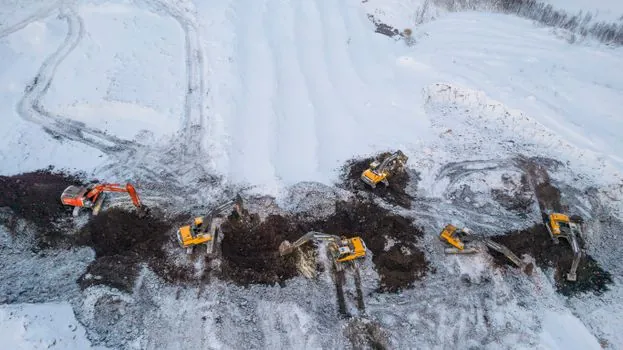
Contractors who try to cross-spec a grab for snow duty typically copy three numbers: 210 bar closing pressure, 800 tonnes clamping force, and a 3.2 m bucket width, but each of those numbers is a vertical-trench rating, not a horizontal-shear rating [S5].
Closing pressure of 210 bar drives a proportional hydraulic circuit that pulls two bucket halves together against dense clay inside a slurry column; a snow plow wants 180–250 bar to angle a moldboard, but applied through a quick-attach coupler to a tool weighing 200–600 kg, not through a 600-tonne clamping force routed to two rigid buckets on a 5 m guide frame [S5]. For truck-mounted snow duty the spec-relevant chassis and pump criteria are covered separately in Concrete Pump Truck Chassis for Snow Removal: Spec Match and Limits.
Limits, Failure Modes, and What to Watch on Either Tool
Grab failure modes center on the trench environment: misalignment between the four guide posts causes spillage, capacity loss, and rapid wear-ring failure; friction forces on bronze guide collars exceed 100 kN during a 1,000-tonne closing cycle; and wet clay sticks to the buckets, requiring mechanical knocker or air vibrator assistance for clean discharge [S5].
None of those failure modes exist on a snow lot, but the failure modes that do, moldboard impact, hydraulic coupler freeze, and undercarriage salt corrosion, are exactly what a grab is not engineered to survive. Equipment rental selection for actual grab projects, machine condition, availability of technical support, and operator assistance, follows the same logic contractors should apply when selecting a snow rig: match the tool's designed operating envelope to the job, and do not borrow specs across categories that share neither geometry nor duty cycle [S3].
The next trackable signal is the autumn 2026 release of updated hydrofraise performance data from soft-ground metro projects, which will tighten the depth-and-soil threshold where grabs yield to cutters and confirm whether 60–80 m remains the practical grab ceiling on transit-station work.
For component-level specifications, see diaphragm valve.