Articulated dump trucks (ADTs) in the 30-45 t payload class are the dominant spec for forestry applications, with permanent 6x6 all-wheel drive and low ground-pressure tires purpose-built for soft, steep, and uneven cut-block terrain [S2][S4].
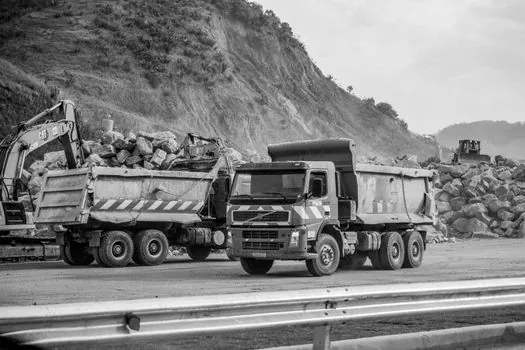
Rigid-frame mining haulers in the 100-400 t class, by contrast, are engineered for high-volume pit haulage on engineered roads and are not a fit for forestry corridors, mountain landings, or temporary skid trails [S1][S7].
Why the ADT dominates the forestry haul segment
Forestry haul cycles combine steep grades, soft organic soils, and seasonal moisture, conditions where ground pressure and traction matter more than peak payload per cycle. Articulated trucks keep loaded ground pressure under roughly 30 kPa through wide-base, low-pressure tires and oscillating front-rear hitch articulation, allowing operation on haul roads that have not been engineered for rigid-truck axle loads [S2][S4].
The 6x6 permanent all-wheel-drive configuration, with a longitudinal torque distribution to all three axles, gives ADTs effective grade climbing in the 25-30 degrees range, well above the practical limit of two-axle on-highway dump trucks [S2]. Manufacturers including Volvo, Caterpillar, and Komatsu offer bare-chassis variants specifically for forestry, water, and service-truck applications, recognizing the segment's distinct duty cycle [S9].
Payload and chassis class: matching truck size to cut-block volume
Forestry operations typically spec ADTs in the 25-45 t payload window; below 25 t, a forwarder or skidder often replaces the haul truck altogether, while above 45 t, ground-pressure and turning-radius penalties outweigh the cycle-time gain on short forestry hauls [S4][S9]. For context, the global dump and mining trucks market crossed USD 34.02 billion in 2025, with ADT demand driven heavily by construction and forestry rather than large open-pit metal mining [S6].
Rigid mining trucks span 30 t to 400 t nominal payload across major OEM line-ups, with Komatsu alone listing a 30-400 t capacity range and Caterpillar's off-highway mining-truck family covering similar envelopes for hard-rock and oil-sand operations [S1][S7]. These large frames assume 80+ kPa ground-bearing capacity on maintained haul roads, a 3-5x higher bearing requirement than a typical ADT [S2].
Selection criteria ranked: ground pressure, grade, cycle, TCO
A 2024 multi-criteria study using the FUCOM (Full Consistency Method) ranked dump-truck selection criteria into four groups: technical, technological, environmental, and economic/organizational, with transport cost share reaching up to 70% of open-pit operating expense and rising 20-30% per 100 m of pit depth [S3]. For forestry, ground pressure and grade capability dominate; for open-pit metal mining, payload per cycle and haul-road CapEx dominate, a useful contrast when adapting the framework to a cut-block.
Rigid haulers win on cost-per-ton only when the haul road is stable, firm, and meticulously maintained, a condition rarely met in active forestry, and they are notably sensitive to thick mud and severe weather, which can force downtime [S2]. ADTs trade peak payload for access: their permanent AWD and superior suspension traverse soft ground, steep grades, and rough terrain without engineered road base, at the cost of a higher cost-per-ton on long, smooth hauls.
Option-by-option fit for a forestry operation
Option 1, in-house rigid hauler: best for forestry operations with long, well-maintained main-line haul roads and a firm commitment to ongoing road maintenance; payload 100-400 t, but requires a road investment of multiple millions of dollars per kilometer of suitable subgrade [S2].
Option 2, outsourced ADT fleet: avoids capital outlay and brings third-party equipment suited to soft ground, steep grades, and rough terrain; common when overburden or biomass haul is seasonal rather than year-round, but introduces external-crew safety and logistics overhead [S2].
Option 3, in-house ADT fleet (30-45 t class): the default fit for active cut-block haul, allowing operators to redeploy machines to road-building, site development, and summer service work when primary forestry haul slows [S2][S4].
Option 4, bare-chassis specialty ADT: configurable as water, fuel, or service truck for fire suppression and dust control on logging roads, a common forestry add-on that improves fleet utilization across seasons [S9].
Standards, certifications, and sourcing signals to verify
Forestry ADT procurement typically references ISO 3457 (earth-moving machinery, guards and deflectors), ISO 5010 (steering requirements), and the relevant regional engine-emission tier, with operators in North America also confirming forestry-specific ROPS/FOPS guarding on bare-chassis configurations [S4][S9]. Tire selection is grounded in the Forestry-Agriculture tire standard (commonly referenced as LS-2/L-2/L-3 tread classifications) for low-pressure soft-soil operation.
Open-pit rigid hauler fleets additionally follow ISO 6483 (earth-moving machinery, truck bodies) and ISO 7133 (terminology and commercial specifications) for payload-volumetric calibration, which is largely irrelevant for forestry work where volume is biomass rather than blasted rock [S3].
Decision rules and what NOT to specify
Specify an ADT, not a rigid hauler, when any of the following apply: grade exceeds 12 degrees, ground bearing capacity is below 60 kPa, haul-road maintenance budget is constrained, or cycle distance is under 3 km. Specify a rigid hauler only when forestry is co-located with an active mine and the haul road can be engineered to mine standards; do not retrofit a rigid truck onto a skid trail. [S2]
Do not pair a 100+ t rigid hauler with a forwarder or feller-buncher operation: the loading-tool match is wrong, the ground pressure will rut the deck, and the turning radius exceeds a typical landing pad. For higher-capacity concrete or aggregate support in adjacent quarry or road-building work, see the mining dump truck payload and TCO spec map and the related dump truck spec for snow plowing for cold-season operations, where similar low-ground-pressure considerations apply on forestry roads.
Verification and trackable signals for a 2026 procurement
Before signing, request OEM-published payload-vs-grade curves (loaded, at 30 degrees), ground-pressure figures at rated load (kPa), tire spec (size, ply rating, recommended inflation), and articulation hitch oscillation angle. Confirm forestry-ready options on the BOM: ROPS/FOPS, branch guards, fire-suppression kit, and LED lighting rated for low-visibility dust. [S3]
Track two signals over the next 6-12 months: (a) the global dump and mining truck market is forecast to grow at over 5.5% CAGR through 2035, with ADT demand likely outpacing rigid haulers as forestry mechanization deepens [S6]; (b) watch OEM bare-chassis ADT availability, a leading indicator of segment demand, since forestry, water, and service-truck configurations are typically built on order rather than stocked [S9].
For component-level specifications, see mining dump truck, dump truck, and reach truck.