A 1-3 tonne electric counterbalanced forklift will lift 1,500-3,000 kg at a 500 mm load centre, run 8-12 kWh per shift on a 48 V or 80 V lead-acid or Li-ion pack, and emit zero tailpipe CO — which is why indoor warehouse and cold-store spec sheets in 2026 still list it as the default pallet mover.
That same machine needs 4.0-4.5 m of right-angle aisle to stack a 1.2 m pallet, weighs roughly 3-4× its lift capacity, and is rated for floor loading of 6-12 kN/m², so a facility with mezzanines or low-clearance slabs often cannot use one at all. The trade-off set below comes out of a working spec map, not a sales brochure.
Where Forklifts Beat Manual Handling and Conveyed Flow
A trained operator on a sit-down counterbalanced truck moves 30-60 pallets per hour versus 8-15 for a hand pallet jack, and reaches 2.5-6.0 m lift heights that no manual stacker can cover safely above 1.8 m. Lift capacity spans 1-10 tonnes for the common IC/electric sit-down classes, with specialised 16-25 tonne heavy-lift trucks for steel coil and container handlers forklift types and classifications.
Versus fixed conveyor, a forklift fleet delivers true point-to-point flexibility: one truck can serve receiving, put-away, replenishment, and shipping without re-engineering the line, which is why most 5,000-50,000 m² distribution centres still run a mixed conveyor-plus-forklift flow. Rental rates of 800-1,800 USD/month for a 2.5 tonne electric (2026 US market) keep capex off the balance sheet for seasonal peaks. The forklift selection map lays out the power-class trade-offs that drive those rental spreads.
Where Forklifts Lose to Other Equipment
Operating cost is the headline disadvantage. Total hourly cost for an electric counterbalance runs 18-32 USD/hour loaded (energy + maintenance + operator), against 4-8 USD/hour for a 24 V powered pallet jack doing the same horizontal transfer. A 2.5 tonne IC diesel truck burns 3-5 L/h and adds diesel particulate and NOx exposure that a 40,000 m² enclosed DC cannot accept. [S5]
Safety exposure is the second hard cost. Floor damage, mast failure, and battery-acid exposure (vented lead-acid only) are recurring failure modes the spec has to price in. The rough-terrain forklift class trades those failure modes for slope and ground-clearance limits that indoor trucks cannot meet.
Power-Class Comparison: Electric vs IC Diesel vs LPG vs Li-ion Conversion
Selection is governed by four criteria, and the answer usually falls out of a 2×2 on the first two. Indoor air quality rules out diesel and LPG in food, pharma, and cold-store, leaving 48 V / 80 V electric with a Li-ion option. Outdoor heavy-duty work above 5 tonnes or with continuous grading still favours diesel or LPG for refuel-in-minutes turnaround.
Energy cost per shift in 2026: lead-acid electric at 0.80-1.20 USD/kWh grid equivalent, Li-ion electric at 0.60-0.90 USD/kWh with opportunity charging gains, LPG at 1.40-1.80 USD/kWh gasoline-equivalent, diesel at 1.10-1.50 USD/kWh diesel-equivalent. Li-ion conversions cut battery-change downtime from 15-20 minutes per shift to under 2 minutes of plug-in, but require a 30-80 kWh DC charger and a 480 V three-phase feed that not every site can host. A 2.5 tonne Li-ion truck costs 35,000-55,000 USD against 22,000-32,000 for the same lead-acid unit, so payback is gated to 2-shift or 3-shift operations above 4,000 hours/year.
Who Forklifts Are FOR, and Who Should Pick Something Else
Forklifts are the right call for mixed-SKU pallet flows above 200 pallets/day, any lift above 1.8 m, outdoor yard work on hard stand, and any load above 2 tonnes. They are the wrong call for narrow-aisle pallet live-storage under 2.7 m aisle width — that is a reach truck or turret truck problem, and a counterbalance will not physically turn inside the racking.
They are also wrong for explosive atmospheres (ATEX zone 1/2) unless the truck is factory-certified with a nameplate marking and corresponding EX-rated peripherals, and wrong for cleanroom ISO Class 7+ where electric traction motor brush wear and hydraulic drip are intolerable. In those cases, an automated guided forklift (AGF/AMR) with sealed hydraulics and stainless mast is the spec target, but only at 1.5-2× the capex.
Limitations, Failure Modes, and Sourcing Standards
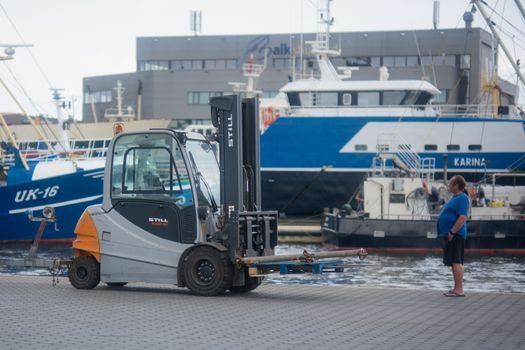
Three constraints dominate a forklift spec sheet. First, rated capacity is at a stated load centre — extend the centre from 500 mm to 700 mm and capacity drops roughly 20-30% on most 2-3 t trucks. Second, free lift is the un-telescoped mast travel (typically 100-200 mm) and determines whether the truck can enter a 2.0 m doorway with a load. Third, right-angle stack aisle width (AST) is set by the truck manufacturer, not by the racking supplier, and a 2.5 t electric commonly needs AST 3.6-4.2 m even though some narrow-chassis variants hit 3.2 m.
Governing standards in 2026: ANSI/ITSDF B56.1 (US safety standard for low-lift and high-lift trucks), EN ISO 3691-1 (EU safety, replaces EN 1726 for rider trucks), OSHA 1910.178 (US operator training and operating rules), and UL 583 (US electric truck electrical). For ATEX zone use, ATEX 2014/34/EU and IEC 60079-0 apply, with truck category 2G/2D as a typical minimum. Battery rooms for vented lead-acid must meet the ventilation rate in NFPA 505 or the equivalent EN 62485-3, which on a 48 V 700 Ah pack sets a hydrogen dilution airflow of roughly 7-12 m³/h per cell. Watch 2026-07 OEM bulletins for Li-ion BMS firmware updates (battery-state-of-charge balancing drift on packs older than 3 years is the dominant field complaint this quarter); cross-check the forklift maintenance log against the latest service-information letter from the mast and hydraulic-hose suppliers before signing the next annual inspection. Related material spec context: the mast and hydraulic seals share alloy choices with broader nickel alloy trade-off data.
Spec-level background on the components involved: pressure transmitter.