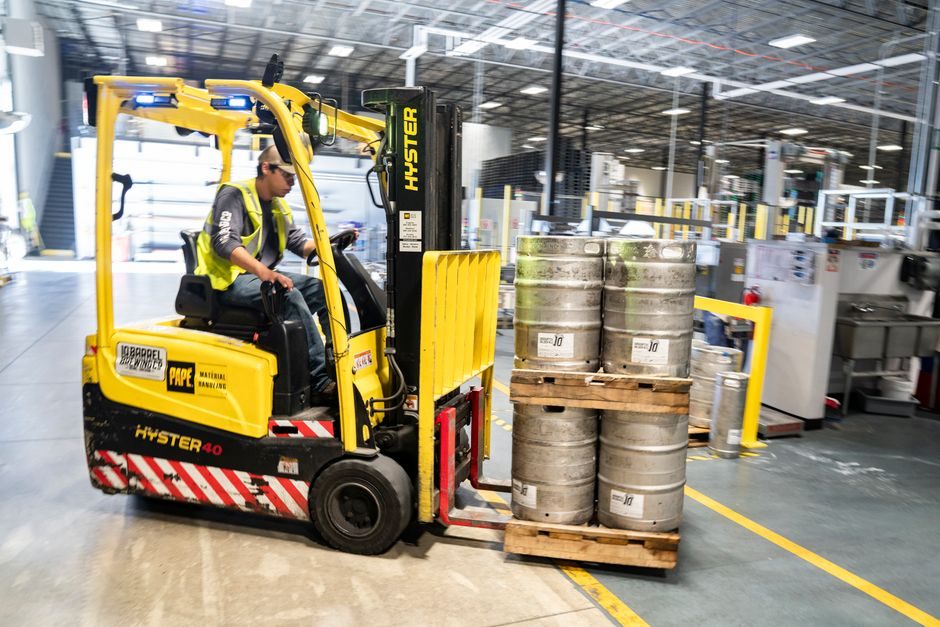
OSHA's powered industrial truck framework groups forklifts into seven classes by power source and operating environment, with Class I electric rider, Class IV/V internal-combustion cushion/pneumatic, and Class VII rough-terrain units covering roughly 80% of industrial deployments [S1][S2].
Capacity is governed by a separate carriage-grade scale: Grade 1 lifts under 1.1 t at ~33 cm hook height, while Grade 5 covers 8.8-12 t at ~73 cm hook height, so a buyer must cross-reference the OSHA class against the SANY carriage table to fix both duty cycle and lift envelope [S3].
OSHA Class Map: Power Source x Operating Environment
OSHA's seven-class taxonomy is the only federally codified system used on U.S. operator-certification cards (29 CFR 1910.178), and it is the reference auditors check first [S1]. Class I is the electric-motor rider truck, broken into Lift Code 1 (stand-up counterbalanced), Code 4 (three-wheel sit-down), Code 5 (cushion-tire sit-down counterbalanced), and Code 6 (pneumatic-tire sit-down counterbalanced). Class II narrows the aisle envelope further with electric high-lift straddle and reach-truck configurations, which is the segment detailed in the rough terrain forklift decision tree only when the same truck must also leave the dock.
Class III covers hand and hand/rider electric units (pallet jacks, walkie stackers), and Class IV/V split the internal-combustion engine trucks by tire: cushion-tire IC for smooth indoor floors, pneumatic-tire IC for outdoor yards and uneven pavement. Class VI is electric-and-hybrid tow tractors, and Class VII is the rough-terrain telescopic-boom telehandler used on construction sites [S1][S2]. For buyers cross-shopping indoor electric versus IC, the forklift encyclopedia entry lists the typical 36 V / 48 V / 80 V battery ladders that distinguish a Class I sit-down from a Class III walkie.
Carriage Grade vs. Lift Height vs. Capacity
The SANY carriage-grade table maps hook height to rated capacity in five discrete steps, independent of OSHA class: Grade 1 = 13 in (33 cm) hook, <1.1 t; Grade 2 = 16 in (40.6 cm), 1.1-2.75 t; Grade 3 = 20 in (50.8 cm), 2.75-5.5 t; Grade 4 = 25 in (63.5 cm), 5.5-8.8 t; Grade 5 = 28.7 in (72.9 cm), 8.8-12 t [S3]. That same capacity range is what a Class I cushion-tire sit-down typically delivers in a distribution center, while a Class V pneumatic-tire IC unit overlaps Grades 3-5 when fitted with a longer mast.
Hook height is a function of mast stage count: a two-stage limited-free-lift mast sits at the Grade 1-2 range, a three-stage full-free-lift mast reaches Grade 3-4, and a four-stage mast on a Grade 5 chassis is the only way to clear 12 t above ~70 cm without exceeding the truck's stability triangle [S3]. Mast tilt, side-shifter carriage, and fork length are then layered on top of the carriage grade; SANY's component guide treats them as separate line items rather than bundled options.
Selection Criteria: Floor, Aisle, Lift, Fuel, Duty
Five criteria drive a defensible spec: (1) floor surface — smooth concrete favors cushion-tire (Class IV) or electric (Class I); unfinished yard demands pneumatic (Class V) or rough-terrain (Class VII). (2) Aisle width — Class II reach and turret trucks operate in 2.4-2.7 m aisles versus 3.6-4.2 m for a Class I sit-down counterbalance. (3) Lift height — anything above 6 m typically rules out Class I cushion-tire and pushes the spec to Class II reach or Class V mast-equipped IC. (4) Fuel policy — indoor food, pharma, or cold storage usually locks the spec to Class I/II/III electric because IC exhaust cannot be ventilated at the required rate. (5) Duty cycle — single-shift light pallet duty is a Class III walkie; three-shift heavy pallet or dock-to-rail duty is a Class I or V sit-down with an 80 V battery or LP-gas tank [S2][S4].
Type-by-Type Comparison: 10 Common Forklift Designs
BigRentz's 2026 industry reference lists ten common forklift types: warehouse (counterbalance), side loader, counterbalance, telehandler, heavy-duty, rough terrain, pallet jack, walkie stacker, order picker, and reach truck [S2]. Stacking them against four decision criteria yields a working comparison:
Counterbalance (Class I/V) — versatile, ~1-12 t capacity, 3-6 m lift, requires 3.6 m+ aisles; the default indoor/outdoor general-purpose pick. Reach truck (Class II) — 1-2.5 t, 6-12 m lift, 2.4-2.7 m aisle, indoor-only racking work. Order picker (Class II) — 1-1.5 t, 3-9 m lift, operator-elevating cab for piece-pick at height. Pallet jack / walkie stacker (Class III) — 1-2 t, low-lift or 3-4 m stacker, dock and trailer duty. Telehandler (Class VII) — 2.5-4.5 t, 6-17 m tele boom, rough-terrain construction and agricultural sites. Rough-terrain forklift (Class VII) — 2-4 t, 3-6 m mast, 4WD, unpaved yards. Side loader — 2.5-5 t, 4-6 m lift, long-load handling in lumber, steel, pipe. Heavy-duty — 10-50+ t, port, container, and steel-mill service [S2][S4].
Operating Limits, Failure Modes, and Safety Boundaries
The OSHA framework ties each class to specific training and operating rules under 29 CFR 1910.178; misclassification is the single most common citation trigger at U.S. audits [S1]. A Class IV cushion-tire IC truck on a rough outdoor yard will chunk its solid tires and lose braking traction; a Class V pneumatic-tire IC truck indoors will fail ventilation calculations for CO and NOx in a closed warehouse. A Class I electric sit-down with a 36 V battery is not interchangeable with an 80 V unit — the chassis, motor controller, and counterweight differ, so a "Class I" label alone is not a substitute for reading the data plate.
Mast and load-backrest extension limits matter: lifting above the mast's two-stage rating without a third stage is a documented tip-over precursor, and a side-shifter that is not pinned correctly can swing the load outside the truck's stability triangle. Class VII telehandler reach envelopes must be derated as boom extension increases — published load charts are non-negotiable on site [S3][S4].
Who Each Class Is For (and Who It Is Not)
Class I/II/III electric is for indoor, ventilation-sensitive, noise-sensitive operations: food, pharma, electronics, cold storage, e-commerce fulfillment. It is not for outdoor yards, mud, or rain-exposed sites. Class IV/V IC is for indoor warehouses with adequate ventilation, loading docks with door access, and outdoor yards on paved surfaces. It is not for food-grade indoor zones or for rough unpaved ground. Class VII rough-terrain is for construction, agriculture, lumber yards, and military logistics; it is not for narrow-aisle racking or finished-floor warehouses. Class VI electric tow tractors are for baggage, parcel, and assembly-line tractor duty and are not a substitute for a load-carrying forklift [S1][S2].
Standards, Sourcing, and Audit Trail
Three reference layers govern a forklift spec: (1) U.S. safety and operator training under OSHA 29 CFR 1910.178, which adopts the seven-class system and the type designation letters; (2) ANSI/ITSDF B56.1, which the OSHA standard incorporates by reference for design and performance criteria on most Classes I-V units; (3) manufacturer carriage and mast tables, which supply the actual capacity-at-height numbers (e.g., SANY's Grade 1-5 ladder) that no class letter can replace [S1][S3]. European CE-marked units additionally conform to EN ISO 3691-1, and rough-terrain telehandlers to EN 1459. Sourcing should always cross-check the OEM data plate against the carriage grade table, the OSHA class letter, and the applicable ANSI/ISO standard before purchase [S1][S3].
The 2026 product-flow signal to track: lithium-ion 80 V battery packs replacing lead-acid on Class I sit-down counterbalances, narrowing the total-cost-of-ownership gap versus Class IV/V IC over a three-shift duty cycle. For buyers comparing the broader material-handling capex envelope, the asphalt paver types and classifications reference and the gravity die casting machine types map apply the same class-by-environment framework to adjacent capital-equipment lines.
Spec-level background on the components involved: pressure transmitter.