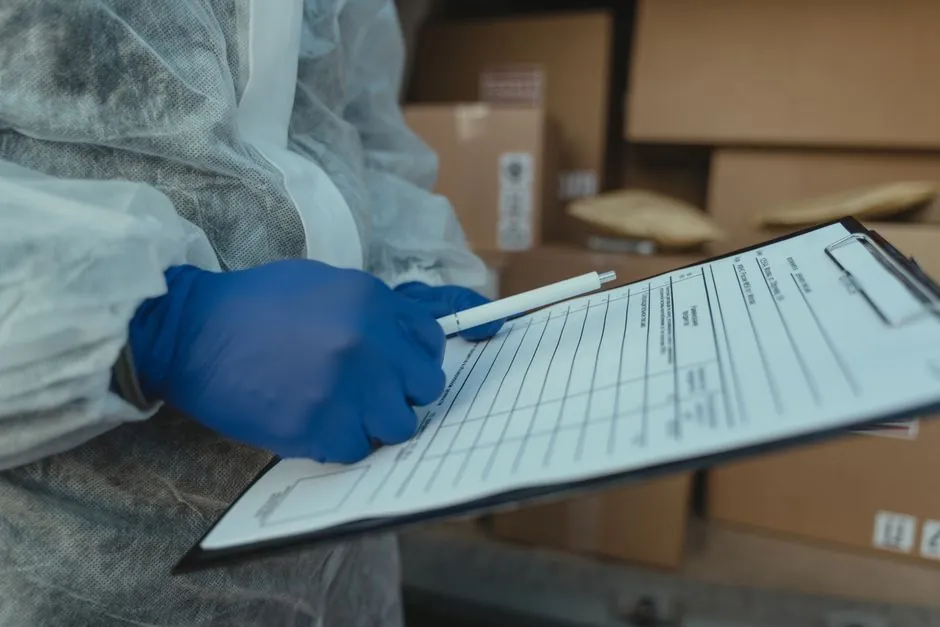
OSHA 29 CFR 1910.178(q)(7) requires a written inspection at the start of every shift before any powered industrial truck is placed in service, with defects recorded and the truck removed from service until repaired [S1]. The most widely used field format, deployed by U.S. Army installations, Yale EHS, municipalities such as Bangor ME, and OEM-led templates from Linde, splits the procedure into a 15-line visual sweep and a 12-line operational check [S2][S3][S4][S5].
The operator, not the mechanic, owns the daily check. Acceptance criteria are hard: bent forks, hydraulic hose cracks, free play in the steering greater than 1-2 inches, or any failed alarm trigger immediate tag-out, and the truck shall not be operated until restored to a safe operating condition [S2][S5]. Documentation is retained for at least one year for audit and incident reconstruction [S5].
Visual Sweep: The 15 Items That Must Pass Before the Key Turns
Step 1 of the inspection is a walk-around with the truck shut down and the parking brake set, covering structural integrity, leaks, mast hardware, and safety devices per the Bangor ME pre-use checklist and the Linde visual inspection block [S2][S4]. Tires and wheels must be free of excess damage or wear, including drive wheels, steer wheels, load wheels, and casters on electric pallet jacks and narrow-aisle models [S2][S5].
Forks are inspected for bends, cracks, holes, and wear; fork positioning latches must move freely and hold the fork pin [S2]. Chains, sprocket teeth, and chain anchor pins are checked for bent, chipped, or worn geometry, since chain stretch is the leading indicator of impending mast failure on forklifts used in multi-shift warehousing [S2][S5]. Hydraulic hoses are checked for leaks, cracks, and abrasion at bend points, while battery cables are verified secure, properly insulated, and routed inside the truck body, never outside the cab or fender line [S2][S5].
Safety devices on this leg include the seatbelt, operator harness (where fitted), overhead guard, load backrest, gates, side rails on SP and turret models, fire extinguisher, and the data plate with all approved attachments listed [S2][S5]. LPG-specific checks demand a damage-free cylinder, relief valve pointed up, and bracket in good working order; diesel models add radiator hoses, clamps, and coolant level, while electric units add a battery condition check for excess corrosion and electrolyte level [S2][S4].
Operational Checks: What the Operator Verifies With the Engine Running
Step 2 is performed at the operator station with the key on, mast clear, and the truck parked on level ground. The operator confirms the horn, back-up alarm, all control panel lights and gauges, headlights, taillights, brake lights, blinkers, and reverse lights before any travel [S2]. On a Yale EHS-style checklist, this step also covers flashing strobes, audible signals, and the entry bar, all of which must function on the first test [S3][S5].
Steering must move smoothly with no binding, and free play at the steering wheel is checked against the Bangor ME 1-2 inch acceptance limit; any greater lash and the truck fails the pre-use check [S2]. Brakes are tested by applying minimal accelerator pedal pressure with the parking brake set: the truck must not creep. Service brakes are then checked for smooth, non-jerky stopping at slow speed, then at normal travel speed, with attention to plugging distance on electric units [S2][S5].
Hydraulic controls are cycled through lift, lower, tilt forward, and tilt back without load, and the operator confirms each control returns to neutral on release with no unusual noise [S2][S5]. Limit switches (travel, lift, tilt, safety reverse on walkies) are exercised, attachments are verified secure and quiet, and the battery discharge indicator on electric models must read full green or at least 75% charge after the first lift test [S5]. For wire-guided SP and turret trucks, end-aisle alarms and slowdown programming are verified by slowly driving off the end-aisle wire [S5].
Power Source Branch Points: Electric, LPG, and Diesel Specific Lines

The same checklist must be supplemented by a power-source-specific block, because each energy carrier introduces failure modes the others do not have. Electric trucks add battery cable routing and connector condition, electrolyte level, and the 75% post-lift discharge minimum [S5]. Charging areas require a separate safe-procedure review, since hydrogen off-gassing and acid splash drive the bulk of electric-fleet incidents logged against the daily check [S3].
Internal combustion LPG trucks require cylinder damage inspection, relief-valve orientation, and bracket integrity on every pre-use check, per the Bangor ME template [S2]. Diesel models add radiator hose and clamp inspection, plus a cooling-system check, as called out in the Linde ongoing maintenance block [S4]. Across all IC units, the operator must look for fuel, oil, radiator, and hydraulic leaks under the truck with the engine off and the mast lowered [S2][S5].
When any visual or operational item fails, the operator tags out the truck, notifies the supervisor, and does not return the unit to service until the deficiency is corrected and re-verified [S2][S5]. A maintenance authorization gate is also enforced: operators shall not make repairs or adjustments unless specifically authorized, which keeps the daily check a condition-monitoring tool rather than a repair log [S5].
Decision Matrix: Daily Pre-Use, Weekly, and Periodic Service Boundaries
Four inspection cadences sit on top of each other in a compliant program, and the daily pre-use is the floor, not the ceiling. The comparison below lines up the trigger, owner, and typical duration for each, sourced from the Linde, Army, and Bangor ME templates [S2][S4][S5].
Daily pre-use, owned by the operator, runs 5-10 minutes per truck and covers the 15 visual plus 12 operational items above, with a one-year retention on the completed form [S5]. Weekly checks, often folded into a sanitation or shift-change sweep, add chain lubrication, fork wear measurement, and tire pressure on pneumatic units, typically 20-30 minutes [S4]. Periodic service, owner is the trained mechanic, runs every 250-1000 hours depending on the OEM and the duty cycle, and covers hydraulic fluid sampling, brake adjustment, mast bushing inspection, and engine diagnostics [S4]. Annual or 2000-hour service adds a load-test certification of the mast, chains, and hydraulic cylinders, required in many jurisdictions for continued indoor operation.
When the daily check reveals a structural crack, a hydraulic hose failure, a bent fork, an inoperative back-up alarm, a non-functioning parking brake, or steering free play above 1-2 inches, the truck is removed from service, and the operator does not attempt field repair without specific authorization [S2][S5]. For complex faults (controller faults, mast drift under load, persistent hydraulic noise), the corrective action is escalation to a qualified technician, not in-line adjustment.
Documentation, Retention, and Audit Trail

Each completed daily pre-use checklist carries the operator name, the week beginning date, the make and model, the hour-meter reading, the fuel type (diesel or LPG), and a Yes/No/N/A column for every item, plus a comments block for repair details [S2][S5]. The U.S. Army form Fort Stewart version requires a one-year retention window, and most U.S. municipal programs mirror that floor [S5].
OSHA's own powered industrial truck eTool provides the same baseline item set: accelerator linkage, inch control (where equipped), brakes, steering, drive control forward and reverse, and tilt control forward and back, which lines up with the operational block in every private-sector template [S1]. A paper or digital CMMS log, such as those bundled with MaintainX and similar platforms, should preserve the inspection record with timestamped sign-off, since paper-only programs fail most third-party audits on retrieval speed [S6][S7].
Two trackable signals will indicate whether a site is running a real program rather than a clipboard ritual: a sustained reduction in the percentage of daily forms returned with any "Needs repair" tick, and a drop in repeat defects on the same component across consecutive weeks. If the same tire or chain is flagged twice in a 30-day window, the corrective action is a root-cause review, not a re-inspection. Forklift storage racks and staging lanes should be treated with the same discipline used for storage rack maintenance in agriculture, since a tagged-out truck with nowhere to park is a compliance gap waiting to be cited.
Detailed specification references: rough terrain forklift, and pressure transmitter.