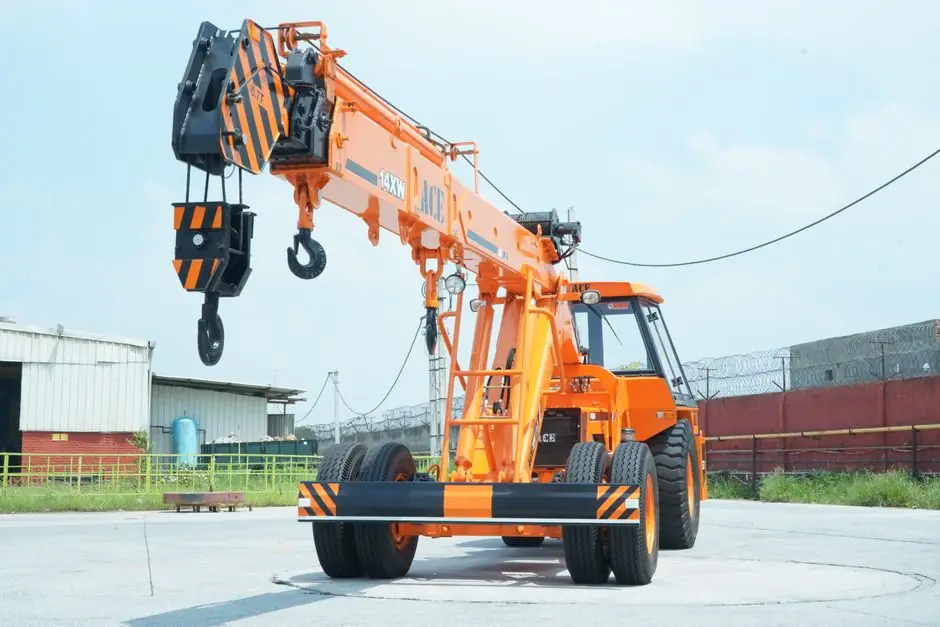
Truck-mounted cranes for pipeline work split into two camps: 8-18 t boom trucks with a 47-91 ft (14.3-27.7 m) boom and 25-120 ft (7.6-36.6 m) tip height for pipe stringing and valve handling, and 40-150 t telescopic hydraulic truck cranes with up to 311 ft (94.8 m) lifting height for main-line and compressor-station work [S2][S5].
The match between crane capacity and carrier chassis is the single most-engineered parameter, because chassis frame rating, axle load, and outrigger span dictate what the crane can actually lift at radius on a pipeline right-of-way. For light pipe-stringing cranes in the 8-10 t class, XCMG specifies a typical 5.8 m cargo box on a comparable carrier, while 10-12 t units generally need an 8.5 m box to balance the crane's rear-axle load [S6].
Capacity and Reach Bands by Pipeline Application
On 2025-10 published XCMG guidance, 8-ton truck-mounted cranes pair with a 5.8 m cargo box and 10-12 t units with an 8.5 m box, reflecting the lever-arm effect of a rear-mounted crane on a standard 6x4 chassis [S6]. For typical district-heating and gas-distribution spreads, Sany's product line caps at 10-32 t maximum lifting capacity, 25-33 m maximum boom length, and 25-45 m maximum lifting height, with the upper figure driven by a jib extension rather than the bare boom [S7].
For larger pipeline stations, crane-market data shows the common production models from Link-Belt, Terex, and Grove at 40-150 t capacity with lifting heights up to 311 ft (94.8 m); the Link-Belt HTC-8675 Series II uses a 127 ft (38.7 m) main boom plus a 38-64 ft (11.6-19.5 m) bifold jib, while the HTC-8690 extends to 140 ft (42.7 m) main boom and a 35-58 ft (10.7-17.7 m) offset jib with 39,500 lb (17,917 kg) of counterweight [S5]. On the smaller 10-18 t boom-truck class, the Elliott 1881TM hits 36,000 lb (16,329 kg) capacity, 81 ft (24.7 m) boom, and 91 ft (27.7 m) max tip height, whereas the 1047F is rated at 20,000 lb (9,072 kg) and 47 ft (14.3 m) boom with a 57 ft (17.4 m) tip [S2].
What Pipeline Cranes Are Designed to Handle
The published 2021-07-13 Sensobogen 16 t telescopic crane report documents a compact telescopic crane lifting 12 m long, 4 t pipe sections into a district-heating trench on a Fernwärme Ulm GmbH spread, which is the canonical use case that a 10-18 t boom truck was designed around [S4]. Sensobogen's "compact crane" framing aligns with how the Elliott 1047F's 47 ft (14.3 m) boom and 44 ft (13.4 m) digger radius are positioned for utility crews: the same chassis works as a loader, a digger, and a pipe setter without swinging a full lattice-boom crawler onto the ROW [S2][S4].
For heavier work, a 40-150 t telescopic truck crane is essentially a mobile version of a crawler boom; the Link-Belt HTC-8690's 140 ft (42.7 m) main boom with 35-58 ft (10.7-17.7 m) offset jib and Cummins ISX11.9 Tier 4F power pack is the typical configuration for compressor-station pipe racks and large-diameter mainline crossings [S5]. Engineers comparing a truck-mounted crane to a crawler for pipeline work should weight mobility and road-permit limits more than peak capacity, because the chassis is the actual limiter on a right-of-way.
Chassis Matching and Outrigger Geometry

The first engineering decision on a pipeline-spec truck crane is carrier-frame yield strength versus crane moment. XCMG's 2025-10 selection guide ties 8 t and 10-12 t cranes to 5.8 m and 8.5 m cargo-box lengths respectively, which is a proxy for keeping the combined center of gravity over the rear axles when the boom is stowed and the box is loaded with pipe [S6]. Stellar Industries' 7,621-14,530 hydraulic service-crane series is built on a similar logic, with model numbers that encode the rated capacity (e.g., 10621 = roughly 10,000 ft-lb class), and every model lists a hydraulic or mechanical brake system sized for the maximum crane load [S1].
Outrigger span, not crane capacity, is what actually governs lift-over-side on a sloped pipeline ditch. Boom-truck OEMs such as Elliott plate the subframe to the chassis rails specifically to resist the racking moment generated when one outrigger is on the trench lip and three are on the crown; the plated subframe is also why Elliott offers a lifetime structural warranty on those units [S2]. Engineers should treat chassis twist as a fatigue limit-state and verify the OEM's subframe plating spec rather than the headline tonnage.
Comparison: 10-18 t Boom Truck vs 40-90 t Telescopic Truck Crane
Across four decision criteria, the 10-18 t boom truck (Elliott 1881TM / 1047F / 1860F) and the 40-90 t telescopic hydraulic truck crane (Link-Belt HTC-8675 / HTC-8690) line up as follows. On capacity, boom trucks reach 20,000-36,000 lb (9,072-16,329 kg) versus 75-90 USt on the Link-Belt HTC class [S2][S5]. On boom length, boom trucks span 47-81 ft (14.3-24.7 m) and tip heights of 57-91 ft (17.4-27.7 m), while the larger telescopics run 127-140 ft (38.7-42.7 m) main booms and 94.8 m (311 ft) maximum lifting height across the 40-150 t class [S2][S5]. On mobility, the boom truck is a single-permit over-the-road unit with a 6x4 chassis and an 8.5 m cargo box, whereas a 75-90 t telescopic is a multi-axle heavy-haul load that typically needs a boom dolly and trailer air/electric hookups [S2][S5][S6]. On pipeline use case, boom trucks are specified for 12 m / 4 t pipe sections, valve setting, and small-diameter stringing [S4]; telescopic truck cranes are specified for compressor-station pipe racks, large-diameter mainline crossings, and equipment unloading at marshalling yards [S5].
Hydraulic, Control, and Safety Systems
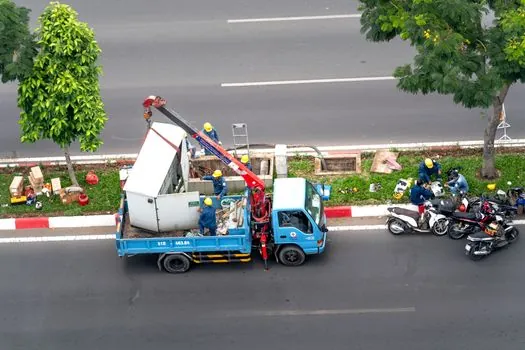
Two-speed hydraulic winches and proportional load-moment indicators (LMI / RCL) are now standard on pipeline-spec boom trucks; Elliott publishes a 14,000-20,000 ft-lb (18,983-27,119 Nm) two-speed auger option, a 40 in x 60 in rotating work platform, and a "Standup Ride-Around Control Console" on its 10-18 t class, with the tilting cab option making it usable as a personnel carrier at low angle [S2]. On the larger Link-Belt HTC-8690, the listed safety package is RCL light bar, boom float kit, block-and-ball, 2-speed winches, and auxiliary lifting sheave, paired with single-axis controls and a Cummins ISX11.9 Tier 4F after-cooled engine [S5].
Maxim Crane's 2024-07 guide on hydraulic truck cranes traces the architecture to the 1946 H-2 Hydrocrane (2-ton class) and the 1960s introduction of mobile hydraulic designs, which is the design lineage behind the proportional hydraulics used in today's pipeline units; the guide also documents how the 1980s all-terrain crane concept fed back into truck-crane carrier design [S3]. For a broader view of how truck-mounted cranes sit inside a contractor's wider fleet, the construction machinery and equipment reference page maps the surrounding categories, while pipeline pump selections matter on the same spread for hydrostatic-test and dewatering trains. Operators moving pipe sections with a truck-mounted boom should also be aware of the broader truck-mounted concrete pump class, which shares the same carrier-engineering rules even though the load profile is very different.
Limitations, Failure Modes, and Right-of-Way Constraints
The dominant failure mode on a pipeline-spread truck crane is not a structural boom failure but a chassis or outrigger overload caused by a soft shoulder or a miscalculated load chart. Boom-truck OEMs therefore plate the subframe and pair it with a full-length heavy-duty design specifically to disperse stress and maximize chassis life; misusing a 10 t boom truck over a ditch lip with the outriggers not fully deployed is the typical precursor to a tip-over, not a boom buckle [S2].
On the larger 40-150 t class, the practical limit is roadability: 140 ft (42.7 m) main booms, 39,500 lb (17,917 kg) counterweight, and a 90 USt rating push the carrier into heavy-haul permit territory and require a boom dolly for transport, so fleet planners should treat highway-bridge and axle-weight limits as hard constraints rather than secondary specs [S5]. For work near process piping, contractors should also cross-reference selection of adjacent equipment, including construction tools for line-up and dump truck classes for backfill and padding, because the same right-of-way often has to carry trench box, padding, and pipe-lift cycles through one corridor. Sensobogen's 16 t telescopic deployment on the Fernwärme Ulm district-heating job is a useful template: a compact telescopic on a tight urban spread, handling 12 m / 4 t pipe sections in a narrow corridor where a larger crawler would not have been permitted [S4].
Trackable signals for the next quarter include any new Tier 4F / Stage V repower announcements from Link-Belt, Grove, and Terex on the 75-90 t HTC-class, and any extension of Sany's published 10-32 t / 25-45 m envelope into a higher-capacity pipeline-truck variant, since the current Sany datasheet tops out well below the 40-150 t class covered by the legacy Western OEMs [S5][S7]. Engineers waiting on 2026-09-17 fleet decisions should also watch XCMG's carrier-box length guidance, because the 5.8 m / 8.5 m pairing for 8 t and 10-12 t units is the simplest proxy we have for rear-axle load balance on a 6x4 chassis [S6].
See also our earlier report, Best Function Generator for HVAC Bench Work: Specs, Pairings, and Pitfalls.