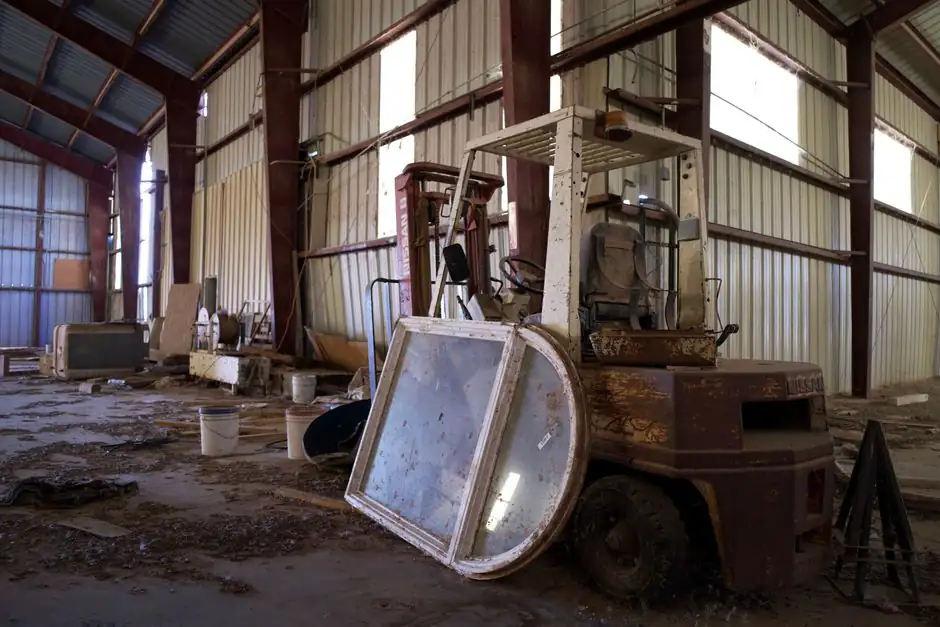
A 20–50 ton heavy duty forklift is a ground-based load mover built for repeatable pick-and-carry cycles, while a crawler crane is a tracked lift-and-place machine built for vertical lifts, long radius, and rigged placement at height [S2].
Forklifts raise loads from below on a vertical mast; cranes raise loads from above using a boom, hoist line, and rigging, which is the core mechanical distinction between the two equipment families [S1]. The choice between them is driven by lift height, radius, ground condition, cycle frequency, and rigging complexity, rather than by maximum tonnage alone.
Core Mechanical and Operational Difference
Forklifts handle loads on forks or attachments that travel up a vertical mast, with the load mass carried between the front wheels and the counterweight at the rear. A crawler crane mounts its load on a hook suspended from a boom, with line pull and radius controlled by the hoist, luffing, and slewing systems [S1].
That geometry change is the entire specification cascade that follows. A forklift's load moment is governed by mast height, fork reach, and load center, typically 600–1,200 mm forward of the fork face. A crawler crane's load moment is governed by boom length, boom angle, and radius, with charts that show capacity falling sharply as radius increases. Operators reading either chart must watch the same physical variable, tipping moment, but expressed against two very different geometries [S1][S2].
Capacity, Reach, and Lift-Height Bands
Heavy duty forklifts in the 20–50 ton class, such as the SOCMA HNF-250 (25 t) and HNF-450 / HNF-500 (45–50 t), are sized for short-radius, low-to-medium lift height placement onto dunnage, racks, or stands [S2]. The effective lift envelope is essentially ground-plus-mast-height, with no meaningful horizontal reach beyond the truck itself.
Crawler cranes are sized for sustained vertical lifting, long boom, and large radius, with the Kobelco CKS1350 cited as a representative heavy-lift crawler [S2]. Compared with a crawler crane, a forklift cannot reach over obstacles, set onto elevated platforms, or place loads at the boom-tip radii a crawler handles routinely. Where a job requires both ground shuffling and a single high placement, fleets typically run both machines in sequence rather than forcing one to do the other's task.
Ground Conditions and Site Mobility
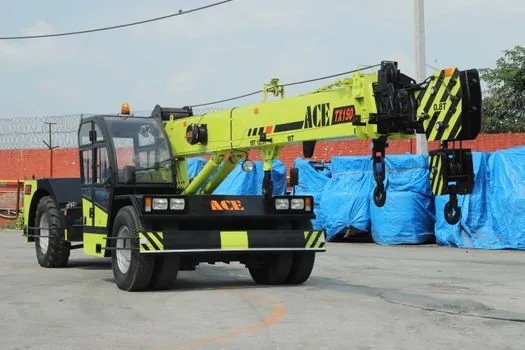
Crawler cranes use continuous steel tracks that spread the machine's weight over a large ground footprint, allowing them to operate on soft, uneven, or unprepared ground where a wheeled machine would sink or tip [S3][S6]. Their mobility between work points is slow, and inter-site transport requires disassembly, loaded trailers, and a skilled rigging crew to re-erect at the next location [S4].
Forklifts, including standard and rough terrain forklift variants, need a prepared, relatively flat, and hard surface to travel loaded. A 25–50 t heavy forklift is fast in a yard, but it cannot follow a crawler across mud, sand, or freshly backfilled trench lines [S2][S5]. Site mobility is therefore the second hard gate: if the only route to the load is soft ground, the forklift is the wrong tool, regardless of how convenient it would be at the destination.
Cycle Time, Crew Size, and Operating Cost Profile
A heavy duty forklift typically runs with one operator and no rigging crew, because the load sits on the forks and the truck travels with it. A crawler crane needs an operator, a rigger, a signaler, and usually a lift-plan engineer for any non-trivial pick, with cycle time dominated by boom repositioning, slinging, and re-slinging rather than by driving [S2][S3].
On a yard full of identical loads moving the same short distance, the forklift's lower crew count and faster cycle dominate the unit-cost calculation. On a structural-steel or vessel-set job, the crane's higher crew and slower cycle are offset by the fact that a forklift cannot physically do the work. Comparing mobile crane classes against forklifts on the same chart rarely makes sense, because the two machines solve different nodes of the same material-handling flow.
Decision Matrix: Forklift vs Crawler Crane by Criterion
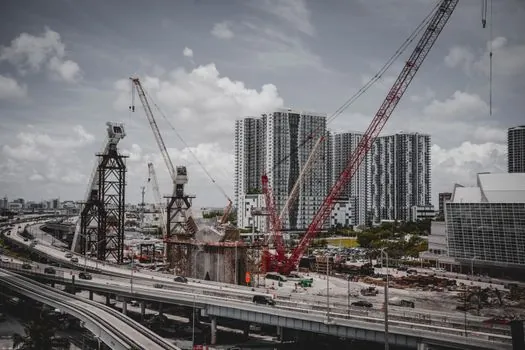
The four criteria that actually drive equipment selection are lift height, radius, ground condition, and cycle pattern. On lift height and radius, the crawler crane wins outright, since a forklift cannot lift over obstacles or place at boom-tip radii [S1][S2]. On ground condition, the crawler crane again wins on soft, uneven, or unprepared surfaces because of its track footprint, while the forklift wins only on hard, prepared, yard surfaces [S3][S6].
On cycle pattern, the forklift wins for high-count, low-elevation, pick-and-carry work, while the crawler crane wins for low-count, long-duration, rigged lifts that need boom, hoist, and slew control [S2][S3]. Crew and rigging cost per hour favor the forklift, but rigging and lift-planning cost per critical pick favor the crane, because the crane is built for the lift envelope that justifies that overhead.
Use-Case Scenarios Where Each Machine Wins
Pick the heavy duty forklift (20–50 t) for ports and breakbulk yards moving steel coils, machinery skids, and large pallets on prepared ground; for precast and concrete yards shuttling blocks, barriers, and heavy pallets on fixed routes; for industrial plants moving spools and fabricated steel between bays; and for mega-project laydown areas shuttling heavy loads from delivery points to staging zones with minimal setup [S2].
Pick the crawler crane for structural steel erection where columns, trusses, and beams must be set at height or over an obstruction; for plant construction setting vessels, modules, and heavy equipment on foundations inside constrained footprints; for wind, power, oil and gas, and infrastructure work where reach and lift planning dominate; and for remote or rough sites where the track undercarriage gives the stability and ground pressure profile that wheeled machines cannot match [S2][S3][S6].
Limits, Failure Modes, and Common Spec Mistakes
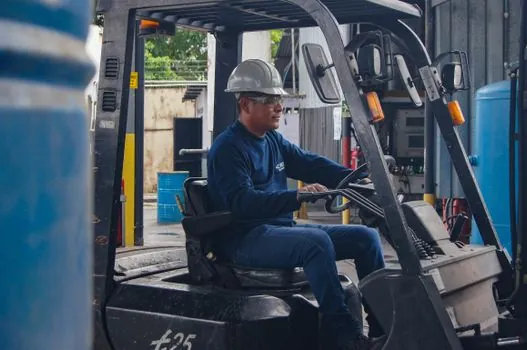
The most common spec mistake is sizing a forklift by nameplate capacity without checking the load center, mast height, and tire configuration at the actual load. A 25 t forklift at a 1,200 mm load center and full lift height is not the same machine as the same nameplate at a 600 mm load center and low elevation, and charts must be read at the real operating point [S2].
The most common crawler crane mistake is reading the maximum-capacity row of the load chart and forgetting that capacity collapses as radius increases and as the boom is extended. Another recurring error is planning an all-terrain crane or wheeled mobile crane onto ground that cannot carry the outrigger pressures, then swapping in a tracked crawler specifically to recover ground-bearing margin, not raw capacity [S3][S4]. On the forklift side, the parallel failure is sending a standard forklift onto a slope, soft subgrade, or rough terrain that should have been a rough-terrain or tracked machine in the first place [S5].
Adjacent Lifting Tools and Where They Fit
Mini crawler cranes, in the sub-10 t class, sit between forklifts and full-size crawler cranes and win in narrow access points, indoor sites, and precision placements such as glass or mechanical-duct installation where a full forklift cannot turn and a full crawler crane cannot enter [S5]. Gantry systems and crane scale-instrumented picks cover the very heavy and very precise end of the same flow, where rigging control and load verification dominate the engineering effort rather than raw mobility.
For wider plant-flow decisions that pair skid-steer-style carriers with paving and milling equipment on the same laydown, the Skid Steer Loader vs Asphalt Paver: Carrier vs Dedicated Paver Spec Cut comparison covers the carrier side, while the Cold Milling Machine vs Asphalt Paver: Spec, Depth, and Role Map covers the dedicated paving side, both of which run into the same yard-logistics question that drives forklift-vs-crane selection.
Selection rule of thumb from the field: if the load is on or near ground level and you will move it many times, specify a heavy duty forklift; if the load must go up and over with rigging and reach, specify a crawler crane; if access is the binding constraint on a smaller pick, look at a mini crawler before either of the above [S2][S5]. Trackable signals to watch in late 2026 are new 20–50 t forklift launches with improved load-center charts and telematics, and crawler crane model updates that push setup time down on the under-100 t class.