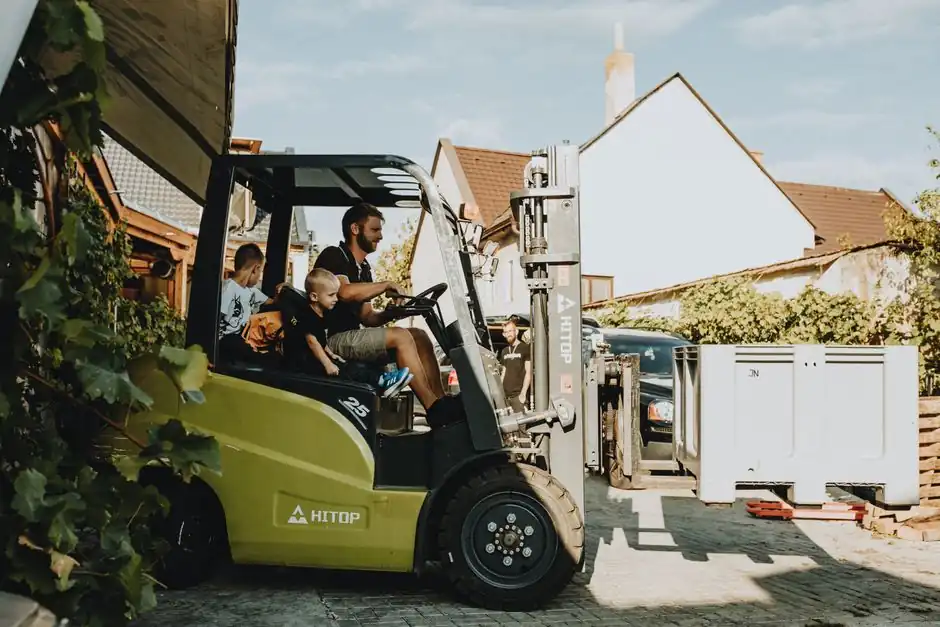
A counterbalanced lift truck raises a load by combining a hydraulic cylinder with a chain-and-fulcrum mast, while a rear-mounted cast-iron counterweight offsets the moment about the front wheels [S1][S2].
Operator demand on the lift valve sends pressurized fluid to the lift cylinder, the piston extends, the mast climbs, and roller chains pull the carriage and forks upward in proportion to the mast stages [S2][S3].
Hydraulic Lift Circuit: Pump, Cylinder, and Control Valve
The hydraulic circuit contains six functional elements: a pump, lift cylinder(s), piston, control valve, relief line, and return line, with fluid choice limited to water-based, petroleum-based, or synthetic hydraulic fluids matched to the duty cycle [S2]. When the operator pulls the lift handle, the pump forces fluid into the cylinder bore; pressure on the piston head generates an upward force, the mast rises, and the system reaches an equilibrium where hydraulic force equals load weight plus cylinder friction [S2]. Releasing the handle vents pressure through the return line, the piston retracts, and the load descends under controlled gravity bleed rather than free-fall [S1][S2].
A single-stage simplex mast uses one lift cylinder, while multi-stage masts stack a free-lift cylinder beneath the main cylinder so the carriage can elevate without increasing the collapsed mast height, a critical spec for low-ceiling warehouses and containers [S2].
Mast, Carriage, Chains, and the Fulcrum Gear
The mast is a vertical assembly of interlocking steel rails that constrain the carriage to pure vertical motion; the carriage is the fork-mounting plate that rides on the rails and is connected to the lift cylinder through roller chains passing over a fulcrum gear at the mast crown [S2]. As the piston extends, it pushes the inner mast up; the chains wrap over the top sheave and pull the carriage upward at a mechanical advantage that allows a 100 mm piston stroke to produce a 200 mm or greater carriage lift on duplex and triplex masts [S2].
Standard simplex masts run a two-chain assembly; higher-capacity lifts add a third load-chain or upgrade to a four-rail wide mast for residual capacity above 5,000 kg, where chain stretch and side loading dominate the failure modes [S2].
Counterweight, Truck Frame, and the Stability Triangle
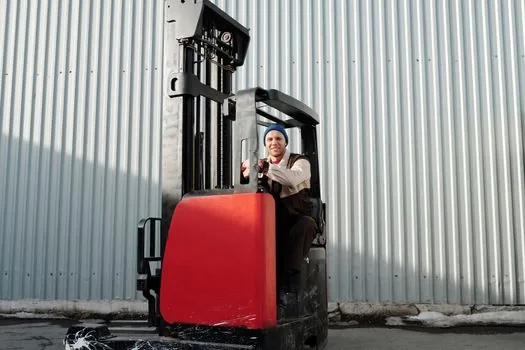
The truck frame anchors the front drive axle, the steer axle, the mast, and the counterweight, which is a heavy cast-iron block sized so the combined vehicle plus load sits inside the stability triangle defined by the two front wheels and the centre of the pivot steer axle [S1]. For a typical 2,500 kg ICE forklift, the counterweight is on the order of 3,000–4,000 kg; the exact figure is stamped on the nameplate and printed in the truck's rated-capacity chart, which must be consulted whenever the load centre or mast height changes [S1][S2].
Load capacity falls as the load centre moves forward or the mast is elevated and tilted, because the tipping moment grows while the restoring moment from the counterweight does not, a behaviour the rated-capacity chart captures in a family of derate curves [S2].
Power Source Comparison: Lead-Acid, ICE, and Fuel Cell
Three energy paths coexist in the market, and each shapes the duty cycle, refuelling model, and ventilation requirement. Lead-acid batteries remain the dominant electric option on indoor trucks, with 24 V, 36 V, and 48 V packs sized to 200–1,200 Ah depending on truck class; lithium-ion is now displacing lead-acid on new Class I and Class III orders but is not yet the default spec [S1][S2].
Internal-combustion forklifts use LPG, diesel, or CNG engines for outdoor yards, where one tank of LPG typically delivers 6–8 hours of intermittent operation before swap-out [S1]. Hydrogen fuel-cell units replace the battery pack on selected Class I electric trucks, giving diesel-like refuel times with electric-only exhaust, an arrangement that maps to cold-storage and food-grade warehouses where ICE exhaust is prohibited, a duty profile that also drives cold-chain equipment demand for zero-emission lift trucks [S1].
Forklift Class Matrix and Where Each Type Fits
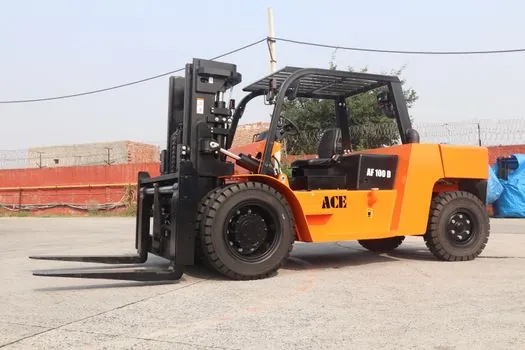
Seven common configurations cover the bulk of industrial use: counterbalance (Class I electric / Class IV/V ICE), reach truck, side loader, pallet jack / stacker, rough-terrain telehandler, heavy-duty high-capacity, and order picker [S1]. Rough-terrain forklifts run pneumatic tyres, open-frame cabins, and four-wheel drive for unpaved sites, a configuration detailed in the rough terrain forklift reference. Reach trucks add a pantograph extending mechanism for narrow-aisle racking above 6 m, while side loaders handle long goods such as timber, pipe, and plate by travelling perpendicular to the load [S1].
For a process-engineer buyer, the decision reduces to four criteria: power source (indoor vs outdoor vs cold), capacity (rated load at a stated load centre), mast stage count (simplex, duplex, triplex), and tyre type (cushion for smooth indoor floors, pneumatic for yard work) [S1][S2]. A forklift selection that fails to match any of these four to the duty will either under-utilise the truck or burn the residual capacity budget on derate losses.
Controls, Load Handling, and Operator-Side Limits
Three manual interfaces run the lift: the lift lever (raise/lower), the tilt lever (forward/back mast angle, typically limited to 5–6° forward and 10–12° back for load retention), and the sideshift lever where fitted, all feeding hydraulic directional control valves that meter flow proportional to handle travel [S1][S2]. Travel, lift, and tilt are interlocked by the operator-presence switch; no hydraulic function engages unless the seat switch is closed, and the parking brake is a spring-applied, hydraulically released calliper on the drive axle [S2].
Operator-side limits are not optional: the load must be entered square against the back of the forks, the fork spacing must match the pallet stringer or load footprint, and the mast must be tilted back before transit to clamp the load against the carriage face, a sequence the forklift operator certification and the truck's nameplate both enforce [S1][S2].
Track the next 12 months for: (a) wider lithium-ion retrofits on Class I sit-down counterbalance trucks, and (b) more hydrogen fuel-cell lift-truck orders in cold-storage and food-grade fleets, both of which are already visible in OEM order intake disclosures for FY2026 [S1][S2].
Spec-level background on the components involved: pressure transmitter.