
Single girder EOT (electric overhead traveling) cranes serving road and bridge construction yards commonly cover 1–20 t capacity, 5–35 m span, and 3–30 m lift height, with VFD-controlled hoist, cross-travel, and long-travel drives [S3][S5].
Top-running units suit heavy pre-cast handling of girders, rebar cages, and form travelers, while underhung configurations are favored in low-clearance workshops where ceiling height limits headroom, per manufacturer guidance [S1][S8].
Capacity, Span, and Lift-Height Envelope
Single girder crane capacity commonly sits between 1 t and 20 t, with specialist lines reaching 28–30 t and pre-engineered modular kits capped at 15 t [S1][S3][S4][S6]. Road construction applications segment into three load bands: 2–5 t for rebar bundles and formwork panels, 10 t for pre-cast beam lifting, and 15–20 t for segmental box girders and pier-head form carriers.
Span ranges from 5 m to 35 m for stock EOT designs, with extended lines reaching 50 m and 65 ft (~19.8 m) for both monobox and plate-girder sections [S3][S5][S1]. Lift height of 3–20 m covers typical pre-cast yards, while dedicated process cranes push to 30–50 m for casting-bay stockpiles [S4][S5]. End-beam box sections on single-girder units measure 130–150 mm half-width, plus a 100 mm minimum safety gap to the runway centerline per Voitto Crane layout guidance published 2026-07-10 [S7].
Top-Running vs Underhung Configuration
Top-running single girder cranes carry the bridge on top of runway rails and accept up to 35 t standard capacity with 90 ft (~27.4 m) maximum span, making them the default for outdoor casting yards and heavy pre-cast bays [S2]. Underhung (under-running) designs suspend the girder beneath the runway, freeing vertical space and reducing column reaction loads, which suits retrofitted workshops and low-headroom rebar fabrication halls [S8].
For road construction sites, the top-running configuration is the usual specifier choice for 10 t+ pre-cast handling because the runway can be supported on free-standing columns independent of the building frame. The underhung option is typically selected where the project must integrate with an existing pre-engineered building and the runway beams can be tied to roof purlins, per Street Crane and O'Brien engineering notes [S6][S8].
Drive, Control, and Duty-Class Selection
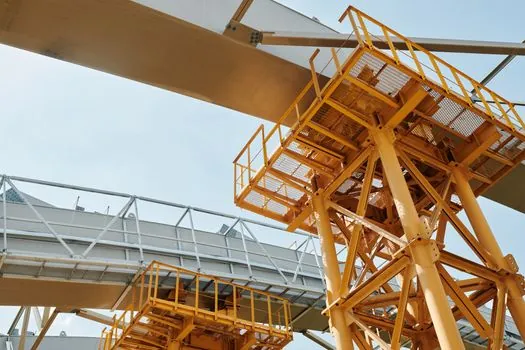
Modern single girder EOT cranes are specified with VFD (variable frequency drive) control across hoist, cross-travel, and long-travel motions, with power fed via shrouded DSL (down-shop lead) or festoon systems [S5]. Control is delivered through pendant, radio remote, or combined-mode operation, with dual-speed and VFD lift options selected when load positioning accuracy matters for segmental placement.
Duty class is defined by CMAA 74 (Classes A–F) for North American builds, mapping to 2–5 lifts/hr light service up to continuous severe service, while Indian-market units reference IS 3177 and IS 807 design codes [S1][S2][S5]. Road construction cranes are usually specified CMAA Class C or D, equivalent to 5–20 lifts/hr at 50% rated capacity, which covers rebar cycle, form striking, and pre-cast loading within a single shift. For comparison against single girder crane reference data, Class C/D duty and 10 t capacity sit at the median of road-project specifications.
Structural Materials and Girder Types
Bridge girders are built from standard I-beam, wide-flange beam, monobox, plate-girder, or patented-track sections, with the choice driven by span, headroom, and trolley-weight constraints [S1][S2]. I-beam and wide-flange girders are economical for spans below 20 m, monobox sections handle 20–35 m with controlled deflection, and plate-girder (box) designs are specified for the 35–50 m extended-span range used in large casting yards [S5].
Material selection typically follows ASTM A36 or A572 for North American builds and IS 2062 for Indian-market EOT cranes, with deflection limited to span/500 under full load for indoor service per general engineering practice referenced in manufacturer catalogs [S1][S5]. Pre-engineered modular kits drawing on these material and section choices are also covered in the construction machinery and equipment reference set, which includes road-building handling gear alongside earthmoving plant.
Standards, Safety Devices, and Compliance
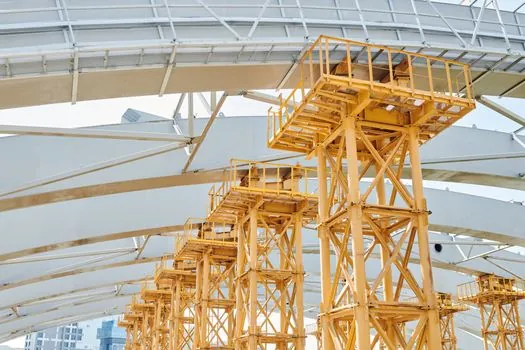
North American single girder cranes are engineered to CMAA Specification 74 and built to meet ANSI, NEC, and OSHA safety standards, with the electrical package conforming to general industrial crane-practice rules [S1]. Indian-market units carry IS 3177 (code of practice for electric overhead traveling cranes) and IS 807 (code of practice for design of cranes), with FEM/ISO classifications applied to the hoisting machinery [S5].
Mandatory safety devices on a road-construction-spec single girder crane include upper and lower hoist limit switches, trolley and bridge travel limit switches, overload limiters, and emergency-stop buttons on both pendant and radio-remote stations [S3]. Hazardous-environment variants add spark-resistant features for explosive atmospheres. Buyers comparing road-site lifts to other heavy handlers should also review crawler crane duty data when pre-cast segments exceed 30 t, because single girder EOT designs lose cost advantage above that threshold [S3].
Selection Criteria for Road Construction Yards
Five criteria dominate single girder crane selection on road and bridge projects: (1) maximum single-piece lift weight including rigging, (2) bay span between runway columns, (3) lift height required for stack-and-load operations, (4) duty class matching shift cycle and lift frequency, and (5) available headroom for either top-running or underhung configuration. [S3]
For a typical 10 t, 25 m span, 12 m lift pre-cast yard the spec is a top-running single girder EOT, CMAA Class C, VFD hoist with dual-speed lifting, pendant plus radio remote, monobox girder, and IS 3177 / IS 807 or CMAA 74 compliance per market. Below 5 t, a low-headroom single girder design with 1–10 m lift is generally specified, with the cost band sitting $12,000–$45,000 versus $10,000–$50,000 for standard EOT units [S4]. Buyers who also handle bulk rebar and formwork in the same yard frequently cross-spec the same crane against a crane scale reference for load verification, since overload protection logic is a typical audit finding on road-site lifts.
Trackable signals to watch through Q4 2026: (a) extended-span monobox launches past the 50 m mark on mega-project casting yards, and (b) wider adoption of VFD-only drive packages replacing dual-speed contactor stacks on Class C/D units [S5]. Specifiers should pin the duty class, code basis, and configuration in the inquiry RFQ before pricing, because the same capacity and span can be quoted across a 2x cost band depending on those three fields alone [S4].
Background reading: Static Pressure Molding Machine Specs for Energy Equipment Castings.