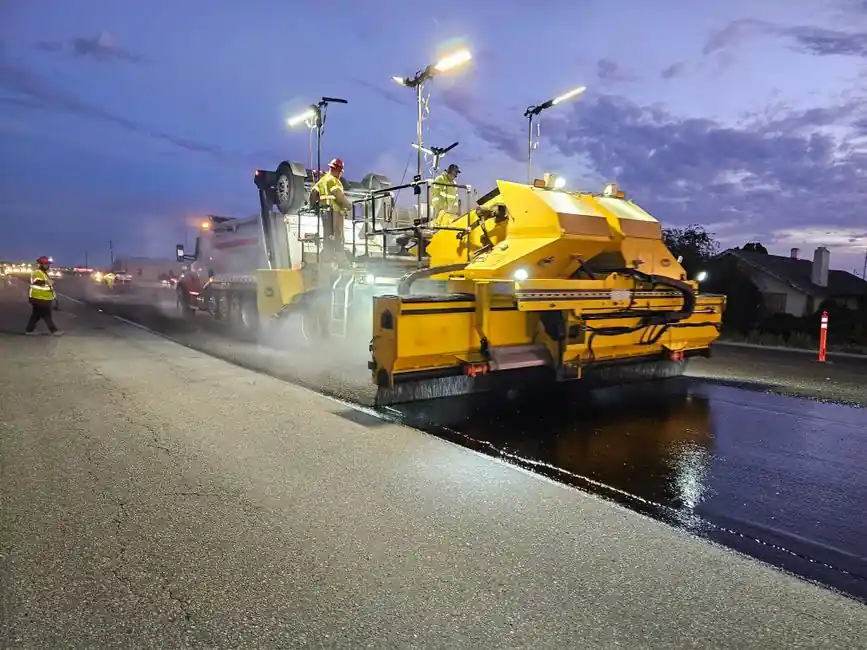
Asphalt paver breakdowns fall into two distinct categories, machine-side operational faults and pavement-side distress modes, and both trace back to a small set of controllable inputs: pre-operation checks, screed calibration, paver speed, hopper balance, and mat temperature [S3].
Field data published 2025-04-25 lists 10 recurring paver mistakes, while pavement-condition guides identify alligator, longitudinal, transverse, edge, and slippage cracking as the dominant surface failure types, each tied to a specific process or mix-design error [S2][S3]. For background on the equipment class itself, see the asphalt paver reference entry.
Machine-Side Failure Modes: Screed, Speed, Hopper, and Temperature
Improper screed setup is the single most expensive pre-pave error: an uncalibrated screed produces inconsistent layer thickness, irregular edge shape, and downstream compaction problems that cannot be fixed after the mat cools [S3]. The preventive protocol is concrete, calibrate the screed position before each shift, confirm extension alignment, set the crown to the design profile, inspect the screed plate for wear, and run a test section before full production [S3].
Inconsistent paving speed is the second-highest contributor to surface flaws (waves, cracks, depressions) and shortened pavement life; the corrective action is a constant travel pace backed by scheduled material delivery to eliminate start-stop cycles, with automated speed controllers and feeders recommended to reduce operator variability [S3]. Hopper discipline is the third leg: overloading spills aggregate and triggers segregation, while starving the hopper starves the auger chamber and produces starved-auger streaks; maintaining a consistent material head in front of the screed is the spec target [S3]. Temperature management is the fourth: stopping the paver allows the mat under the screed to cool below the working window, which is why continuous flow at planned speed is non-negotiable, a point reinforced in the broader construction machinery and equipment operating envelope. Related field practice is covered in asphalt paver testing and commissioning: a field procedure.
Pavement-Side Distresses: Cracking Patterns and Root Causes
Alligator (fatigue) cracking is a structural failure pattern: an interconnected network resembling alligator scales, caused by repeated traffic loads that exceed the structural capacity of the pavement layers, weak surface course, improperly compacted base or subgrade, an under-thickness base, or poor drainage [S2]. Crack seal will not fix it; full-depth removal and replacement of the affected area is the only true repair, with sealcoating used only as a temporary moisture barrier [S2].
Longitudinal cracking runs parallel to traffic and is driven by fatigue, excessive loads, reflective cracking from an underlying crack, or poor joint construction where two paver passes meet (cold joints are typically the least-dense zone in the mat) [S2]. Transverse cracking runs perpendicular and is tied to reflective cracking, heavy loads, daily thermal cycling, or improper paver operation; cracks between 1/4 in. and 1 in. wide should be sealed early to slow water intrusion, with milling and overlay reserved for advanced cases [S2]. Edge cracking appears along the inside edge where poor drainage and heavy vegetation erode the base, and tree roots lift and crack the surface; the only permanent fix is full-depth removal and replacement after drainage and vegetation are corrected [S2]. Slippage cracking shows up as crescent-shaped stretch-marks and is an installation failure where the tack coat was omitted, leaving the surface layer unbonded to the underlayer [S2].
Comparison of the Five Dominant Failure Modes
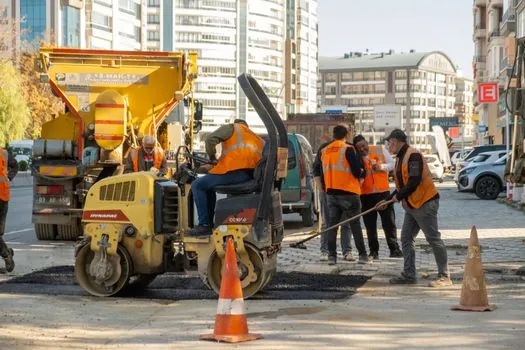
Choosing the right corrective action depends on the failure pattern, traffic regime, and base condition. The matrix below aligns the five primary asphalt distresses against root cause, visual signature, and the repair depth they require [S2]:
Alligator cracking versus longitudinal cracking: both can be load-driven, but alligator is a structural-capacity failure requiring full-depth patch, while longitudinal is often joint or reflective and can be sealed at 1/4-1 in. width. Edge cracking versus slippage cracking: edge cracking is a base and drainage problem (fix the water, then full-depth replace), while slippage is a bond failure (tack coat omission, fix by removing the unbonded layer). Transverse cracking sits between them, often thermal or reflective, sealable early but requiring mill-and-overlay if it propagates [S2].
Selection rule of thumb: if the distress pattern is interconnected (alligator) or crescent-shaped (slippage), plan for removal; if it is a single linear crack under 1 in. wide, seal and monitor; if it tracks the pavement edge, fix drainage first, then patch [S2].
Pre-Operation Inspection: The 10-Point Daily Check
Skipping the daily walkaround is the cheapest way to turn a serviceable paver into a downtime event, with hydraulic leaks, worn conveyor belts, and low fluid levels the most common ignition sources [S3]. The published 10-point protocol covers fluid levels (fuel, coolant, engine oil, brake fluid), conveyor and hydraulic hose condition, engine filter and battery state, tamper bar and screed plate wear, control and gauge function, backup warnings, and work lights, with any finding documented and cleared before the machine is released to the crew [S3].
Two inspection items carry the most failure-mode weight: the screed plate (its flatness directly controls mat smoothness and edge shape) and the tamper bar (its wear controls initial compaction density before the rollers arrive) [S3]. For the consumables and wear-item side of this checklist, the asphalt paver spare parts and consumables guide maps part numbers and replacement intervals. Routine maintenance is the tenth published mistake to avoid, the other nine being pre-operation checks, screed setup, paving speed, hopper loading, segregation, temperature, on-site communication, head-of-material, and compaction timing [S3].
Process Controls: Head of Material, Compaction Timing, Communication

Head of material in front of the screed is a controlled variable, not an artifact: too little produces a torn, segregated mat; too much causes the screed to ride up and over-compact the leading edge, creating a hump that rollers cannot erase [S3]. The operational target is a consistent, slightly convex auger chamber that keeps the screed floating on a uniform mat without starving or flooding.
Compaction timing is set by mat temperature, not by the clock: rollers must finish breakdown, intermediate, and finish passes while the mat is still in its working window, which is why any paver stoppage cascades directly into density failures and subsequent fatigue cracking [S2][S3]. On-site communication, truck scheduling, paver speed, and roller cadence are coupled, and a single uncoordinated link in that chain (a late truck, a slow roller, a paused paver) shows up in the mat as segregation, tender zones, or thermal cold joints [S3]. These process controls are the reason pavement-side distresses are largely predictable from machine-side telemetry, a pattern that holds across the wider construction machinery and equipment operating envelope.
Prevention Summary: Spec-Anchored, Not Adjective-Anchored
Across both the machine-side and pavement-side literature, the prevention message converges on the same five inputs: correct load assumptions, a competent and well-drained base, a calibrated screed, constant paver speed with matched delivery, and disciplined temperature and compaction timing [S1][S2][S3]. Failures are rarely caused by the paver unit alone, they are system-level outcomes of subgrade, base, drainage, edge restraint, and operating practice [S1].
Trackable signals to watch on the next shift: (1) screed plate flatness verified before each pour, with any deviation logged; (2) paving speed held within the planned range and recorded by the automated controller; (3) joint construction at every paver pass meeting density spec, since cold joints are the least-dense zone in the mat and the most common longitudinal-cracking seed [S2][S3].
The underlying component specifications are covered under lamps and light fittings.