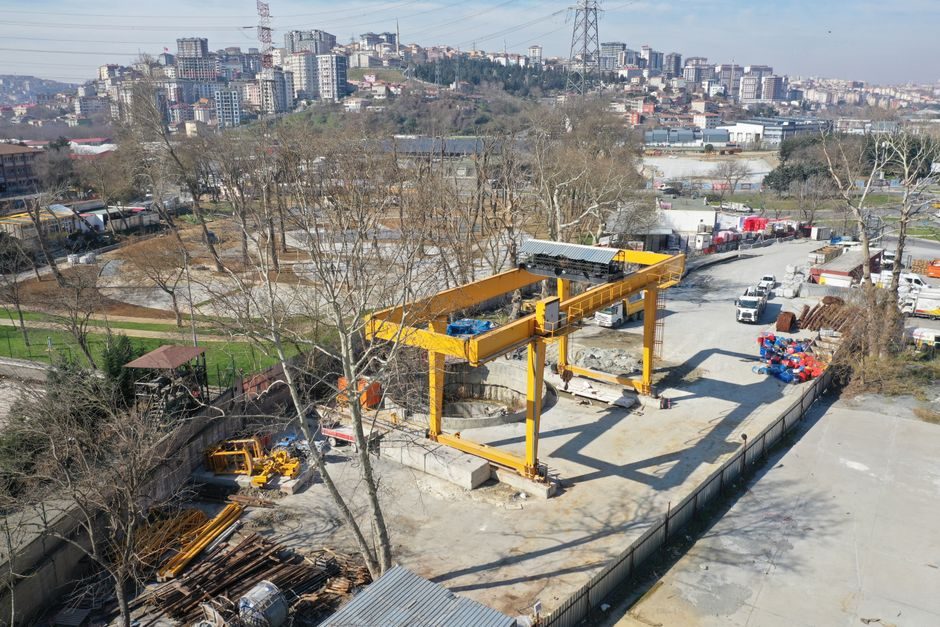
A gantry crane is a bridge-style hoist carried on legs that run on ground-level rails (or rubber tyres) rather than being suspended from an overhead runway — the practical differentiator from a bridge crane is that the crane itself is floor-supported, so no building steel is required [S2][S3].
Across 2026 OEM catalogues, four structural families dominate: full gantry (both legs on rails), semi-gantry (one leg on a rail, one side running on an elevated building runway), truss-girder (open-lattice main beam, light self-weight), and box-girder (welded plate box, heavy-duty). Capacities in published 2026 spec sheets range from 5 t workshop units to 500 t shipyard / transformer-handling machines, with spans of roughly 5–50 m [S2][S3].
Full Gantry, Semi-Gantry and Truss Variants
Full gantry cranes carry both the main girder and the trolley on two A-frame or box-leg portals that ride on rails embedded in the ground; this is the default outdoor choice for stockyards, container terminals, and rail-freight loading because the rails can be laid on grade without building modifications [S2][S3].
Semi-gantry cranes are specified when one side of the bay already has a building-mounted runway rail — only the outer leg runs on a ground rail, freeing floor space on the building side. Truss-girder construction (open lattice) drops self-weight by roughly 20–30% versus an equivalent box girder, which directly extends span capability and reduces wheel loads on the rails [S2]. A 2026 truss-girder MGh series published by a Zhengzhou OEM lists 35 t at 23 m span with 10 m above-ground / 40 m below-ground hook reach, and 120 t at 35 m span with 16.5 m above-ground / 13.5 m below-ground reach [S2].
Box-Girder, Single-Beam vs Double-Beam
Box-girder gantries are welded steel plate boxes, used where dynamic loads, heavy duty cycles, or high travel speeds make an open truss too flexible. Single-beam (single-girder) designs pair one main girder with an under-running or top-running hoist — lighter, cheaper, typically capped at about 20–32 t. Double-beam designs carry the hoist on a trolley riding on top of two main girders, which is the configuration for higher capacities and for cranes fitted with auxiliary hooks or magnetic spreader beams [S2].
Published 2026 data point: a double-girder overhead bridge crane in the same product family as the gantry line lists main-hook ratings of 16 t, 20 t, 32 t, and 50 t across model codes QD16/3.2, QD20/5, QD32/5 and QD50/10, while the corresponding single-girder line tops out at 20 t (LD5 / LD10 / LD16 / LD20) — the same single/double split applies to gantry product lines [S2]. For buyers comparing a gantry crane against a mobile crane for the same lift, the deciding factor is repeated-cycle duty at one site vs occasional relocation.
Mobility: Rail-Mounted, Rubber-Tyred and Portable

Rail-mounted gantries are the heavy-haul workhorses — 2026 OEM sheets show travel speeds of 20 m/min on standard units and 0–15 m/min on the 120 t class, with trolley traverse at 0–8 m/min and hoist hoist-up at 2.5 m/min on the larger machine [S2]. Rubber-tyred (RTG) gantries add a diesel or battery drive to the same A-frame, so the crane can straddle a stack and reposition without rails — the standard format for container yards.
Portable / aluminium gantries (1–5 t, 2–6 m span, adjustable height) are a different product class — sold as welded-aluminium A-frames on swivel casters for workshop and HVAC install work. Power input on the larger industrial gantries is around 110–112 kW for the main hoist and traverse drives [S2]. For yard-logistics applications, the stacker crane is the narrower-aisle automated alternative worth comparing on throughput per bay.
Duty Classification, Power and Drive Specs
Published 2026 gantry data sheets quote a 112 kW main power feed for a 35 t truss-girder machine and 110 kW for a 120 t unit — total installed power is therefore not a clean proxy for capacity, because heavier lifts run slower (2.5 m/min hoist on the 120 t vs 10 m/min on the 35 t) [S2]. Cantilever extension is the other differentiator: the 35 t model lists a 3 m cantilever off the main girder for off-rail hook reach, while the 120 t unit is straight-span only with no cantilever — a direct trade-off between versatility and structural load.
Modern 2026 gantries use VFD (variable-frequency drive) hoists and travels, which is why travel speed is quoted as a 0–15 m/min or 0–8 m/min range instead of a single fixed value [S2]. OEM documentation for Guangdong Nangui's 2026 gantry and semi-gantry lines confirms the same architecture (VFD hoist, top-running trolley, single- and double-beam options) for the transformer and aluminium-profile handling segments [S3]. Where a buyer is comparing a gantry against a tower crane on a long-term site, the gantry wins on repeat-cycle yard duty and the tower crane wins on vertical reach over a fixed radius.
Application Segments: Container Yards, Transformer Shops, Bridge Sites
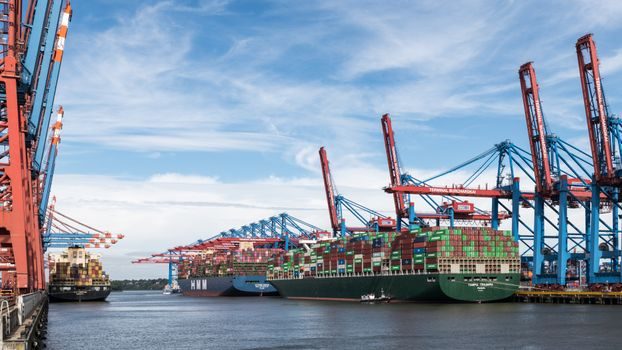
Three end-use segments dominate 2026 gantry orders. Container terminals run RTG / RMG (rubber-tyred / rail-mounted gantry) units with telescopic or fixed-spreader hoists at 30–65 t under-spreader, span 20–50 m, stack height 4–6 high. Heavy-industrial / transformer shops run box-girder double-beam gantries at 50–500 t, span 15–35 m, with a 3 m cantilever option for off-centre loading [S2][S3].
Bridge-construction sites use walking-type bridge-girder launchers — a related gantry variant — to lift and position precast concrete girders during pier-by-pier deck assembly. The same 2026 product family published by the same Chinese OEM groups these launchers with the gantry and overhead-crane lines under a single "construction cranes" category [S2]. For smaller rigging and HVAC / mechanical-install work, the portable aluminium gantry at 1–5 t fills a niche the industrial gantry cannot serve economically [S2].
Selection Criteria and Common Failure Modes
Selection boils down to five spec inputs: rated capacity, span, lift height above and below ground, duty cycle (FEM / ISO classification), and whether the site can lay rails. A common mis-spec is choosing a single-beam gantry above 20 t — the trolley and hoist geometry on single-girder designs limits hook approach and wheel-load distribution, and 2026 OEM line-ups push buyers to double-beam above that threshold [S2].
Other typical 2026 mis-specs: under-rated rail-beam foundations for outdoor gantries (soil bearing pressure vs point load from the legs), missing anti-collision buffers between adjacent cranes on a shared rail, and undersized power feeders for VFD regeneration. For capacity verification, buyers should request the OEM load-test certificate (typically 1.25 × rated capacity, dynamic 1.1 ×) and the FEM / ISO duty-class designation matching the actual number of working cycles per shift, not the marketing "heavy duty" label [S2]. Buyers cross-shopping a crawler crane for the same pick should run the comparison on mobility-vs-cycle-frequency, not headline capacity.
Trackable signals for the next buying cycle: (1) more VFD regen and lithium-ion battery power packs on rubber-tyred yard gantries, replacing diesel-hydraulic drives for emissions compliance at port and steel-yard sites; (2) higher standard lift heights above 20 m for transformer and wind-turbine component handling, with published 2026 spans already at 35 m for 120 t class [S2][S3]. The cross-listing of a gantry and tower crane in the same 2026 OEM catalogue is a reminder that the two machines are complementary, not substitutes, on large construction sites.
See also our earlier report, Tower Crane Trade-Offs: 2026 Site-Spec Reference.