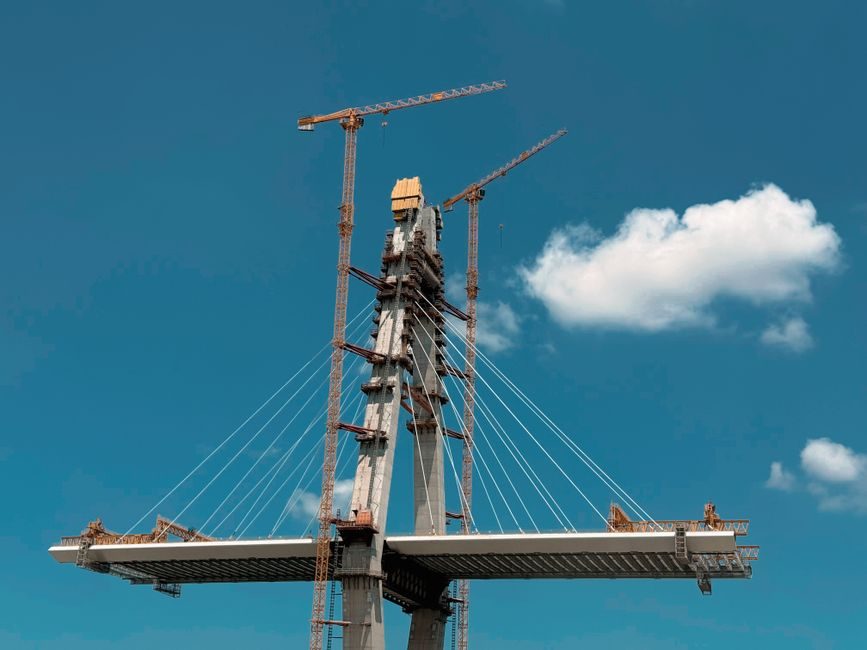
Tower cranes fall into four primary structural families — hammerhead, luffing-jib, self-erecting, and flat-top/topless — with safe design and operation governed by ASME B30.3-2012 (revision of B30.3-2009) [S4]. The capacity envelope stretches from 2.5 t mini units sold for civil projects [S7] up to the 600 t XCMG XGT15000-600S topless platform [S7], meaning the same product category serves a single-family home builder and a supertall-structure contractor with completely different machines.
Selection is driven by four decision variables: site footprint, free-standing or tied height, working radius, and assembly method. Common ISO/CE certification and the QTZ designation prefix on Chinese-built models — QTZ40(4208), QTZ63(5011), QTZ100(6013) — encode jib length and tip-load (the first pair is jib length in 0.1 m, the second is tip load in 0.1 t) [S7]. A process engineer specifying for a constrained urban plot will end up with a different machine than one specifying for a 200 m supertall, even at identical capacity.
Hammerhead (Cat-Head) Tower Cranes: The Default High-Radius Workhorse
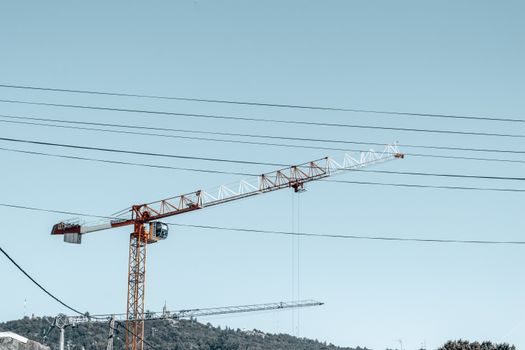
ASME B30.3-2012 explicitly recognises the hammerhead as a distinct tower-crane configuration with a horizontal jib, a counter-jib, and a fixed tower mast [S4]. The cat-head apex ties the jib and counter-jib through a top tie-rod, which gives the crane a tall apex profile but excellent radial coverage — typical jib lengths run 40 m to 80 m on standard QTZ-series machines [S2][S7].
Common capacity bands land at 4 t (QTZ40/4208), 6 t (QTZ63/5011), 8 t (QTZ80-class), and 10 t (QTZ100/6013) for the general construction market, with the 5 t CNBM TC5516 advertised at a one-unit minimum order and five-unit-per-month supply capability [S2]. Hammerhead units are the default for open industrial sites, large residential blocks, and civil infrastructure because the radial reach and simple luffing geometry minimise operator training overhead.
Limitations: the cat-head apex adds height on top of the working height, so air-space permits, signal tower light obstruction marking, and adjacent-structure clearance become constraints. On congested sites, the same reach advantage is a problem because the crane cannot fold out of the way of neighbouring buildings or flight paths.
Luffing-Jib Tower Cranes: Tight Footprint, Variable Geometry
Luffing-jib cranes replace the horizontal cat-head jib with a pivoting jib that raises and lowers between roughly 15° and 75° from horizontal, trading the cat-head's reach envelope for a much smaller slewing radius. ASME B30.3-2012 covers their jib-hoist, derricking, and slewing systems as separate safety-critical subsystems [S4].
Operationally, luffing-jibs are specified when multiple cranes must overlap on a tight urban site, when the crane must slew over occupied property, or when air-rights above the jib are restricted. They are also the typical choice for supertall cores where the tower crane climbs inside the building and the jib must clear neighbouring structures at every height.
Cost and complexity: the additional derricking winch, luffing cylinder or rope reeving, and anti-collision logic add roughly 20–30% to purchase price over a comparable hammerhead, based on the price spread between standard QTZ-series hammerheads and luffing models from the same Chinese OEM tier. Counter-jib tail swing is also larger because the jib pivots low and the counterweight must balance the full vertical load case.
Self-Erecting Tower Cranes: Mobile, Fast, Sub-10 t

Self-erecting (or "self-climbing") cranes fold onto a single trailer-loadable chassis and erect in a few hours without an assist crane, which is why they dominate the residential and small-commercial segment. Machmall lists a 2.5 t / 35 m mini tower crane targeted at "civil project small lift" work alongside the larger QTZ models [S7], and Moufarej Tower Cranes markets its service fleet explicitly across "self-erecting and tower cranes" with on-site inspection through trailer loading as a maintenance boundary [S6].
The typical envelope is 1.5 t to 8 t maximum load, jib lengths of 18 m to 35 m, and a transport weight low enough for a single low-loader move. Counterweight, jib, and tower fold within the manufacturer's outrigger footprint, which is usually 4 m × 4 m to 6 m × 6 m depending on the model.
Where they fail: free-standing height is usually limited to 25–35 m without tie-ins, so a self-erector on a four-storey job is fine but a 12-storey job requires either a tied configuration (which negates the speed advantage) or a different crane class. They are also not a substitute for a mobile crane on rough ground — outriggers need a prepared pad.
Flat-Top / Topless Tower Cranes: Multi-Crane Overlap on Supertall
Flat-top (topless) cranes remove the cat-head and tie-rod, leaving a clean horizontal jib with no apex above the working height. This geometry is what allows multiple flat-top cranes to be grouped on a single site, their jibs overlapping at different radii and heights without striking each other's tie-rod envelopes. ASME B30.3-2012 covers the structural configuration [S4], and Chinese OEM catalogues now lead this segment: Machmall lists the XCMG XGT15000-600S at 600 t capacity as a topless platform [S7].
Selection signals that point to flat-top: multiple cranes on one job, internal climbing through a building core, or job-site air-space constraints. The CNBM TC5516 is one of the "main products" pitched at the same buyer and explicitly supports "standard section hydraulic lifting and connecting" for climbing [S2], which is the same mechanism a flat-top uses to grow with the structure.
Trade-off: because the jib lacks an apex tie, the jib is a pure bending beam and the tip-load curve drops faster with radius than a hammerhead of the same capacity. For very high tip loads at long radius, hammerhead still wins. For a multi-crane supertall site, flat-top wins by geometry.
Selection Criteria Compared: Which Type Fits Which Job
The four families line up against four decision criteria as follows. (1) Site footprint: self-erecting ≤ flat-top ≈ luffing-jib < hammerhead, because hammerhead needs clearance for the tail counter-jib swing. (2) Working radius / tip-load: hammerhead and flat-top are the only options for >60 m jib at meaningful tip load; luffing-jib sacrifices tip-load for variable geometry. (3) Free-standing height: luffing-jib and flat-top climb internally; hammerhead needs external ties above ~40 m; self-erecting is shortest. (4) Assembly time: self-erecting wins at hours, hammerhead at 1–2 days with assist crane, luffing-jib and flat-top at 1–3 days depending on configuration. [S6]
Capacity class maps to family as well. Below 6 t at <30 m jib: self-erecting. 4–10 t at 40–65 m jib: hammerhead QTZ40 through QTZ100. 6–25 t at 35–55 m jib with tight footprint: luffing-jib. Above 25 t, or any multi-crane supertall configuration: flat-top / topless, scaling up to the 600 t XCMG XGT15000-600S class [S7]. The same logic also explains why the related crawler crane and gantry crane categories sit in adjacent product directories on Made-in-China.com [S3] — buyers frequently cross-shop them when the job requires ground-level travel instead of vertical lift.
Standards, Sourcing, and Buyer-Side Risk
ASME B30.3-2012 is the US safety standard for cableways, cranes, derricks, hoists, hooks, jacks, and slings applied to the tower-crane category [S4], and it is the document most owner-side safety officers will ask for. EU buyers will additionally see EN 14439 and FEM 1.001 referenced in OEM documentation; Chinese-built units commonly carry ISO and CE marks per the Machmall listings [S7]. The CNBM TC5516 is offered with a one-unit minimum order and TT or LC payment terms, with five-unit-per-month supply capability — a data point for procurement lead-time planning [S2].
Night-operation compliance is the other frequently missed spec: a tower crane above 45 m (or near an aerodrome) typically requires ICAO-compliant or FAA-compliant obstruction lighting, which is why "tower crane light price" is its own product category with IP66 LED low / medium / high-intensity Type B red and white options starting around US$58 per piece on Made-in-China.com [S3]. A crane scale on the hook is a separate buy, but for any lift above ~80% of rated capacity the load-monitoring instrumentation is what turns the structural spec into a safe lift.
For buyers comparing hammerhead and luffing-jib on the same site, the spec sheets are rarely the deciding factor — it is the anti-collision planning, the climbing sequence, and the obstruction-lighting layout that close the deal. Engineers working through this on supertall cores will recognise the same upstream procurement logic that drives decisions in adjacent heavy-lift categories, including the truck-mounted crane pros and cons trade-off map. The CNBM TC5516 listing remained active on Okorder as of 2026-05-26 [S2] and the Machmall tower-crane category page was updated through 2026-04 listings [S7], so both are live trackable nodes for spec confirmation; the Made-in-China tower-crane light price index updated for 2026 [S3] is the third.