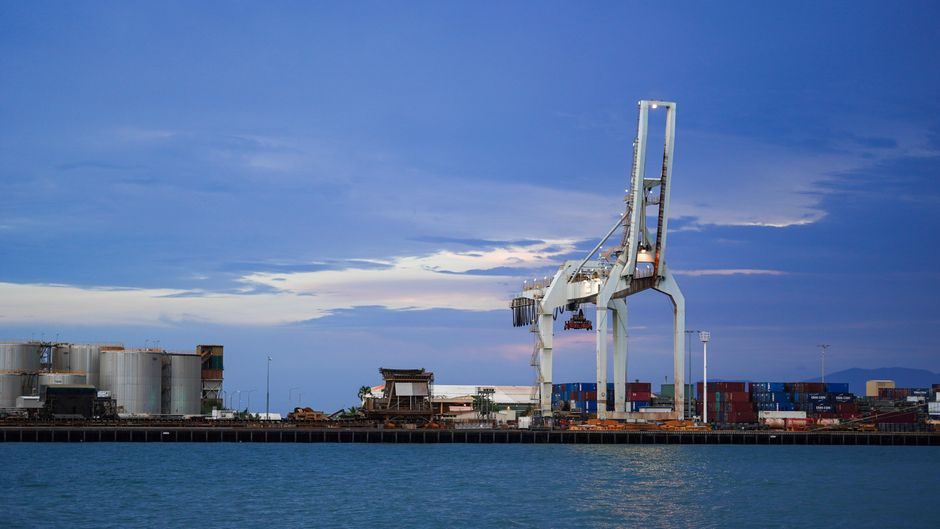
Gantry cranes operate on ground-level rails with spans of 5–35 m and lifting capacities of 2–32 t for single-girder models and up to ~80 t for heavy wire-rope hoists, while stacker cranes are aisle-bound, mast-guided storage-and-retrieval machines designed for fixed rack heights in automated warehouses [S6][S10].
Both are technically "crane" equipment, but the operating envelope, control philosophy, and project economics diverge sharply: gantry cranes are general-purpose yard handlers, whereas stacker cranes are integrated subsystems of a warehouse control stack [S3][S7].
Definition and Operating Envelope
A gantry crane is a bridge-type lifting machine whose horizontal bridge sits on two supporting legs that run on ground rails, giving the unit a gantry silhouette and removing the need for a building-mounted runway [S3]. Application scope covers open storage yards, shipyards, power stations, ports, and railway freight depots where the load travels between two fixed points and the working area is exposed to weather [S3]. Konecranes lists standard gantry safety features including flashing beacons, emergency stops dimensioned to the crane envelope, anti-collision safety loops, derailment catches with semi-gantry rail cleaners, storm locks and tiedowns, and an audible windspeed-meter alarm [S10].
A stacker crane — also called a stacker-crane AS/RS unit — is a mast-guided, rail-bound lifting machine designed to shuttle pallets, totes, or bins between a fixed aisle rail on the floor and a top rail on the rack structure. Unlike a gantry crane, it has no cross-travel between aisles; aisle change happens by transferring the pallet at the aisle end or via a transfer cart. Coverage suits high-density, high-throughput pallet or tote storage under a controlled indoor envelope. The S10 standard configuration of a ground-rail gantry with storm locks and windspeed metering is irrelevant to a stacker crane, which is an indoor, climate-controlled asset by design.
Selection Criteria: Capacity, Span, Lift Height, Environment
Voitto Crane publishes a single-girder gantry crane rated 2–32 t capacity, 5–35 m span, and 6–24 m lifting height, with wire-rope hoist options up to 80 t at 1–10 m/min hoisting speed and 5–30 m lift height [S6]. Konecranes literature frames gantry cranes as outdoor-rated equipment with standard wind-load protection, confirming that the structural package is sized for span, capacity, and wind class rather than for rack-integrated geometry [S10].
Stacker crane selection is governed by four different numbers: load unit size (pallet 1200×1000 mm typical or tote 600×400 mm), unit load mass (commonly ≤1500 kg for pallet stackers), rack height (often 8–40+ m), and aisle width (typically 1500–1700 mm for miniload, 3000–3500 mm for pallet stackers). When the spec calls for outdoor exposure, span above 35 m, or single-lift capacity above ~10 t, the gantry crane is the only option in scope.
Comparison: Gantry Crane vs Stacker Crane on Four Decision Criteria
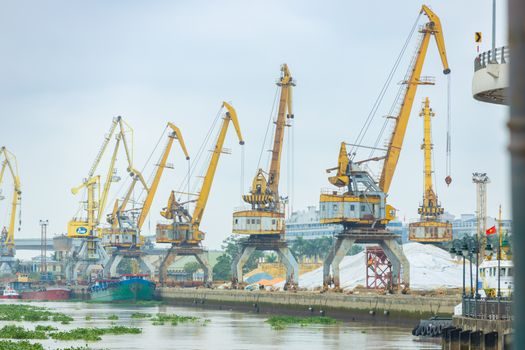
On capacity and span, the gantry crane wins outright: documented single-girder ratings go 2–32 t across 5–35 m spans, and heavy-duty double-girder units reach ~80 t, while a typical stacker crane is sized to a single pallet or tote at ≤1500 kg and a fixed aisle width [S6]. On duty cycle and throughput, the stacker crane wins under steady-state, two-shift warehouse operation with thousands of cycles per day; a gantry crane is sized for intermittent, low-to-medium cycle work and is rarely specified above ~20 cycles/hr.
On integration and control, the stacker crane must be commissioned as part of a warehouse execution system (WES) or warehouse control system (WCS) with position-encoding at every rack level, while the gantry crane is normally a standalone asset with pendant, radio, or cab control and optional anti-collision loops between multiple units on the same runway [S10]. On installation footprint, the gantry crane needs a prepared track, foundation beams with verified straightness and levelness, and a clear outdoor envelope per pre-lift checklist [S3]; the stacker crane needs rack-mounted top rails, machine-room provisions, and aisle floor rails but no spread foundation. Cost shape tracks these factors: the stacker crane carries higher per-unit automation cost but a much smaller building footprint per pallet position.
Use-Case Match: Who Each Crane Is For
The gantry crane fits open-yard and outdoor handling: shipyard erecting, port container moves, concrete-product yards, granite handling, railway freight depots, and power-station maintenance bays, with documented deployments at Alexandria Container & Cargo Handling on a 14-unit gantry fleet and the 400 ft / 8,400 t Hunter's Point gantry as the documented scale extreme [S8][S9]. The single- and double-girder product line in nucleon's catalogue explicitly targets workshops, material stocks, cement plants, granite industry sites, ports, freight yards, factories, warehouses, and other load/unload points [S4].
The stacker crane fits automated pallet or tote storage with fixed SKU counts, FMCG distribution centres, cold-store buffer racks, and parts warehouses with hundreds to thousands of storage positions per aisle. For lighter warehouse needs, a complementary pallet stacker (manual or walkie type) handles ad-hoc pallet moves at lower cost and without the rack integration overhead.
Limitations, Failure Modes, and Safety Constraints
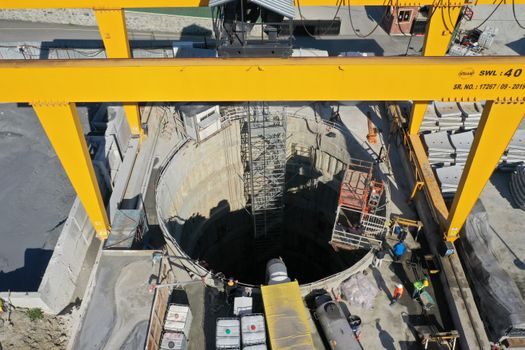
Outdoor gantry operation is wind-bound: documented practice requires stopping work when wind exceeds Beaufort 6, chocking rails with iron wedges, raising the hook to its upper limit, securing doors, cutting power, and tensioning cable wind ropes before personnel leave the crane [S3]. Two-crane tandem lifts on the same track must keep a minimum 3 m separation, and combined-lift capacity is capped at 75% of the sum of the two cranes' rated capacities, with synchronized travel and hoist motion [S3].
Stacker crane limitations are different and largely structural: mast deflection under load must stay within the rack tolerance or the load clamps will bind, the top-rail alignment tolerance is tighter than for ground rails, and any aisle obstruction stops the entire aisle. For facilities that need a mobile, lower-cost alternative to either fixed machine, a mobile crane or a crawler crane covers intermittent lift points but does not provide the storage-density of a stacker crane nor the yard-spanning of a gantry.
Standards, Sourcing, and Decision Rules
Gantry crane pre-lift work follows a written checklist: verify accessory and electrical integrity, prepare the track, complete and tamp the foundation, verify rail-base-beam straightness and levelness, confirm personnel certification, stage tools and documents, issue a written notice of commencement, recheck equipment integrity, and lay out construction power and lighting before any lift [S3]. Manufacturers' published 2026 catalogues (Nucleon, Voitto, DGCRANE, Konecranes) all classify gantry cranes by girder count, span, capacity, and lifting height rather than by storage position, which is the first sanity check when comparing a vendor's offer [S1][S4][S5][S6][S10].
Decision rule for 2026 specifiers: if the load unit is a pallet or tote and the storage geometry is a fixed rack, specify a stacker crane tied to the WCS. If the load is a single heavy object, the work area is outdoor, the span exceeds 20 m, or multiple load types must be handled in the same bay, specify a gantry crane.
Trackable signal for the next quarter: Nante Crane's news feed is actively publishing IP55-vs-IP65 motor comparison guides for overhead and gantry crane motor protection, which signals ongoing standard-conflict resolution for outdoor enclosure ratings in 2026 [S7]. A second signal: vendor catalogues continue to expose parallel product lines for gantry crane, stacker crane, and complementary pallet stacker units, so direct per-asset spec comparison across the two machine classes is feasible without custom datasheet work [S1][S4][S5].
For related coverage, see Explosion-Proof Control Station vs Explosion-Proof Lighting: 2026 Spec Comparison.