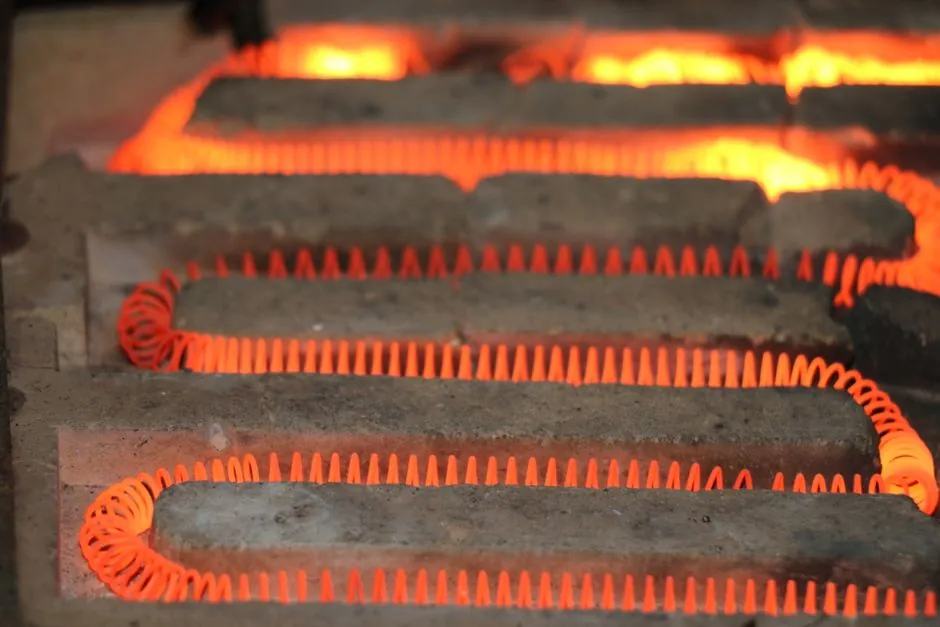
Electronics housing die-casters running 6061 or A380-type alloys on gas-fired melters must hit three numbers simultaneously: melt rate in kg/h, dross generation below roughly 1.5 to 2.0% of charged weight, and dissolved hydrogen under 0.15 ml/100 g Al to keep pressure-tightness on RF enclosures and heat-sink castings.
The selection problem is narrower than a generic foundry build. Housing walls run 1.5 to 4 mm, surface finish is customer-facing, and any oxide or spinel inclusion shows up as a leak path or a cosmetic reject, so combustion atmosphere, refractory, and alloy choice all feed into one decision tree rather than three independent specs.
Clean Combustion: Air-Fuel vs Oxy-Fuel on Aluminum Melts
Air-fuel burners in gas-fired aluminum furnaces pull combustion air at roughly 10 to 12 Nm^3 per Nm^3 of natural gas, which means the flame atmosphere carries 8 to 9% water vapor by volume, and that water is the main driver of aluminum oxidation at 700 to 760 degrees C [S3].
Oxy-fuel burners cut the N2 ballast, lower flame mass flow, and reduce specific flue gas volume by roughly 70 to 80% versus air-fuel on the same duty, which is why the Light Metals 2020 / Springer study of AlMg alloys used both burner families side-by-side to isolate atmosphere effects on oxide growth [S3]. For electronics housings, the practical reading is: oxy-fuel lowers dross but the burner capex premium and bottled-O2 logistics are only justified when the housing wall rejects are tracked to oxide inclusions and not to die-cock or shot-speed problems.
The Casthouse study used 65 g AlMg samples with 0 to 5% Mg in steel and ceramic crucibles for 10 minutes to 6 hours, then weighed samples after cooling, and that mass-gain protocol is the most defensible way for a housing foundry to bench-mark its own air-fuel vs oxy-fuel dross numbers before buying a new burner train [S3].
Refractory Stack and Furnace Type: Stack Melter vs Crucible vs Holding
Stack melters, dry-hearth crucible furnaces, and bath-type holding furnaces are the three configurations a housing foundry will be offered, and each one maps to a different production pattern. A stack melter fed by a 1 to 3 t/h ingot or sows conveyor suits a 24/7 housing cell running one or two die-cast machines; a crucible furnace (typically 500 to 1500 kg holding capacity) suits a job-shop running multiple alloys on a shared line; a holding-only furnace suits a foundry that central-melts in electric and dispenses at the cell. [S2]
Refractory choice interacts with alloy chemistry. Fired brick and high-alumina castables in the bath zone are standard, but Mg-bearing alloys (AlMg3, AlMg5, 5xx-series) attack spinel-forming refractories, and the AlMg study from the BEST project (BIA Project No. 269634/O20, partners: Hydro, Alcoa, Gränges, NTNU, SINTEF, HYCAST, Linde) explicitly documents MgAl2O4 layer formation plus internal MgO and MgAl2O4 clusters at higher Mg content, which is a direct warning to any housing line that drifts into 5xx-series alloys [S3].
For housing work in 413, A380, A383, 384, or A360 (the typical Al-Si-Cu / Al-Si families used in electronics enclosures), a standard high-alumina / SiC lining is acceptable, and the maintenance window is dominated by burner tile and door jamb wear rather than bath-lining corrosion. See the general melting furnace reference for the construction layers, and the gas aluminum melting furnace page for burner-layout and recuperator options that are common in this class.
Selection Criteria for Electronics-Housing Duty
Four decision gates filter the spec for a housing cell: alloy range, surface-finish sensitivity, melt rate vs utilization, and atmosphere tightness. [S3]
Alloy range. Confirm the cell will not run above 0.5% Mg, otherwise refractory chemistry, dross rate, and melt-loss budget all shift, and 5xx-series castings on the same furnace should be isolated on a separate stack with a hardened spinel-tolerant lining.
Surface-finish sensitivity. Housing walls under 3 mm and any cosmetic Class-A face (bezel rings, heat-sink fins exposed to view) need dross carry-over below 1.5% of charge and a tight skim routine, which usually means a stack melter with side-well pump-down or a sealed transfer well, not an open-top crucible dip.
Melt rate vs utilization. A 1 t/h stack running 16 hours per day at 80% utilization delivers 12.8 t per shift, which matches a two-machine housing cell running 1.0 to 1.5 kg shot average and 8 to 12 second cycle. Oversizing the melter is a common failure mode: a 2.5 t/h stack on the same duty forces the operator to throttle burners into low-fire, which drives incomplete combustion and rising CO and unburned hydrocarbon carry-over that biases the atmosphere toward sooty, hydrogen-rich flue gas.
Atmosphere tightness. Door cycle frequency, bath cover, and stack damper position are the three knobs that set draft. Anything over roughly 8 to 10 door cycles per hour on a holding furnace will pull ambient humid air across the bath, raise dissolved H2, and surface-finish rejects climb within a shift. A preheated bath cover (typically 200 to 300 degrees C) is the lowest-cost mitigation.
Gas-Fired vs Electric: Where Each Wins on Housing Work
Gas-fired melters win on capital cost per kg/h, on the ability to ramp from cold to tap in roughly 90 to 120 minutes for a 1 t unit, and on the ability to accept high-recycled-content charges with 30 to 50% turnings or chips mixed in, where the open flame plus bath agitation helps dry the charge. [S1]
Electric resistance melters win on atmosphere cleanliness, on dissolved hydrogen typically running 30 to 50% lower than a comparable gas-fired unit, and on NOx and CO being effectively zero at the furnace, which is increasingly relevant for indoor cells in Vietnam, Mexico, and Eastern European electronics clusters where permitting favors point-source electric heat. The trade-off is element capex and the cost of spare heater banks, addressed in detail on the electric melter comparison page for the structural-die-casting variant of this duty.
For a foundry deciding between a single 1.5 t/h gas-fired stack and two 750 kg electric crucible units, the housing-grade verdict is usually hybrid: gas-fired central melt feeding a sealed electric holding furnace at each die-cast cell. That configuration decouples the atmosphere at the die from the combustion atmosphere at the melt, and it is the architecture that most premium electronics-housing lines in Germany and Japan have standardized over the last decade.
Refractory and Burner Maintenance on a Housing Line
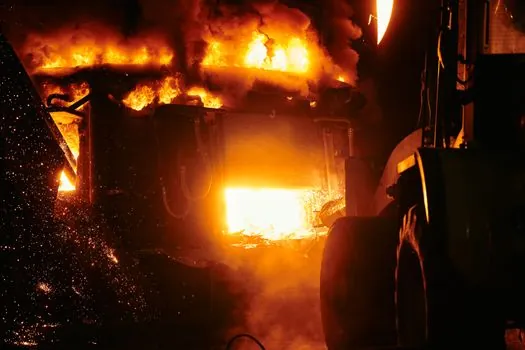
Refractory life on a properly designed housing-line gas melter is typically 3 to 5 years on the bath zone and 1.5 to 2 years on the burner quarl and door jamb, with a hot-repair cycle every 6 to 9 months on the upper sidewall where flame impingement is highest. The fired brick reference covers the alumina-silica grade selection that dominates this service. [S1]
Burner tile and recuperator tube life dominate the unplanned-downtime budget. Switching from alloy 353 to A380 in the same furnace does not change burner life much, but switching from 413 (high Cu, ~0.4% Fe) to a high-Mg 5xx alloy does, because the spinel-forming reaction is more aggressive on the burner tile hot face. The presence of beryllium additions (typically 30 to 100 ppm) is a documented oxidation mitigator in the AlMg casthouse study, with measurable mass-gain reduction versus an unmitigated baseline, and that is the only alloy-side lever that an electronics-housing line should consider if it has to run a 5xx series [S3].
Burner commissioning checklist that protects housing-grade output: (1) flue gas O2 at 2 to 4% excess air, (2) CO below 50 ppm at the stack, (3) NOx below 60 ppm corrected to 3% O2, (4) bath temperature uniformity within plus or minus 10 degrees C across the 1 t bath when measured with a 3-point immersion thermocouple tree. Outside those windows, dross rate climbs 20 to 40% and the housing rejects trend follows within a shift.
Where Gas-Fired Wins, and Where It Loses, on Housing Geometry
Thin-wall housings below 2.5 mm are sensitive to shot-speed and die-temperature transients, so the furnace specification should fix a melt-temperature window of plus or minus 5 degrees C of nominal setpoint, typically 680 to 720 degrees C for a hypoeutectic Al-Si housing alloy. A gas-fired stack with a properly sized recuperator (typically 60 to 70% thermal efficiency on the furnace unit, 35 to 45% without recuperator) can hold that window on a 24/7 basis, but it requires a working bath-level sensor; a wandering bath level in a stack melter forces the burner to chase a moving heat sink, and the bath temperature spread widens to plus or minus 20 degrees C within an hour. [S1]
For alloys intended to be anodized or given a cosmetic conversion coat, see the aluminum alloy reference for Si, Fe, and Mg ceilings per housing drawing, and the aluminum veneer panel entry for the architectural side of the same alloy/finish matrix. For larger structural castings the same furnace line often feeds automotive work, and the cross-vertical piece at Gas-Fired Aluminum Melting Furnace Selection for Automotive Parts Foundries walks through the higher-Mg, thicker-wall variant where gas-fired is less competitive. For the small-frame, smaller-tonnage cell the ag-machinery variant at Gas-Fired Aluminum Melting Furnace Specs for Agricultural Machinery shows the lower-melt-rate, more batch-oriented spec that a housing line can adopt when a continuous stack is overkill.
Verified Signals to Track in the Next Cycle
Two trackable signals will tell the next-quarter spec whether the housing-grade gas melter market is moving: (1) oxy-fuel retrofit pricing on retrofittable stacks, which historically traded at a 1.8 to 2.5x premium over an equivalent air-fuel burner train and is sensitive to bulk O2 supply contracts; (2) the next major refresh of the AlMg oxidation literature from the Norwegian BEST project consortium, whose partner list (Hydro, Alcoa, Gränges, NTNU, SINTEF, HYCAST, Linde) remains the most credible public reference for housing-grade aluminum melt-loss data [S3]. Equipment buyers specifying in this category should require, at minimum, a quoted bath-temperature uniformity window, a measured dross-rate number on a production alloy, and a refractory scope-of-supply pinned to a named grade rather than a generic 'high-alumina' callout, because at the housing spec level those three numbers separate a working furnace from a cosmetic one.