External and internal gear pumps continue to dominate pharmaceutical fluid transfer, dosing, and aseptic filling because they are positive-displacement devices that deliver a fixed volume per revolution, giving engineers a predictable basis for both metering and CIP/SIP skid design [S2][S6]. The key performance envelope a process engineer has to lock down before vendor selection is flow rate, differential pressure, power, efficiency, and operating temperature, with viscosity, solids content, and cleanability acting as the hard go/no-go filters [S1].
Pharma duty profiles are unusually demanding: the same pump that meters a high-viscosity ointment (around 10,000 cP and up) often has to be validated for clean-in-place and steam-in-place between batches, so the spec sheet has to satisfy both fluid mechanics and 3-A / EHEDG sanitary design rules in parallel [S2][S6]. This dual constraint is the reason gear pump selection in pharma is treated as a qualification exercise, not a catalogue buy.
Internal vs External Gear Pump: Geometry Drives the Pharma Use Case
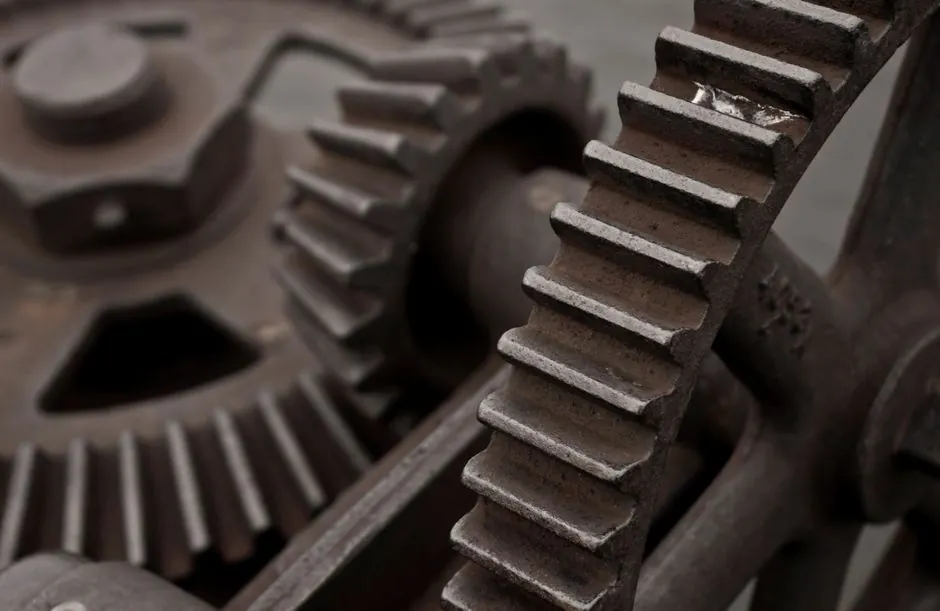
Internal gear pumps use a smaller idler gear rotating inside a larger rotor, creating a single expanding-then-contracting chamber that is well suited to high-viscosity fluids such as peanut butter or pharmaceutical ointments, and they typically handle a wider viscosity range than external designs [S2]. External gear pumps use two identical interlocking gears with tight tooth clearances, which gives the most consistent, pulsation-free flow and the highest metering accuracy per revolution [S2][S4].
For pharma aseptic filling and diagnostic cartridge filling, external gear pumps are commonly specified because the precise and consistent flow characteristics created by the interlocking gears map directly to dose-volume repeatability, and the compact footprint eases skid integration [S2][S9]. For shear-sensitive biologics, monoclonal antibody transfer, or viscous cream and ointment duty, an internal gear pump running at reduced speed is often the safer choice, accepting a small slip penalty in exchange for lower shear and gentler displacement [S2][S6]. The mechanical difference is not academic: external gears touch the fluid on every tooth pass, while internal designs expose only one idler surface, so the wetted-area ratio and particulate-shedding risk are not identical and must be qualified separately under the user's extractables and leachables protocol [S3][S6].
Spec Map: Viscosity, Pressure, NPSHA, and Slip
Gear pumps in pharma duty are typically run in the 1 cP to 10,000 cP window for solvent, buffer, and intermediate feed streams, with high-viscosity cream and ointment lines pushed into the 50,000 cP to 100,000 cP band, where lobe pumps are sometimes substituted to keep shear in check [S2]. Differential pressure is the parameter that consumes the most horsepower: typical pharmaceutical metering circuits are designed at 2 bar to 10 bar differential, while CIP loops push the same pump close to its mechanical limit, often 10 bar to 15 bar, which is why the suction line must be sized for adequate Net Positive Suction Head Available to suppress cavitation [S4].
Slip is the governing accuracy loss mechanism in gear pumps, and it scales inversely with viscosity: low-viscosity fluids at high discharge pressure recirculate through the machined clearances from discharge back to suction, which both wastes energy and, for products that harden on standing such as certain creams and adhesive excipients, can force a suckback line to keep the pump wet between batches [S4]. For a metering service, the cure is to minimize clearances, accept a higher drive horsepower, and run the pump at the slowest speed consistent with the required flow, since slow speed reduces slip percentage and protects accuracy [S4]. The drive itself, whether stepper, servo, or fixed-frequency AC, becomes part of the accuracy budget, because gear pump metering precision cannot exceed the repeatability of the drive [S4].
Sanitary Construction: 316L, Surface Finish, and CIP/SIP
Pharmaceutical gear pumps are built around 316L stainless steel wetted parts with documented surface finishes, typically Ra ≤ 0.8 µm for product-contact surfaces, and are ordered as SIP- or CIP-cleanable so they can be validated against the same GMP cleaning protocols as the upstream reactor and downstream filling line [S6]. The pump head is selected for drainability: sloped or self-draining housings, crevice-free rotor pockets, and seals rated for both hot caustic and steam-in-place temperatures, commonly 121°C to 134°C steam cycles for 30 minutes, are the baseline for any line that runs between sterile batches [S6][S8].
Elastomer choice is the other half of the sanitary spec: EPDM, FKM, or PTFE seals are picked for chemical compatibility with the active pharmaceutical ingredient and the cleaning chemistries, and any gear-pump build for aseptic filling should carry a 3-A sanitary or EHEDG certification note in its datasheet, paired with a materials traceability file [S2][S6]. Because the gear teeth themselves are the tightest-tolerance surfaces in the pump, gear-pump vendors in pharma typically offer hardened tool-steel or nickel-alloy rotors as upgrades over standard carbon steel, trading cost for particulate-shedding resistance in injectable and ophthalmic lines [S8]. A practical sanity check is to confirm the pump can pass the same swab and rinse recovery test the rest of the skid is validated against, rather than trusting generic food-grade ratings.
Selection Criteria: When Gear Pump Is and Is Not the Right Tool
A gear pump is the right tool for pharmaceutical duty when the process needs steady, pulsation-free flow at moderate-to-high differential pressure, the fluid is non-abrasive or only lightly loaded with soft particulates, viscosity is high enough that slip is not catastrophic, and dose-volume repeatability is a controlled process parameter [S3][S4]. It is the wrong tool for ultra-low flow chromatography and microdosing under 1% coefficient of variation, where ceramic rotary reciprocating piston pumps deliver sub-1% accuracy with chemically inert heads; for any line carrying hard or fibrous solids, where lobe pumps dominate; or for single-use disposable circuits, where peristaltic pumps remain the default [S3].
A direct four-way comparison of the pump classes that compete on a pharma skid is useful at this point. Piston pumps offer high pressure capability, low shear, chemically inert ceramic heads, and flow-stable output, but they are not natively single-use and have a flow-rate ceiling that excludes bulk transfer [S3]. Peristaltic pumps are easy to sterilize or replace and low cost, but tubing fatigue and rupture risk at high pressure plus collapse under vacuum constrain them to low-pressure dosing and transfer [S3]. Syringe pumps give high precision and good batch dosing, yet are slow, low-throughput, and require frequent refilling [S3]. Gear pumps offer high flow in a compact body, but the documented trade-offs are particulate shedding from tight-tolerance gear teeth, cavitation susceptibility when NPSHA is marginal, and poor performance at ultra-low flow, so they sit in the middle of the matrix rather than at any single extreme [S3][S4]. For a broader process-engineering context on positive-displacement selections, the reference entry on gear pump configurations lays out the same internal-versus-external trade-off across industries.
Failure Modes and Limits: Cavitation, Particulates, Abrasive Service

Three failure modes drive most pharmaceutical gear-pump returns. Cavitation, caused by insufficient NPSHA on the suction side, erodes the gear flanks and shows up as noise, vibration, and lost flow, and is mitigated by shorter and larger-diameter suction piping, flooded suction where possible, and lower pump speeds on high-viscosity lines [S4]. Particulate shedding from gear-tooth wear is a contamination event in injectable and ophthalmic duty, which is why gear pumps are rarely used in the final filling step for parenterals and are more often found in upstream buffer, media, and excipient transfer where the downstream filter absorbs the risk [S3][S6]. Abrasive service accelerates wear on the idler and rotor flanks, and any formulation containing suspended crystals, silica, or polymer beads should be re-routed through a lobe or peristaltic pump to protect the gear set [S2][S3].
Temperature is a silent limit: high-temperature duty lowers the fluid viscosity, which raises slip and erodes metering accuracy, so a hot-process gear pump must be re-sized with viscosity at operating temperature, not at ambient [S4]. For very slow-speed metering, slip as a percentage of total flow climbs sharply, so the engineer should either accept a larger pump running at higher speed or switch technology to a piston or syringe pump that holds accuracy at low flow [S3][S4]. When a process crosses two or more of these boundaries, a helical gear reducer on the drive train can give the speed control needed to keep the gear pump inside its safe operating window.
Pharma Use Cases Mapped to Pump Class
For vaccine fill/finish, diagnostic cartridge filling, buffer and media preparation, in-line dilution, and tangential flow filtration, the published guidance routes engineers toward ceramic rotary reciprocating piston pumps for the precision-critical step and toward peristaltic or gear pumps for the bulk transfer and feed side, depending on whether the line is single-use or reusable [S3]. For aseptic filling of viscous creams, ointments, and syrups, gear pumps are routinely selected because they hold a steady, pulsation-free flow at pressures higher than most other positive-displacement styles, and the same body geometry can be built as CIP- and SIP-capable to match GMP cleaning cycles [S6][S9]. For chocolate, adhesive excipients, and other shear-tolerant but viscosity-extreme products, internal gear pumps running at low speed remain the workhorse, accepting the slip and suckback complexity in exchange for a single, simple displacement device [S2][S4].
Engineers working across a plant that mixes high-viscosity and low-viscosity duty will often find the most efficient design is a single external industrial gear pump platform with interchangeable rotor sets and seal kits, qualified once and reused across product families, instead of stocking a different specialty pump for every SKU. When the line is also coupled to a gearbox on the agitator or conveyor side, matching the pump speed envelope to a standard gear reducer frame simplifies spare-parts holding and keeps the maintenance crew on a single coupling standard, a point covered in the related reference on gear coupling selection.
Qualification, Standards, and Sourcing Checklist

For pharmaceutical service, the gear-pump datasheet should be reviewed against four documents before purchase: the user's own URS, the applicable 3-A sanitary standard or EHEDG guideline for cleanability, the material certificates (316L wetted parts, FDA- or USP-class elastomers, and surface-finish certification), and the vendor's CIP/SIP validation report for the specific rotor geometry and seal stack [S6][S8]. Documentation of lot-traceable materials, surface-finish measurements, and passivation records is non-negotiable for any pump whose product-contact surface is part of a validated process [S6].
The next decision node after vendor shortlist is the factory acceptance test script: request a flow-versus-pressure curve at the actual operating viscosity, a slip test at minimum and maximum back pressure, a 30-minute dry-run for vibration and temperature-rise baseline, and a clean-in-place recovery test using the user's rinse and swab protocol. For a parallel spec-mapping exercise on adjacent process equipment, the field guide on expansion joint installation follows the same qualification-first approach used here.