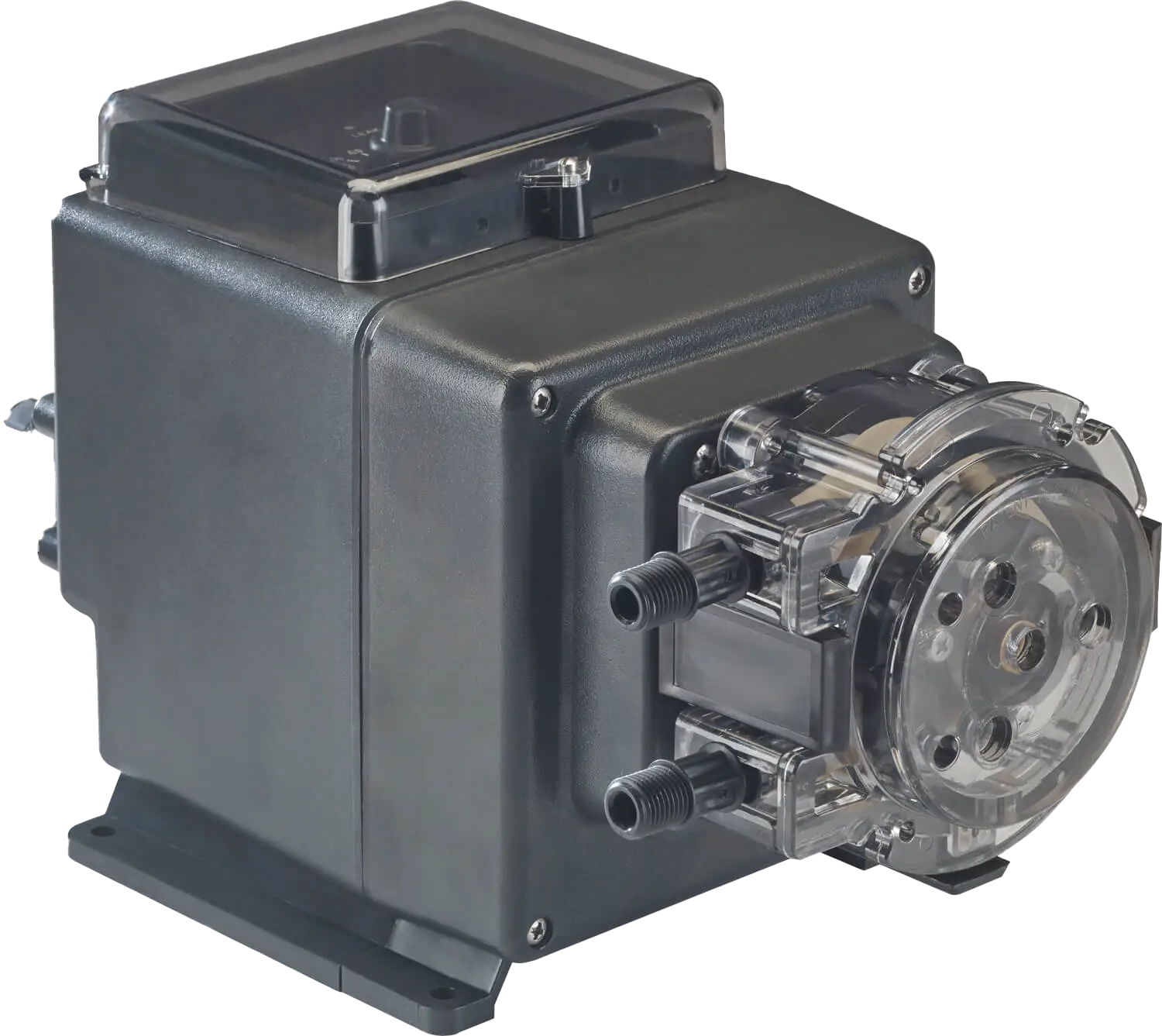
A peristaltic pump moves fluid by squeezing a flexible tube or hose with rollers or shoes that travel along its length, the same wave of progressive compression the human gut uses to move food, which is where the name peristalsis comes from. Because the fluid only ever touches the inside of the tube or hose, the pump has no seals, valves, or rotor contact with the media, which makes it self-priming, able to run dry, gentle on shear-sensitive products, and ideal for abrasive, corrosive, or hygienic duties.
Engineers split the family into two designs: low-pressure tube pumps for dosing and laboratory work, and high-pressure hose pumps for slurries and bulk transfer in mining, wastewater, and chemical plants. This guide separates the two clearly, because confusing them is the most common selection error.
Photo: Z22, CC BY-SA 3.0, via Wikimedia Commons
This guide is written for industrial purchasing engineers and design engineers. Six chapters cover how peristaltic pumps work, the tube versus hose split, occlusion mechanics, tubing and hose materials, the spec sheet decoded, and a selection decision sequence, with 7 selection FAQs and verified maker comparisons. Parameters are drawn from manufacturer datasheets (Watson-Marlow, Verderflex, Bredel, Flowrox by Valmet, Albin, Saint-Gobain) and reference material on positive-displacement pumping; tubing and hose grades reference FDA and USP Class VI biocompatibility and the relevant rubber compound families.
Chapter 1 / 06
What is a Peristaltic Pump
A peristaltic pump is a positive-displacement pump that moves fluid by progressive occlusion of a flexible element. A rotor carries rollers or shoes that press the tube or hose flat against a curved track, and as the rotor turns, the point of compression sweeps forward, pushing a captured slug of fluid downstream while the trailing compression maintains pressure and prevents backflow. Behind the moving compression point the element springs back to its round shape, creating the vacuum that draws fresh fluid in. The fluid is therefore handled in discrete pockets and never contacts any rotating or sealing surface.
This single structural fact, total containment inside the element, is the source of every characteristic advantage. There is no mechanical seal to leak, no valve to clog, no impeller to abrade, and no close-clearance gap to be wrecked by solids or dry running. The pump is inherently self-priming, can run dry without damage, is gentle enough for shear-sensitive products such as cell cultures and fruit pulp, and contains aggressive or hazardous media completely so an operator never touches them. The trade-off is that the element is a wear part: it flexes millions of times and must be replaced on a schedule, which dominates the lifecycle cost.
Two physical realities define the design space. First, flow is set by displacement: a fixed volume per revolution multiplied by rotor speed, so output is close to linear with speed and largely independent of discharge pressure within the rated range. This makes peristaltic pumps natural metering and dosing devices, with some metering models offering turndown ratios as wide as 10,000 to 1. Second, the pressure the pump can develop is limited by how hard the element can be squeezed without destroying it, which is why the family divides sharply into thin-wall tube pumps for low pressure and thick reinforced-hose pumps for high pressure.
Historically the principle is old, with roller-tube blood pumps patented in the early twentieth century and widely used in heart-lung machines and dialysis, where total containment and gentle handling are non-negotiable. Industrial hose pumps scaled the same idea up with fabric-reinforced rubber hoses and lubricated casings to reach mining and wastewater pressures. Today the category spans nine orders of magnitude in flow, from sub-millilitre-per-minute laboratory dosing to roughly 90 to 100 cubic metres per hour of abrasive slurry, all built on the same wave of compression.
Four engineering metrics decide whether a peristaltic pump is the right tool: the required flow and its accuracy, the discharge pressure, the chemical and abrasive nature of the media, and the acceptable element-change interval. When the media is abrasive, corrosive, shear-sensitive, or must be fully contained, the peristaltic pump often wins despite its consumable element. When clean water must be moved cheaply at high flow and modest pressure, a centrifugal pump is almost always more economical, so the two technologies rarely compete head to head.
Chapter 2 / 06
Tube Pumps vs Hose Pumps
The most important fork in peristaltic selection is tube versus hose. Both occlude a flexible element, but they are built for opposite ends of the pressure and flow map and are rarely interchangeable. A tube pump compresses a thin-wall, non-reinforced extruded tube with rollers; a hose pump compresses a thick, fabric-reinforced rubber hose with sliding shoes inside a lubricant-filled casing. The table below contrasts the two designs on the parameters that drive a purchase.
Attribute
Tube Pump
Hose Pump
Element
Thin-wall extruded tube, non-reinforced
Thick fabric-reinforced rubber hose
Compression part
Rollers (often spring-loaded)
Sliding shoes (fixed geometry)
Max discharge pressure
~2 to 4 bar
up to 16 bar
Typical flow range
0.1 mL/min to ~33 L/min
<1 L/h to ~90 to 100 m³/h
Casing lubricant
Usually none
Glycerine-based, fills casing
Primary duties
Dosing, lab, OEM, sampling
Slurry, sludge, abrasives, bulk transfer
Tube pumps use a smooth-bore extruded tube clamped in a roller head. The thin wall is easy to squeeze, so rollers can be small and the drive low-torque, but the same thin wall cannot resist much pressure, which caps these pumps at roughly 2 to 4 bar. Their strength is precision at low flow: laboratory and OEM tube pumps deliver from about 0.1 millilitres per minute up to a few litres per minute, and cased metering pumps reach into the hundreds of litres per hour. The Watson-Marlow 120 and 520 families and the Qdos cased metering range are representative; Qdos quotes roughly 1 percent dosing accuracy with flow staying linear up to about 7 to 9 bar in its higher-pressure variants.
Hose pumps use a thick rubber hose built from an inner liner, several fabric reinforcement plies, and a tough outer rubber layer, compressed by two or more shoes rotating inside a casing flooded with lubricant. The reinforcement lets the hose recover its shape against high backpressure, so hose pumps reach discharge pressures up to 16 bar and flows up to roughly 90 to 100 cubic metres per hour. They are the workhorses for abrasive and high-solids media: mining tailings and slurries, wastewater lime milk and sludge, and aggressive chemicals. Bredel, Verderflex, Flowrox, and Albin are the established industrial hose-pump names; a Bredel SP-class element, for example, fixes a known volume per revolution so output scales cleanly with speed regardless of discharge pressure.
The practical rule is blunt: if the duty is dosing, sampling, or low-flow transfer below a few bar, specify a tube pump; if the duty is moving abrasive or high-solids fluid, or transferring against meaningful backpressure, specify a hose pump. Trying to push a tube pump beyond its pressure ceiling bursts tubes; oversizing a hose pump for a delicate dosing task wastes capital and resolution.
Chapter 3 / 06
Occlusion, Rotor and Drive Mechanics
Occlusion is the single mechanical parameter that governs accuracy, slip, and element life. It describes how far the roller or shoe compresses the element. With full occlusion the bore is pressed completely flat, so no fluid leaks past the compression point and the pump delivers a fixed displacement per revolution with volumetric accuracy approaching 100 percent. With partial occlusion a small gap remains, and under discharge pressure fluid slips backward through that gap, so delivered flow falls as backpressure climbs. The table below summarises the two occlusion philosophies and their consequences.
Occlusion type
How it is set
Effect on accuracy and life
Fixed occlusion
Roller or shoe gap fixed by geometry for one element size
Consistent, repeatable; element must match exactly
Variable occlusion
Spring-loaded or adjustable rollers track wall thickness
Tolerates tube tolerance; constant force aids tube life
Under-occlusion (gap)
Deliberate or worn clearance
Slip rises with backpressure; flow drops, accuracy lost
Over-occlusion (excess)
Too much squeeze for the wall
Near-zero slip but excess flexing shortens element life
Fixed occlusion sets the roller or shoe clearance by hard geometry for a single element bore and wall, which gives repeatable, predictable performance but demands that the installed element match the pump exactly. Hose pumps are almost always fixed-occlusion: the shoe radius is matched to the specific reinforced hose, and the high load is carried by the casing and lubricant. Variable occlusion, common on tube pumps, uses spring-loaded or adjustable rollers so the compression force tracks the actual wall thickness. This tolerates the dimensional spread of extruded tubing and keeps the squeezing force roughly constant regardless of tube size, which helps tube life and lets one head accept several tube bores.
The rotor design then sets pulsation. A two-roller or two-shoe rotor always keeps at least one element fully occluded so flow never reverses, but it produces a noticeable pulse as each roller engages and releases. Adding rollers or shoes, or offsetting them, smooths the flow at the cost of more flexing points and slightly lower suction recovery per revolution. Where downstream processes are pulse-sensitive, such as inline instrumentation or coating, engineers add more rollers, use a pulsation dampener, or select a model designed for low-pulsation output.
The drive determines flow control and torque. Low-flow dosing pumps pair the head with a stepper or brushless DC motor for fine, repeatable metering and wide turndown, some reaching 10,000 to 1. Industrial hose pumps need substantial starting torque because the shoes must deform a thick reinforced hose under pressure: a mid-size unit can require on the order of several hundred newton-metres of starting torque, so they use geared motors and, frequently, a variable-frequency drive to trim flow. Because displacement per revolution is fixed, dosing is set simply by counting or commanding revolutions, which is why peristaltic pumps integrate cleanly with batch and recipe control.
One further mechanical consequence matters in the field: friction and heat. In a hose pump the shoes rub the hose continuously under load, generating heat that must be removed or the rubber fatigues and cracks. The lubricant in the casing both lowers friction and carries heat into the metal body, so running too fast, too hot, or with the wrong or low lubricant is the fastest way to kill a hose. Tube pumps run at lower load and usually need no lubricated casing, but excessive speed still heats and shortens the tube.
Chapter 4 / 06
Tubing and Hose Materials
The element is the heart of a peristaltic pump and the part that is chosen, replaced, and budgeted around. Material selection balances three demands that often pull against each other: chemical compatibility with the pumped fluid, flex fatigue life under the chosen pressure and speed, and any sanitary or regulatory approval the process requires. Tube pumps and hose pumps draw from different material families because they operate at different loads.
Tube materials are extruded thermoplastic elastomers and silicones. Platinum-cured silicone gives an ultra-smooth bore, biocompatibility, and a wide temperature window, but its flex fatigue life is short and it is gas-permeable, so it suits clean, gentle, lower-duty service. TPE grades such as PharMed BPT and Marprene last far longer: PharMed BPT is a polypropylene-based TPE that stays flexible from about -40 to +135 degrees Celsius, has low gas permeability, withstands autoclaving, and offers roughly ten to twenty times the pump life of silicone. Tygon grades cover broad chemical resistance against acids, bases, salts, and ketones, with high-temperature variants usable above +135 degrees Celsius. For pharmaceutical and food work, the deciding factor is usually validated approval to FDA and USP Class VI rather than raw chemical resistance.
Hose materials are thick fabric-reinforced rubber compounds, and the choice is driven by the inner liner that contacts the fluid. Common families are natural rubber (NR) for general abrasion resistance, nitrile (NBR) and food-grade nitrile (NBRF) for oils and food contact, EPDM for many chemicals and hot water, and Hypalon, a chlorosulphonated polyethylene (CSM), for oxidising and aggressive chemicals. The outer layer is typically tough natural rubber so it survives the constant rubbing of the shoes and maximises hose life. Reinforcement plies, often two to six depending on hose size, give the hose the stiffness to recover against backpressure and the strength to reach 16 bar.
The table below is a first-pass lookup for matching media to element family. It is for initial screening only: before committing, obtain the manufacturer chemical compatibility chart and verify the specific concentration, temperature, and pressure, because compatibility frequently changes with all three.
Media or duty
Tube grade (tube pumps)
Hose liner (hose pumps)
Water, mild aqueous
Silicone or Marprene
Natural rubber (NR)
Oils, fats, hydrocarbons
Tygon (fuel grade) or Viton-lined
Nitrile (NBR)
Acids, bases, oxidisers
Tygon Chemical
EPDM or Hypalon (CSM)
Hot water, CIP chemicals
PharMed BPT
EPDM
Abrasive slurry, sludge
Not suited (use hose pump)
Natural rubber, reinforced
Food contact
Platinum silicone, FDA grade
Food-grade nitrile (NBRF)
Pharma, biotech
PharMed BPT, USP Class VI
N/A (tube pumps preferred)
Two operational notes complete the picture. First, element life is a strong function of speed and pressure, not just material: the same silicone tube that lasts hundreds of hours at high speed can last far longer at moderate speed, and reducing rotor speed while increasing bore to hold flow is a standard way to extend life. Second, on hose pumps the lubricant is part of the material system: a glycerine-based casing lubricant cuts shoe-to-hose friction and conducts heat away, and a hose rupture contaminates that lubricant, which is the basis of the leak-detection alarm that warns before pumped media escapes the casing.
Chapter 5 / 06
Key Specification Parameters
Peristaltic pump datasheets list many numbers, but only a handful drive selection: flow range, maximum discharge pressure, flow per revolution, accuracy and repeatability, suction lift, media and ambient temperature limits, element life, and motor or drive type. Each is explained below, with the meaning that matters on the order form rather than the marketing headline.
Flow range and flow per revolution are the core sizing numbers. Because the pump is positive-displacement, output equals a fixed volume per revolution times rotor speed, so the datasheet flow per revolution (for example a Bredel hose element rated near 1.3 litres per revolution on a small pump, rising to around 40 litres per revolution on the largest models) tells you exactly how speed maps to flow. Tube pumps span roughly 0.1 millilitres per minute to about 33 litres per minute; cased metering pumps such as Qdos reach 600 litres per hour; heavy hose pumps reach roughly 90 to 100 cubic metres per hour. Always confirm the figure at your actual element bore, since flow scales strongly with bore.
Maximum discharge pressure is the hard ceiling set by the element, not the motor. Tube pumps sit at roughly 2 to 4 bar, cased metering pumps hold linear flow to about 7 to 9 bar, and reinforced hose pumps reach 16 bar. Exceeding the element rating does not just lose accuracy through slip; it bursts tubes or fatigues hoses prematurely. For metering duty, check the pressure at which the quoted accuracy still holds, not merely the maximum the pump survives.
Accuracy and repeatability matter most in dosing. Quality cased metering pumps quote on the order of 1 percent dosing accuracy and around 0.5 percent repeatability, and because displacement is fixed, that accuracy holds across the rated pressure band rather than collapsing as backpressure rises, which is a structural advantage over diaphragm metering pumps that rely on check valves.
Suction lift and self-priming come free with the principle. The released element springs back and pulls a vacuum, giving suction lift of roughly 8 to 9 metres of water column depending on element, bore, and speed, and full self-priming and dry-run capability because nothing depends on the liquid for sealing or lubrication.
Temperature, drive, and element life round out the sheet:
Media temperature is bounded by the element: most TPE and silicone tubes run to about +80 to +135 degrees Celsius; reinforced hose pumps commonly handle media to roughly +80 degrees Celsius.
Particle size on hose pumps can be large because there is no tight clearance; heavy-duty units pass solids up to several tens of millimetres, with one large model rated past 30 millimetres.
Motor and drive range from stepper or BLDC for fine dosing and wide turndown to geared motors with VFD for high-torque hose pumps; starting torque on big hose pumps reaches several hundred newton-metres.
Element life is the consumable budget line: a few hundred to several thousand hours for tubes, months to a few years for reinforced hoses, all dependent on speed, pressure, duty cycle, and fluid.
Turndown ratio on metering models can reach 10,000 to 1, letting one pump dose across an unusually wide flow window.
Chapter 6 / 06
Selection Decision Factors
To turn the preceding chapters into a specific model, follow the decision sequence below. Most selection mistakes are not a single wrong number but a decision made at the wrong level, usually choosing tube versus hose too late. These eight steps double as a fixed RFQ template.
Tube or hose, decided first: Classify the duty as low-pressure dosing or sampling (tube pump, up to about 2 to 4 bar) versus abrasive, high-solids, or higher-pressure transfer (hose pump, up to 16 bar). Every later step depends on this fork.
Flow and pressure window: State required flow and discharge pressure, then size the element bore and rotor speed from the datasheet flow per revolution. Confirm the quoted accuracy still holds at your working pressure, not only that the pump survives it.
Element material and approvals: Match the tube or hose liner to the media using a manufacturer compatibility chart at real concentration, temperature, and pressure. For food and pharma, require FDA and USP Class VI validated grades; for abrasives, require reinforced NR hose.
Accuracy and metering needs: For dosing, target around 1 percent accuracy and 0.5 percent repeatability and confirm the turndown ratio covers your minimum and maximum dose; for bulk transfer, accuracy is secondary to flow and pressure.
Pulsation and downstream sensitivity: If instrumentation, coating, or membranes sit downstream, choose more rollers or shoes, a low-pulsation model, or a dampener. For most transfer duty, standard two-element pulsation is acceptable.
Drive and control: Stepper or BLDC for fine dosing and recipe control; geared motor with VFD for high-torque hose pumps. Verify starting torque against the hose, and confirm interfaces for 4-20 mA, pulse, or fieldbus dosing control.
Installation envelope: Confirm suction lift (typically up to 8 to 9 metres of water column), ambient and media temperature limits, ingress protection for washdown or outdoor sites, and for hose pumps the lubricant fill and leak-detection wiring.
Total cost of ownership: Budget the consumable element replacement interval, lubricant top-ups on hose pumps, and the labour to change a tube or hose, since these dominate cost. A cheaper pump with short element life and frequent stoppages usually loses to a correctly sized unit within a year or two.
One last dimension is commonly overlooked: serviceability and element supply. The pump body outlives many element cycles, so what really determines uptime is fast, reliable access to the correct tube or hose, the matching lubricant, and a hose-change procedure your maintenance crew can perform on site. Watson-Marlow, Verderflex and Bredel (both under Watson-Marlow Fluid Technology Group), Flowrox by Valmet, Albin, ProMinent, and Cole-Parmer Masterflex maintain element stocks and service networks; confirming local element availability and lead time at the purchasing stage prevents an expensive line stoppage years later when a hose finally wears out.
FAQ
What is the difference between a peristaltic tube pump and a hose pump?
Both work by occlusion, but the pumping element and the duty differ. A tube pump compresses a thin-wall, non-reinforced extruded tube with rollers and is built for low pressure, typically up to 2 to 4 bar, with flows from microlitres per minute up to a few litres per minute. A hose pump compresses a thick, fabric-reinforced rubber hose with sliding shoes inside a lubricant-filled casing, reaches discharge pressures up to 16 bar, and handles flows to roughly 90 to 100 cubic metres per hour. Tube pumps suit dosing and laboratory work; hose pumps suit abrasive slurries, sludge, and high-pressure transfer.
How does occlusion affect flow accuracy and slip?
Occlusion is how far the roller or shoe compresses the element. Full occlusion presses the bore 100 percent flat so no fluid leaks backward, giving near 100 percent volumetric accuracy and a fixed displacement per revolution. Partial occlusion leaves a gap that lets fluid slip back under discharge pressure, so delivered flow drops as backpressure rises. Tube pumps often use spring-loaded or adjustable rollers to set occlusion against tube wall thickness; hose pumps use fixed-geometry shoes sized to the hose. Over-occlusion shortens element life through excess flexing, so the setting is a trade-off between accuracy and service hours.
How do I select peristaltic pump tubing or hose material?
Match the element to three things: chemical compatibility with the fluid, the pressure and flexing life required, and any sanitary or regulatory approval. For tube pumps, platinum-cured silicone offers a smooth bore and biocompatibility but short flex life, while TPE grades such as PharMed BPT and Marprene last roughly 10 to 20 times longer and resist gas permeation. Tygon grades cover broad chemical resistance. For hose pumps, reinforced rubber hoses come in NR, NBR, food-grade NBR, EPDM, and Hypalon (CSM). Always cross-check the manufacturer chemical compatibility chart at the actual concentration, temperature, and pressure before committing.
What pressure and flow can a peristaltic pump actually deliver?
It depends entirely on element type. Tube pumps cover microflows of about 0.1 millilitres per minute up to a few litres per minute at low pressure, typically 2 to 4 bar. Cased metering pumps such as Watson-Marlow Qdos reach 600 litres per hour, with flow staying linear up to about 7 to 9 bar. Heavy-duty hose pumps such as Bredel and Verderflex deliver up to roughly 90 to 100 cubic metres per hour at discharge pressures up to 16 bar. Flow per revolution is fixed by bore and rotor geometry, so output is set by rotor speed and is largely independent of backpressure within the rated range.
Why do hose pumps need lubricant in the casing?
In a hose pump the sliding shoes rub the thick reinforced hose under high load, generating friction and heat. The casing is filled with a lubricant, commonly a glycerine-based fluid, that reduces friction between shoe and hose and conducts heat away into the metal casing. This directly extends hose life: running too fast, too hot, or with the wrong lubricant accelerates fatigue and cracking. The lubricant also confirms hose integrity, since a ruptured hose contaminates the lubricant and triggers a leak-detection alarm before the pumped media escapes. Tube pumps, running at lower load, generally do not need a lubricated casing.
How long do peristaltic tubes and hoses last, and how is the cost structured?
The element is a consumable and is the dominant lifecycle cost. Tube life ranges from a few hundred hours for silicone to several thousand hours for reinforced TPE grades, driven by pump speed, pressure, duty cycle, and fluid. Reinforced hoses in industrial duty commonly last from months to a few years, and well-sized installations can run 5 to 10 years with periodic element changes. Plan total cost of ownership around scheduled element replacement, lubricant top-ups on hose pumps, and the labour to swap a tube or hose, rather than purchase price alone. The capital pump body itself typically outlasts many element cycles.
Which manufacturers and series are credible for industrial and sanitary duty?
For low-flow dosing and laboratory work, Watson-Marlow (520 and 120 series), the Qdos cased metering range, ProMinent, and Cole-Parmer Masterflex are established. For heavy-duty high-pressure hose pumps in mining, wastewater, and chemicals, Bredel, Verderflex (VF and Dura series), Flowrox by Valmet, and Albin Pump are the recognised industrial names. For sanitary food and pharmaceutical transfer, choose tube grades validated to FDA and USP Class VI with the matching pump hygiene level. Verify the exact series, element material, and certification on the current manufacturer datasheet, since ranges are revised frequently.
Peristaltic Pump Manufacturers
Source-backed product routes. Open a company dossier for procurement scope and cited evidence.