
An o-ring is an elastomeric torus seated in a machined groove, delivering line-contact sealing at zero-to-low pressure (typical static limit ~1.5–10 MPa depending on compound) with no adjustment over its service life [S5].
Gland packing is a stack of braided rings (PTFE, graphite, aramid, carbon) compressed axially in a stuffing box by a gland follower; leakage is controlled by torque on the gland studs, and the seal is rebuilt ring-by-ring without replacing metal hardware.
Mechanical Function: Static Elastomer vs Compression-Loaded Braid
An o-ring works because the groove squeezes the cross-section by 10–30%, generating radial contact stress that blocks the leakage path even when surface finish is rougher than 1.6 µm Ra [S5]. The seal is binary: installed, it seals; cut, scraped, chemically swollen, or permanently set (compression set >80% of available squeeze), it leaks — and there is no field adjustment.
Gland packing works by friction: each ring rubs the shaft and the adjacent ring, generating a layered pressure drop that is the actual seal. Because the rings slide, the designer intentionally allows a controlled drip — API 675 and most refinery pump standards target 2–60 drops/min for centrifugal pump service as both cooling and leakage indicator [S2]. Tightening the gland follower compresses the stack further and reduces leakage; loosening it extends packing life at the cost of higher drip rate.
Selection Criteria: Where Each Technology Fits
Engineers should default to an o-ring when all four of these are true: (1) the hardware is a machined groove rather than a stuffing box; (2) the joint is static or reciprocating below ~0.5 m/s; (3) temperature sits inside the elastomer envelope (FKM ~ −20 to +200 °C, FFKM ~ −10 to +325 °C, EPDM steam-capable to ~180 °C); (4) the connection is serviceable only as a full-disassembly repair [S5].
Engineers should default to gland packing when the hardware is a cylindrical stuffing box (pump shaft, valve stem, agitator), the shaft is rotating or stroking, temperatures exceed 250 °C, pressures climb above the elastomer ceiling, the shaft diameter is over ~50 mm where o-rings become uneconomical, or the operator must retighten the seal online without breaking the process. A cable gland is a different family entirely — compression around a wire — and is not interchangeable with either seal.
Options Compared on Four Decision Criteria

Four braids dominate pump and valve packing duty and the choice is governed by a temperature/chemistry/speed matrix: PTFE filament (~ −200 to +260 °C, pH 0–14, lowest friction, slow speed); graphite yarn (~ −200 to +450 °C in non-oxidising service, pH 0–14 except strong oxidisers, handles steam and hot oil); aramid (Kevlar/Nomex) yarn (~ −200 to +300 °C, excellent abrasion resistance, pH 4–11, poor on strong acid); carbon fibre (~ −200 to +500 °C in inert/reducing atmospheres, high thermal conductivity, premium price). [S1]
On the elastomer side, the comparison is shorter: NBR (~ −30 to +110 °C, oil/hydrocarbon), EPDM (~ −50 to +150 °C, steam/alkali), FKM/Viton (~ −20 to +200 °C, broad chemical), silicone (~ −60 to +200 °C, dry heat, weak mechanically), FFKM (~ −10 to +325 °C, near-universal chemical, highest cost). For static hydraulic fittings up to ~700 bar with no movement, an o-ring backed by a back-up ring is typically smaller, cheaper and faster to fit than an equivalent compression pack [S5].
Use Cases and Limits in Real Plants
Centrifugal pump shafts above 50 mm running at 1,500–3,600 rpm in hot oil, slurry, or chemical service are almost universally sealed with gland packing, often paired with a lantern ring carrying buffer fluid to keep product away from the seal face — an o-ring simply cannot run against a rotating shaft at that diameter without immediate frictional failure. [S2]
Control valve stems on globe valves still use a gland packing stack as primary seal, with an o-ring typically fitted as a secondary static element between the packing nut and the body [S2]. The packing handles the stroking motion and live loading; the o-ring handles the dead-ended static interface. For high-cycle, low-leakage ESD service, however, valve makers have largely migrated to bellows seals because adjustable gland packing cannot meet modern fugitive-emission thresholds (ISO 15848) on a high-stroke valve without frequent re-tensioning.
Failure Modes Engineers Should Pre-empt
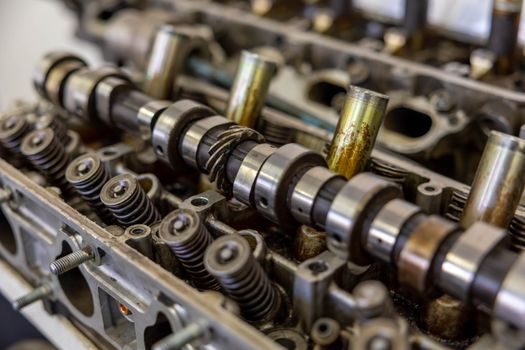
O-ring failure mode #1 is extrusion into the clearance gap when system pressure exceeds the elastomer’s extrusion resistance — mitigated with a hard back-up ring (PTFE or Peek) when pressure pushes past 10–15 MPa or the gap is wider than ~0.15 mm. Failure mode #2 is chemical attack or temperature overrun that hardens the compound; failure mode #3 is spiral failure on reciprocating seals from insufficient lubricant or excessive side load [S5].
Gland packing failure mode #1 is scoring of the shaft sleeve from a run-dry episode, which means the sleeve must be re-machined or replaced before new rings are fitted — there is no field fix. Failure mode #2 is overheating from over-tightening; graphite packing above ~450 °C in air oxidises rapidly, and a 50 °C overshoot can halve packing life. Failure mode #3 is chemical incompatibility — strong oxidisers attack graphite above ~400 °C, and strong caustic degrades aramid fibres. Spare packing rings matched to the original braid, plus a spare sleeve, are the standard service-kit content.
Sourcing, Standards and Cost Shape
For pump service, API 682 governs the newer cartridge mechanical-seal path, but where adjustable packing remains the spec, the original equipment datasheet lists the packing material, cross-section, ring count, lantern ring position and gland stud torque — a documentation discipline reinforced in valve OEM datasheets that call out packing and o-ring as separate line items [S2]. ISO 15848 and API 624 set the fugitive-emission classes that an adjustable gland can meet at limited stroke cycles, which is why most modern ESD valves have moved to bellows.
Industrial e-commerce listings for replacement o-rings cluster in the 1–25 USD per-piece range for commodity metric or inch sizes in FKM or NBR, and the wider industrial gasket price and cost map for 2026 shows why elastomer and compressed-fibre gaskets dominate static joints while compression packing survives only where the function demands a sliding or adjustable seal. For procurement, treat o-rings as a stocked commodity and packing as a service-engineered consumable cut from bulk roll or supplied as a pre-cut ring set.
Trackable signals to watch: tighter ISO 15848 class A and B emission testing pushing more control-valve stems onto bellows; refinery and chemical tenders still calling out split-braided graphite or PTFE packing for any pump shaft above 50 mm; and o-ring compound development focusing on higher-temperature FKM/FFKM and steam-resistant EPDM rather than new geometries.