
For commercial HVAC, spiral round duct is specified in diameters from roughly 100 mm to 1500 mm with galvanized steel gauges typically between 0.5 mm and 1.2 mm, lock-seam or companion-flange joints, and SMACNA HVAC Duct Construction Standards as the default fabrication reference [S6][S2].
Specifying engineers treat spiral duct as a distinct product line from rectangular duct because of how it is formed (continuous helical lock seam from coil stock) and how it is joined (slip-coupling or flanged ring), which dictates gauge upgrades, stiffening rings and hanger spacing on larger diameters [S3].
Diameter, Length and Gauge Range
Stock spiral round duct from US fabricators commonly runs 3 in (≈80 mm) through 60 in (≈1500 mm) nominal diameter, with 10 ft (3.05 m) standard lengths and 20 ft (6.1 m) available for long straight runs [S3]. Standard gauges offered by Vortex Metal Manufacturing and similar Mid-Atlantic shops cover 26 ga through 20 ga for galvanized steel, which translates roughly to 0.45–0.95 mm; heavier 18 ga (≈1.2 mm) is used for industrial exhaust and high-pressure classes.
China-origin export data codes spiral duct fittings and tubes under customs declaration norms that explicitly require shape, steel grade, and dimensional fields (diameter for round, length×width×thickness for rectangular), which matches the same dimensional data sheet any specifier must fill [S2]. For reference, the steel-grade HS-code path 7222.20 covers cold-formed bars/rods used in ductwork hangers and supports, with MFN duty of 6% and VAT 13% as of mid-2026 [S2].
Material Selection: Galvanized Steel, Stainless, Aluminum
Galvanized steel (G-60 / G-90 coating) is the default for indoor commercial HVAC. For corrosive exhaust, restaurants, coastal plants and pool ventilation, 304 or 316 stainless spiral duct is specified, and for low-weight cleanroom or fume-hood branches, aluminum spiral (often 3003-H14) is offered as an alternative [S6]. The decision is driven by dew point, chloride exposure and the chlorine/sulfur content of the airstream, not by aesthetics.
Acoustic flexible spiral duct from Foshan Chuangxing Ventilation uses internal and external steel wire helix with insulation cotton, addressing noise-sensitive terminal runs where rigid spiral cannot bend around obstacles. For permanent welded industrial systems, spiral rigid duct is preferred because it handles higher negative/positive pressure classes and supports internal cleaning.
Joint and Fittings Logic
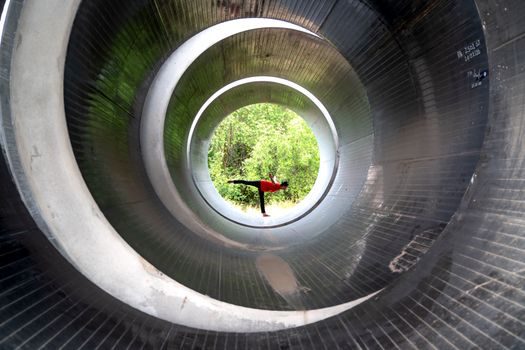
Spiral duct's joint system is the most overlooked selection lever. Slip coupling (drive-cleat) is the cheapest option for low-pressure (≤1 in w.g. / ≈250 Pa) Class A supply, and is what stock fab shops ship by default [S3]. SMACNA Class B/C or higher static pressure requires companion flanges, T-25/T-30 flanged joints or angle-ring flanges with gaskets, and duct gauge must be upgraded one step for diameters above ~600 mm in many shop standards [S6].
The standard SMACNA 2005 fabrication baseline referenced by Spiral Products Inc. and Hopewell Sheet Metal covers rectangular duct construction, sealing classes (A–D), and reinforcement tables, but for round spiral duct the ASME / SMACNA round-duct tables and the SMACNA HVAC Duct Construction Standards (Metal and Flexible) are the governing documents used by inspectors in the US and Gulf markets [S6][S4].
Pressure Class, Velocity and Acoustic Limits
Low-pressure residential and commercial supply typically runs 0.5–1.0 in w.g. (125–250 Pa) at 1,200–1,800 fpm (6–9 m/s) branch velocity, while industrial exhaust and dust collection can reach 6–10 in w.g. (1,500–2,500 Pa), pushing specifiers to heavier gauge spiral and welded flanges [S6]. For laboratories, healthcare and cleanroom branches, duct acoustic insertion loss is built up through fiber-glass lining added at the fab shop, not on-site.
The flexible acoustic spiral product from Foshan Chuangxing combines inner helix wire, insulation cotton and outer PVC hose to deliver a single-piece sound-attenuating section for fan-coil and AHU terminations, which rigid spiral cannot provide without an inline silencer.
Fabrication Equipment and Tolerance Reality

A modern spiral duct line forms coil stock into a continuous helical tube, with seam locked, then cut to length. The formers (e.g. machines listed at $1,000–$50,000 per unit on Made-in-China) can run 0.4–1.2 mm galvanized, with PLC-controlled diameter changeover in the 80–1,500 mm range [S5]. For projects above 1,500 mm diameter, rectangular or welded round is typically selected because standard spiral formers cap out around that size.
Tolerance on diameter is typically ±2 mm on small sizes and ±3–5 mm above 600 mm; ovality after forming is the parameter inspectors actually check, and good fab shops keep it under 2% of nominal diameter for clean gasket seating [S3].
Coating, Liner and Code Compliance
For outdoor or humid runs, hot-dip galvanizing to ASTM A653 G-90 is the baseline; for kitchen exhaust, UL 710 listed grease duct (welded black steel) is required by code, not spiral. Spiral duct is not a substitute for grease duct in commercial kitchen hood runs [S6].
For pharmaceutical and semiconductor branches, electro-polished stainless or PVC-coated internal surface is specified to meet cleanability targets, and the supplier (e.g. Spiralite Ductwork, Dubai) typically holds the project-specific accreditations rather than a generic ISO 9001 [S4].
Supplier Geography and Sourcing Notes

Domestic US fab shops (Hopewell Sheet Metal in Hagerstown MD, established 1981, 30,000+ sq ft; Vortex Metal in Richmond VA; Spiral Products Inc. since 2001) cover the Mid-Atlantic and 4-state region, typically fabricating to SMACNA 2005 and the engineer's stamped spec [S3][S6]. Gulf-market suppliers such as Spiralite Ductwork (Khansaheb Industries, National Industries Park, Dubai) supply UAE and Saudi projects and align to NFPA 90A / SMACNA leakage classes [S4]. Chinese export sources (Yuyao Dongfang Ventilation, Ningbo; Foshan Chuangxing) push heavily into Southeast Asia, Africa and Latin America at FOB Ningbo / FOB Foshan, with MOQs as low as 15 m³ for standard gauges and 1 piece for forming equipment.
Specifiers should request the SMACNA leakage class target, gauge schedule, joint type and reinforcement table with the PO, and confirm whether the project falls under ANSI-coordinated standards (such as the ANSI/AHRI 880 I-P performance or ANSI/AHRI 260 sound rating on the AHU side) where duct acoustics matter [S1][S6]. For welding-heavy jobs, MIG welder selection guides and TIG welder specs become directly relevant for shop qualification of the spiral seam and flange welds.
For cross-referenced component selection on the same project, pressure transmitter and flow meter sizing for the AHU duct-side, plus industrial valve specification for the hydronic coil, sit alongside the duct spec package. A related spec discussion for fabrication-adjacent forming and cutting equipment is covered in laser welding machine selection, which addresses the seam-welding and stiffener-ring options that occasionally substitute for lock-seam spiral at the high-pressure end.