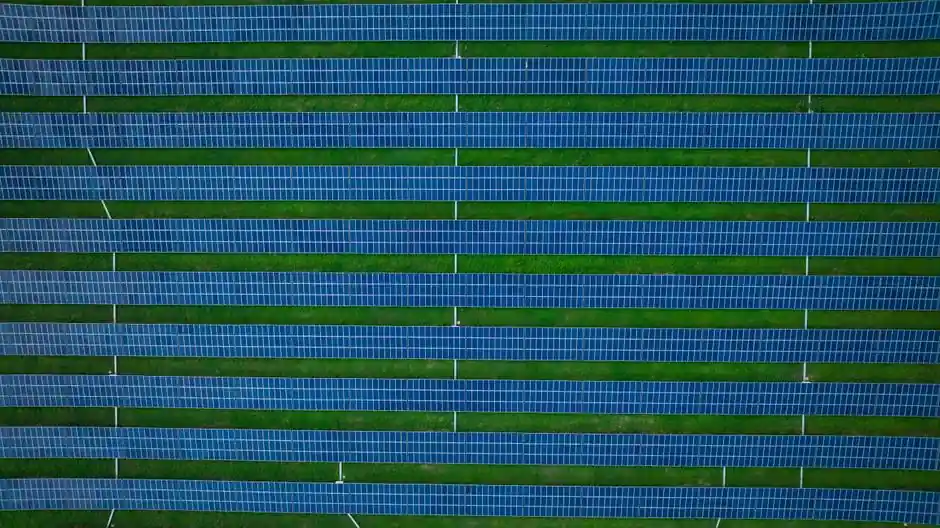
Chinese module manufacturers hold the dominant share of global solar PV module shipments, with Jinko Solar, JA Solar, Trina Solar, LONGi Green Energy, and Canadian Solar regularly cited as the top-five c-Si suppliers by gigawatt output [S2][S8].
The global photovoltaic materials market was valued at USD 76.4 billion in 2026 and is forecast to reach USD 104.3 billion by 2030, at a 7.9% CAGR from 2024 to 2030 [S8]. Solar PV glass, a sub-segment tied directly to module output, was USD 7.8 billion in 2023 and is projected to grow to USD 27.3 billion by 2028 at 28.4% CAGR, with Asia Pacific accounting for USD 15.8 billion of that 2028 figure [S3].
Who Actually Builds the Modules: Maker Tiering
The vertical-integrated Chinese tier (Jinko, JA Solar, Trina, LONGi, Canadian Solar) sets the volume benchmark. The 2018 WiseguyReports survey listed 12 named global manufacturers; of those, First Solar (US, CdTe thin film) and Sharp (Japan) were the only non-Chinese producers with multi-GW scale [S2].
For related water-pumping and pumping-equipment context, see the sludge pump sizing spec guide.
Technology Split: c-Si vs Thin Film vs Perovskite
Crystalline silicon (mono- and multi-) is the workhorse and the technology under which the Chinese tier scaled. The 2018 panel-market taxonomy split the field four ways: Thin Film, Crystalline Silicon, Organic PV, and Concentrated PV; in deployment terms, c-Si has carried the majority of utility, commercial, and residential installs through 2024–2026 [S2].
Thin film is the realistic second place. Perovskite and tandem cells remain in pilot line / early commercial production as of mid-2026 and are not yet a measurable share of the named-manufacturer mix in this research set [S3].
Adjacent Segments: Glass, Trackers, Materials, Pumps
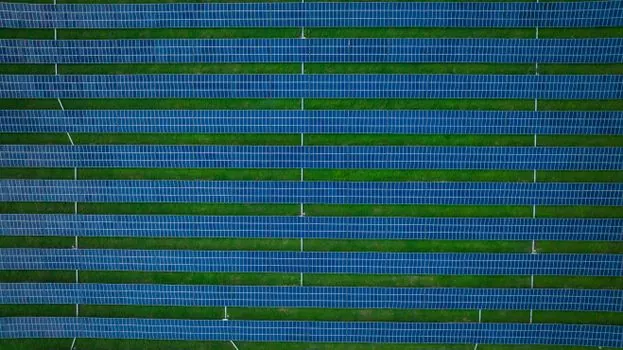
Solar PV glass demand scales roughly with module output. The market is segmented by coating type (AR-coated, tempered, TCO-coated) and by end-module (c-Si, thin film, perovskite), with c-Si modules consuming the majority of front-cover glass volume [S3].
The global solar tracker market was valued at USD 3.40 billion in 2021 with a projected 20.5% CAGR for 2022–2030; tracker OEMs (Array Technologies, STI Norland, Trina Tracker, Soltec) sit downstream of the module makers covered here, but their share of bill-of-materials is a useful proxy for utility-scale project intensity [S5]. In the off-grid / irrigation segment, the photovoltaic pump market identified Lorentz and Grundfos as the technology leaders at roughly 25% combined production share, with Indian suppliers (Tata Power, Shakti Solar) and Chinese entrants (SAJ, Komaes, Solartech) competing on price [S1]. The 3 kW / 24 V pure sine wave MPPT inverter SKU on Okorder illustrates the commodity Chinese inverter/MPPT segment that fills the residential and small-commercial tier behind the module makers [S7].
Selection Criteria When Spec'ing a Module Maker
Volume leadership is not equivalent to fit-for-purpose. For a utility-scale ground-mount spec, the decision matrix is roughly: bankability (top-tier BloombergNEF Tier 1 list, dominated by the Chinese tier plus First Solar), technology (mono-PERC, TOPCon, HJT, or CdTe), product warranty (typically 12-year product, 25-year linear power for c-Si; First Solar offers 30-year on Series 6/7), and BOM/LCoE rather than unit module price [S2][S3].
For commercial rooftop or residential, the same Chinese tier supplies most installers, with choice driven by availability, frame colour, and connector type (MC4 vs EVO2) rather than cell technology. For developers wanting Asian tracker + module + inverter bundling, the Trina / Jinko / JA Solar / LONGi groups all offer integrated tracker and inverter lines as of 2025–2026 [S2][S5].
Limitations, Failure Modes, and the Cautions

The market-share numbers carry an audit caveat: most public figures are manufacturer-reported shipments, not independently audited deployments, and Chinese-tier leadership in shipments has not consistently translated into top-tier bankability status across all regional markets [S2]. Warranty enforcement in markets with weak distributor networks is a known weak point: a 25-year linear power warranty has limited practical value if the local entity behind it is a small trading arm rather than the listed parent.
For upstream, the solar PV glass market faces raw-material price volatility (soda ash, float-glass line energy) and quality inconsistency, with low-quality cover glass flagged as a structural challenge for module reliability [S3]. For downstream off-grid use, PV pump deployments remain constrained by water-source depth, storage battery cost, and pump-end durability rather than panel choice [S1]. Investors and procurement teams should treat the named-manufacturer share as a directional input, not a procurement audit.
Standards, Sourcing, and What to Watch
Module procurement specs are anchored to IEC 61215 (c-Si design qualification) and IEC 61730 (safety), with UL 61730 governing the North American market. For harsh-environment or coastal sites, IEC 61701 salt-mist and IEC 62716 ammonia corrosion testing are the routine gating tests.
For procurement and operations teams, the practical next nodes to track are: (a) TOPCon vs HJT vs BC cell share within the Chinese tier through 2026–2027, (b) First Solar Series 7 ramp and any CuRe / perovskite-on-CdTe stack announcements, and (c) whether any non-Chinese c-Si integrator crosses back into multi-GW annual output. A signal worth flagging is that the solar PV glass market growing at 28.4% CAGR (2023–2028) [S3] is consistent with continued module-output growth rather than a plateau, and a slowdown in the glass sub-segment would be an early read on module-side saturation.
Spec-level background on the components involved: pressure transmitter, flow meter, and industrial valve.