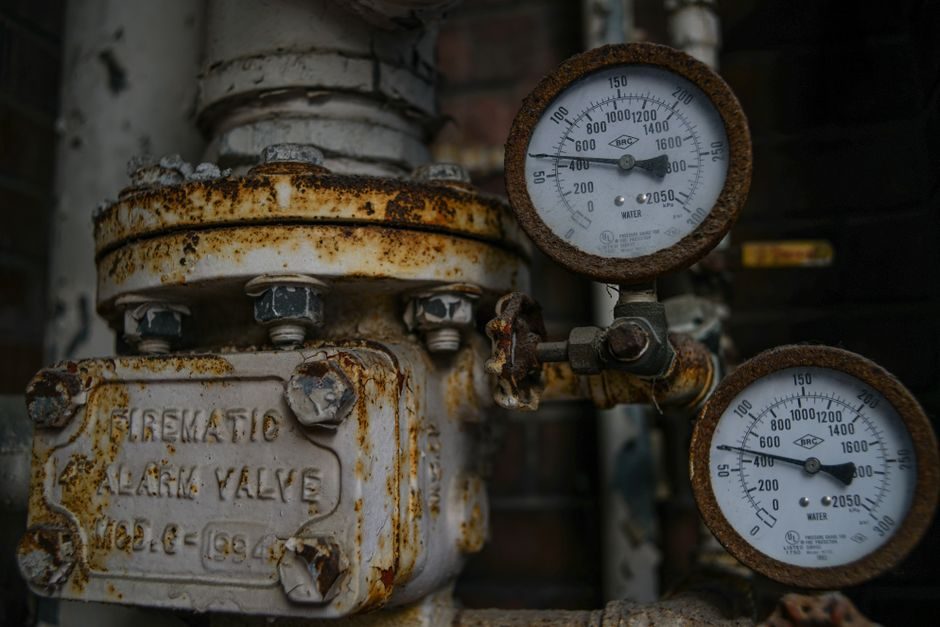
A globe valve is selected by aligning service fluid, pressure class, end connection, and shutoff duty to one of three body patterns — straight-pattern (T-port), Y-pattern, and angle — and matching the trim to the flow characteristic, before any vendor model is shortlisted. The decision discipline below maps those gates to concrete spec values drawn from manufacturer data published in 2025-2026 and the governing API/ASME/EN cast-valve standards.
For projects where a globe valve sits next to a ball valve in the same line, the practical rule is: pick globe for modulating duty and ball for tight on/off isolation. That single choice drives almost every downstream spec.
Body Patterns and Where Each One Earns Its Keep
Straight-pattern globe bodies give the best shutoff class and the simplest maintenance, which is why fire-protection and pressure-reducing pilots default to that pattern; CLA-VAL's 90G-21 pressure-reducing valve is a straight-pattern globe rated to 250 psi / 400 psi at 180 °F (82 °C) and is listed as "indispensable in any fire protection system" [S1]. Y-pattern bodies cut the pressure loss roughly in half versus a straight-pattern of the same size and are the right call for high-ΔP modulating service where seat velocity would otherwise erode a straight-pattern plug.
Angle bodies replace an elbow plus a valve and are common in high-temperature steam and feedwater where the flow turn is already required; they also reduce total joint count, which is a leak-path win in services covered by NACE MR0175 / ISO 15156 [S3]. Sizing the body pattern to the piping geometry — not the catalog picture — is the gate most mis-spec'd projects fail at first.
Pressure Class, End Connection and the Trim Stack
Pressure class and end connection are locked together: ANSI Class 150 / 300 / 600 raised-face flanges are the baseline for steel-bodied industrial globe valves, with the body wall, bonnet bolting, and gasket seating all sized off that class. Badger Meter's 860-series electric globe control valve ships with 150 lb ANSI raised-face flanges on a 1/2" body and accepts interchangeable trim sets — linear, equal percent, quick-open, or double taper — with TFE chevron packing and ANSI Class IV shutoff from size J trim upward [S2]. The Class IV shutoff figure is the load-bearing spec for any on/off-in-a-modulating-package question; a body advertised as "modulating" without a stated shutoff class is a red flag.
For carbon-steel commodity globe, gate, and check valves below Class 300 and up to 24", standard WCB castings are widely stocked against an 8-week nominal lead time, with API 600 / API 602 / API 603 / ASME B16.34 as the typical design chain [S3]. EN 10204 3.1 certification ships free with most mill orders; 3.2 certification (third-party witnessed, e.g. BV / TÜV / SGS / LR) is available at added cost and is normally only required for sour service, offshore, or nuclear-adjacent projects [S3].
Material and Standard Stack for the Common Service Bands
Material selection follows the service fluid: WCB carbon steel handles most water, steam, and hydrocarbons below ~425 °C; CF8/CF8M stainless covers corrosive chemicals and clean utilities; bronze (B62/B61) is still the default for threaded plumbing-class globe valves up to ~200 psi saturated steam. The wider cast-valve standard chain — API, ASME, ISO, DIN, EN, BS, JIS, GOST — applies across all of the above [S3], and most OEM datasheets will quote conformance to one or more of those frames rather than a single standard.
Sour service (H₂S-bearing) requires NACE MR0175 / ISO 15156 compliance, with material hardness and chemistry controlled per those documents; this is a standard checkbox on most serious OEM quote sheets [S3]. Fire-safe builds (typically API 607 / API 6FA for soft-seated ball and high-performance butterfly valves) are also available on globe valve variants from the same vendors, though fire-safe certification is more commonly demanded on isolation valves than on modulating globe valves [S3]. The simple selection rule: pick the body material against corrosion first, the standard frame against project spec second, and the trim material against erosion/throttling last.
Actuation, Characteristic and Modulating Duty
For manual isolation, a rising-stem handwheel with OS&Y (outside screw-and-yoke) is the default and gives a visible open/closed indication — required by code on most boiler and fire-protection lines. For modulating duty, electric or pneumatic actuators are matched to a flow characteristic: equal-percent trim is the right default for process control where the setpoint travels a wide range, while linear trim is the right choice for level or on/off-style feedback loops. The Badger 860 above ships in linear, equal-percent, quick-open, and double-taper variants on the same body, which is the right level of configurability for a process skid [S2].
Steam service demands stainless trim (17-4 PH, Stellite-faced seat) above ~150 psi saturated, and Y-pattern or angle bodies when the ΔP is high enough to flash the seat. For tight electric modulating shutoff at high temperatures — up to 1 000 °F (538 °C) on the 860 — actuator thrust must be re-checked against the cold-to-hot differential; many "modulating" bodies are only rated for full-throttle travel at ambient, with a derate curve above 400 °F [S2].
Comparison: Globe vs Ball vs Butterfly for the Same Line

Three options, four decision criteria — pick the valve that wins on the row that matters for the service, not on overall score. Below is a working comparison for a typical 150-300 lb steam or process-water line on a plant skid. [S1]
Globe valves win on flow characteristic accuracy and seat life under continuous modulation, lose on pressure drop (typically 5-10x a full-bore ball of the same line size) and on initial cost versus butterfly valve in larger sizes. Ball valves win on tight on/off (typically ANSI Class IV or V vs Class IV for the smaller globe trims) and lowest pressure drop, lose on throttling accuracy — most ball valves are not rated for sustained partial-port operation because seat life collapses. Butterfly valves win on cost and footprint in sizes ≥ 4" and on fast actuation, lose on high-temperature and high-ΔP throttling where disc life and seat geometry become limiting.
The hard crossover rule used on most EPC specs: globe for throttling, ball for isolation, butterfly for size-and-cost. A modulating globe valve and an isolation ball valve are commonly paired on the same line, each doing the job it is best at. The wrong-spec pattern — using a ball valve to throttle, or a butterfly to isolate a high-pressure steam header — is the single most common globe-related failure mode in field-rework tickets.
Use Cases: Where a Globe Valve Is, and Is Not, the Right Answer
Globe valves are the right answer for: pressure-reducing pilots on fire-protection risers (CLA-VAL 90G-21 at 250/400 psi, 82 °C [S1]); electric modulating control on a 1/2" 150 lb ANSI flange with linear or equal-percent trim and ANSI Class IV shutoff (Badger 860 at up to 5 000 psi and 1 000 °F [S2]); WCB commodity castings stocked against an 8-week lead for gate/globe/check (GGC) low-pressure carbon-steel service [S3]; and any NACE MR0175 sour-service or API 607/6FA fire-safe build where the modulating trim and metallurgy must be documented [S3].
Globe valves are the wrong answer for: line-size slurry, where the tortuous flow path erodes the seat in days; vacuum service with hard shutoff, where seat lift geometry tends to leak; large-diameter (>12") clean water where the butterfly cost/weight advantage is overwhelming; and tight positive isolation on a hazardous header, where a ball valve with a verified soft-seat and double-block-and-bleed is normally mandated. For steam-system separator and strainer selection upstream of a globe valve, the spec boundary work is similar in structure to steam separator vs Y-strainer spec rules — pick the device against a removal-target particle size and a ΔP budget, not against line size alone.
Limits, Failure Modes and What to Track After Award

The most common field failure on a globe valve is seat erosion from sustained partial-port throttling at high ΔP — fix is Y-pattern or angle body plus Stellite-faced trim, not a bigger handwheel. The second is packing leakage on steam above ~250 °C; TFE chevron packing (Badger 860) handles the temperature but has a finite stroke-life on modulating duty and must be re-torqued on a published schedule [S2]. The third is wrong shutoff class for the line — Class IV is the floor for modulating service, Class V or VI is required for hazardous isolation, and a Class II body on a Class VI service is a known leak path.
Trackable post-award signals: lead time against the 8-week commodity baseline [S3], EN 10204 3.1/3.2 cert presence on shipping documents, fire-safe test certificate (API 607 / API 6FA) when the service requires it [S3], and NACE MR0175 / ISO 15156 compliance line for sour service [S3]. For projects pairing a globe valve with on-site separation upstream, the cyclone separator selection guide covers the upstream removal-target and pressure-drop logic that feeds a globe's seat-life budget. The signal to watch on the next vendor-quote cycle: castings to EN 10204 3.2 witnessed by a named TPI, lead time held to the 8-week GGC baseline, and full material traceability on the trim certificate.