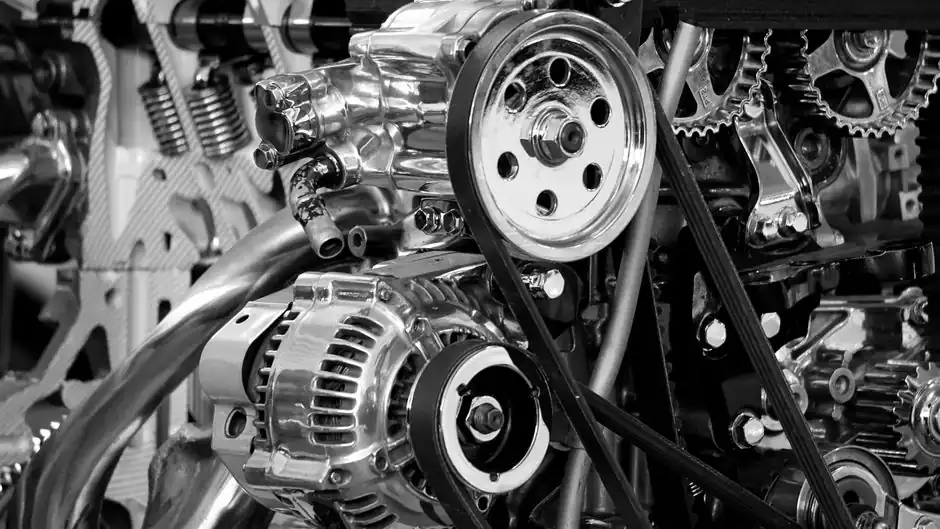
Rail-bogie side frames, traction-motor housings, and gearbox casings sit in a narrow process band where aluminum gravity die casting earns its place: the part must carry load after T6, the annual volume does not justify high pressure die casting tooling, and the section thickness is too aggressive for clean sand fill [S2][S5].
A356-T6 is the dominant rail-grade alloy in this band, with cast test-bar minimums of 290 MPa tensile, 210 MPa yield, and 4% elongation per EN 1706 [S2]. Gravity die casting machines as a category hold roughly 20% of the global die casting machines market, used in applications requiring lower injection speeds and heavier non-ferrous sections than high pressure tooling handles [S3].
Process Definition and Where Gravity Die Casting Fits
Gravity die casting is a permanent mold process where molten metal fills a reusable steel or cast iron die under gravity alone, with no pressurized injection [S1][S5]. The die is preheated to 200–300 °C, coated with a refractory release layer, filled from a top basin, and the casting ejects after directional solidification [S2].
Against sand casting, the permanent die delivers repeatable geometry batch after batch instead of re-making a mold each cycle [S2][S5]. Against high pressure die casting, gravity casting accepts thicker sections, runs slower cycle times, and avoids the gas porosity that can blister a T6 batch [S2]. The wider landscape, including low pressure and squeeze casting, sits between these two poles on cost and consistency [S1]. A practical reference for the parent machine family is the gravity die casting machine category page, which anchors the process to equipment form factor and clamping class.
Selection Criteria for Rail-Spec Castings
Tilt-pour configuration is the more reliable fill variant for rail structural parts: the die rotates from horizontal to vertical during pour, metal enters with almost no turbulence, and directional solidification stays consistent regardless of operator skill [S2]. Stationary vertical-pour machines remain the lower-cost option for cover plates and small brackets where fill height is short and section thickness is uniform.
Clamping tonnage, die envelope, and pour basin capacity scale with part size; rail bogie side frames and motor housings typically need 600–1500 kN clamp force and die envelopes above 1.0 m × 1.0 m. Mold preheat capability to 200–300 °C is non-negotiable for A356-T6, because pouring into a cold die creates skin layers and misruns that heat treatment cannot rescue [S2]. Surface finish and dimensional repeatability beat sand casting on every measurable criterion where the volume justifies permanent tooling [S4][S5].
Alloy, Heat Treatment, and Mechanical Targets
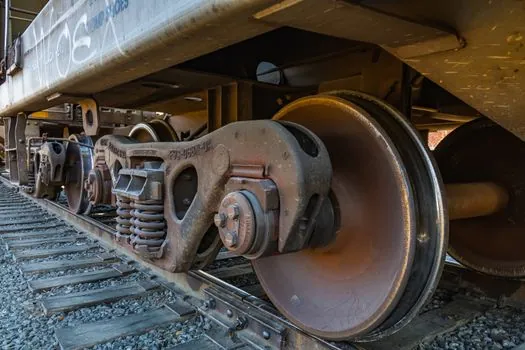
A356-T6 is the workhorse alloy for rail structural gravity castings, hitting strength-to-weight and ductility that sand and high pressure die casting struggle to match in a single part [S2]. A319 enters the spec when higher silicon content is needed for fluidity in thinner sections such as motor end covers, accepting some ductility loss. LM25 (the British designation for a similar Al-Si7Mg composition) is the historical default for rail programs in the UK supply chain [S4].
T6 treatment, solution soak plus artificial aging, raises A356 to 290 MPa tensile and 210 MPa yield minimums on the cast test-bar, with 4% elongation as the ductility floor [S2]. T5 is acceptable for less loaded brackets and covers, but bogie side frames and traction housings should not be downgraded to T5 without explicit fatigue-life justification. Tilt-pour plus a properly fed riser network is what keeps the T6 batch free of shrinkage porosity that would otherwise fail ultrasonic or radiographic inspection.
Comparison of Casting Routes for Rail Components
Sand casting fits prototype and very large parts where pattern cost is acceptable, but it loses on dimensional repeatability and surface finish [S1][S5]. High pressure die casting wins on cycle time and thin-wall fill, but it traps gas in heavier sections and disqualifies many T6-critical rail parts [S2]. Low pressure die casting sits in the middle, with a pressurized riser pushing metal up through the gate, and is the right pick for safety-critical wheels and suspension arms on some European rail platforms.
Gravity die casting is the default pick when wall sections run 4–12 mm, annual volume falls in the medium band (a few hundred to a few thousand parts per year per tool), and the part must respond to T6 without blistering [S1][S2][S5]. The economics work because the permanent die is reusable across thousands of cycles, while sand tooling breaks every cycle and high pressure dies are wasted on parts that do not need their thin-wall agility. The process band is also documented in the broader die casting machine reference, which situates gravity units against high pressure and vacuum variants.
Limitations, Failure Modes, and Sourcing Signals
Three failure modes dominate when a gravity die casting machine is misapplied: the required wall section will not fill, a T6 heat-treated batch blisters from trapped gas, and per-part cost never drops as volume climbs [S2]. Porosity from poor riser design is the most common rejection cause at ultrasonic inspection, and it is almost always a DFM issue caught only after the die is cut.
Tooling cost is a sunk cost the moment it is approved, so DFM review before die cut is the highest-leverage step in the sourcing cycle [S2]. For buyers who also need to track surface finish downstream, the sand blasting machine TCO reference maps air and media cost per square meter, useful for sizing the cleaning cell around a gravity casting line. For mold base steel selection on the die itself, the mold base selection for pump and valve production guide covers hardness, frame class, and expected die life in the same hardness bands that rail gravity dies require. The rail market itself is a recognized gravity casting end-use, listed alongside automotive, aerospace, and marine by long-standing UK foundries [S4].
Trackable signals for the next sourcing cycle: A356-T6 cast test-bar results to EN 1706 minimums on every heat, tilt-pour versus stationary pour configuration, and permanent die material certificate (DIN 1.2343 / H11 tool steel is typical). The aluminum die casting machine page covers machine variants built around aluminum alloys, including the gravity tilt-pour class most rail programs specify.