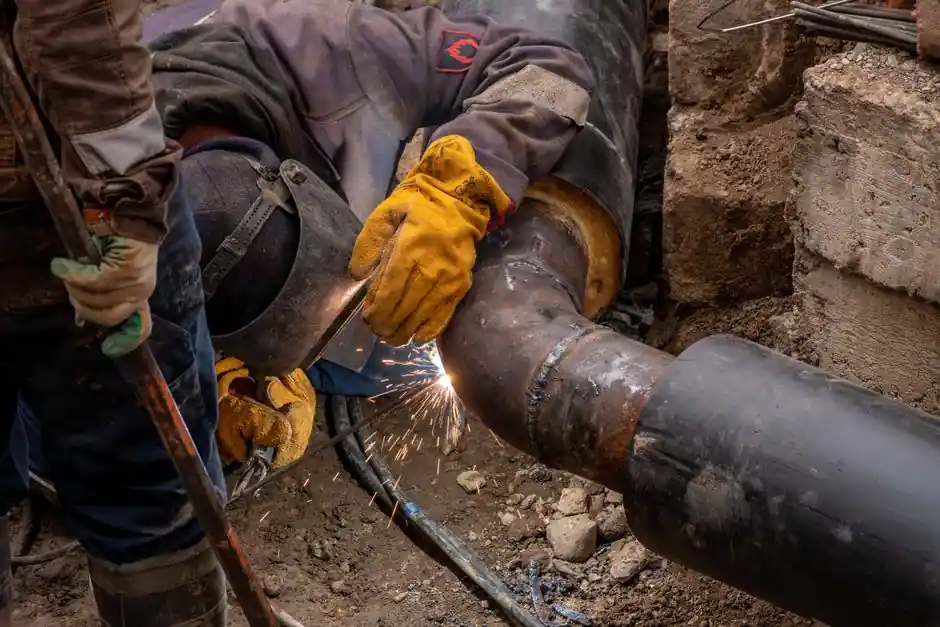
GTAW and TIG refer to a single arc welding process that uses a non-consumable tungsten electrode, an inert shielding gas (argon or helium), and a constant-current power source to join thin stainless steel, aluminium, magnesium, and copper alloys [S1][S3].
"TIG" is the informal label popularized in shop-floor usage, "GTAW" is the American Welding Society (AWS) designation, and "Heliarc" was the original 1941 trade name from Northrop Aircraft for a helium-shielded variant patented by Russell Meredith [S1].
Why three names exist for one process
The terminology split is historical, not technical: in 1940s Northrop Aircraft development of the magnesium XP-56 airframe, Vladimir Pavlecka, Tom Piper, and Russell Meredith coined "Heliarc" for the helium-shielded tungsten electrode process and patented the torch design in 1941 [S1].
As bottled inert gas supplies matured in the 1930s and Linde Air Products developed air-cooled and water-cooled torches with gas lenses, the process spread beyond aerospace; "TIG" (tungsten inert gas) became the dominant European and shop-floor shorthand, while the AWS formalized "GTAW" (gas tungsten arc welding) as the official standard nomenclature [S1]. Today all three terms appear on weld procedure specification (WPS) documents, OEM datasheets, and training curricula interchangeably [S1][S2][S3][S5].
Process mechanics every specifier should ground
GTAW requires a drooping, constant-current power source (DC or AC); a flat-characteristic source (typical of MIG/GMAW) will fuse the tungsten to the workpiece on contact, because TIG does not self-regulate current through a consumable electrode dip [S3].
DC electrode negative (DCEN) places roughly two-thirds of the arc heat at the workpiece anode and one-third at the tungsten cathode, preventing electrode overheating; AC reverses polarity at about 50 Hz and is used for aluminium and magnesium because the electrode-positive half-cycle strips the tenacious surface oxide film [S3]. Arc starting relies on high-frequency (HF) sparks of several thousand volts lasting microseconds, ionizing the electrode-to-workpiece gap, with HF also reigniting the arc at every AC half-cycle reversal [S3]. For more on electrode polarity and process control, see the TIG welder reference.
GTAW vs GTAW-P: where the terminology actually forks
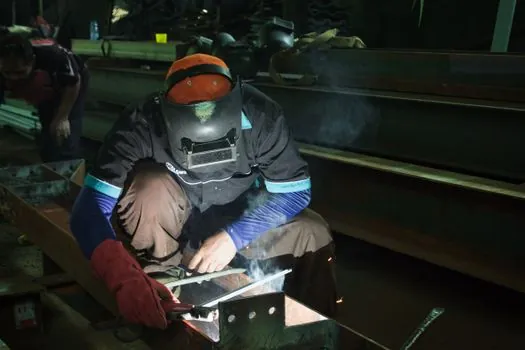
The only operationally meaningful terminology fork inside the GTAW family is GTAW versus GTAW-P (pulsed GTAW); both use the same tungsten electrode and inert shield, but GTAW-P modulates the welding current between a high peak and a low background to control heat input on thin material and dissimilar joints [S4].
GTAW torches split into two cooling classes: air-cooled for thinner material and lower amperage, and liquid-cooled for higher-amperage, thicker-section work where heat dissipation in the torch head becomes a duty-cycle limit [S6]. Shielding gas choice is independent of the name: argon is the default for steel and most stainless work, helium-rich mixes raise arc voltage and heat input for high-speed aluminium, and the "Heliarc" trade name survives primarily in helium-shielded specifications [S1][S3].
Selection criteria: when the process name is irrelevant, and when it is not
For procurement and WPS review, the acronym matters only in two places: AWS-coded weldment documentation (use GTAW), and European / shop-floor communication (TIG is standard). The underlying parameters, electrode classification (e.g. pure tungsten or 1-4% thoriated for DC), filler metal, and shielding gas spec, are identical regardless of which label is printed on the machine or procedure [S1][S3][S5].
The process suits thin-section stainless (typical food-grade and pharmaceutical pipe), non-ferrous alloys (aluminium, magnesium, copper), and any joint where slag-free, low-spatter, high-cosmetic-quality welds are mandated; it is the wrong tool when deposition rate, thick-section productivity, or field portability dominates, because GTAW is significantly slower than GMAW/MIG and shielded metal arc welding (SMAW/stick) [S1].
Cost-versus-control trade-offs line up as follows: GTAW offers the highest operator control and cleanest beads but the lowest deposition rate and steepest skill curve; GTAW-P adds pulse control for thin-gauge and out-of-position work at the cost of more complex power-source programming; GMAW/MIG trades control for speed on thicker ferrous sections; SMAW/stick trades speed for field portability and outdoor tolerance [S1][S4].
Quality and safety constraints specific to GTAW nomenclature
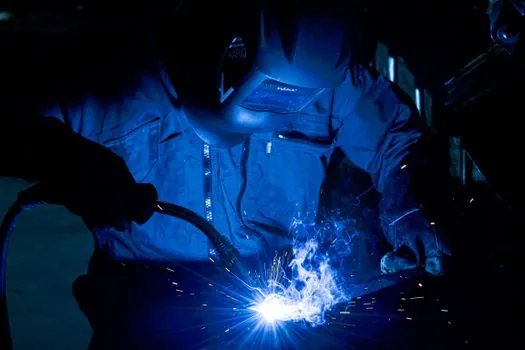
Because HF starting generates abnormally high electromagnetic (EM) emission, both air-borne and conducted along power cables, GTAW installations must be evaluated for interference with adjacent control systems and instrumentation; this constraint applies identically whether the procedure sheet calls the process TIG or GTAW [S3].
For weld inspection contexts, porosity and inclusion defects in critical cast or wrought joints are typically evaluated by X-ray radiography versus ultrasonic testing, and GTAW's slag-free autogenous or filler-added welds generally produce lower defect rates than flux-based processes when operator skill is held constant [S1]. Operators should also note that the consumable category of welding and cutting tools for GTAW is restricted to filler rods and tungsten electrodes, with no continuously-fed consumable wire as in GMAW.
Trackable signals for specifiers
Next node: confirm on every incoming WPS whether the document lists "GTAW" (AWS A5.36 / A5.01 filler classification context) or "TIG" (ISO 4063 process code 141) before cross-referencing filler metal certifications, because the standard body cited will change but the required test results do not [S1][S3]. Watch for ISO 4063-141 explicit citation in European PED/EN 13445 pressure-equipment weld maps, where process-number traceability is mandatory and the colloquial "TIG" must be backed by the 141 designation.
Spec-level background on the components involved: pressure transmitter.