
External vibrators clamped to precast steel moulds deliver centrifugal force from roughly 2.9 kN (294 kgf) on small electric high-frequency units up to about 60 kN (6,118 kgf) on pneumatic high-speed models, with 100 Hz (6,000 VPM) being the dominant operating point for box-element moulds [S5][S7].
Selection is driven by mould mass, reinforcement density, concrete rheology, and the geometry of the element being cast; pairing multiple lower-force units across the mould face gives better coverage than one high-kN unit, and effective vibration reach per unit is about 0.9–1.5 m radius [S2].
Centrifugal Force Range and Frequency Map for Precast Moulds
Electric high-frequency external vibrators for precast moulds cover roughly 2.9 kN to 25.5 kN (294–2,600 kgf) at fixed 3,000 VPM (low speed) or 6,000 VPM (high speed), the latter requiring a frequency converter [S2][S5]. Pneumatic precast units extend the envelope to 7.1 kN to 60 kN (720–6,118 kgf) at 10,000–12,000 VPM, with the high end reaching about 20,000 VPM for fine-granule mixes [S5].
Frequency choices map directly to mould behaviour: 6,000 rpm (100 Hz) is treated in the literature as a compromise between equipment cost, amplitude, and compaction quality on steel moulds, with 4,500, 6,000, 9,000, and 12,000 VPM all common for clamp-on service [S1]. Brecon catalogues its general-purpose external vibrators up to 100 kN and above, indicating the upper end of what a single three-phase asynchronous motor with eccentric discs can reach in industrial formwork duty [S4].
Comparison: Electric High-Frequency vs Pneumatic vs Variable-Frequency External Vibrators
Three families compete on the precast mould floor. Electric 3,000/6,000 VPM units give 2.9–25.5 kN, run on standard three-phase supplies (6,000 VPM units need a frequency converter), and suit continuous-duty steel-mould tables where finish quality matters [S2][S5]. Pneumatic units cover 7.1–60 kN at 10,000–20,000 VPM, contain no electrical parts, and are favoured where spark-free service or very high frequency is needed; a single Haiyu-style core-mould station quotes 300 kN total vibrating force at 2,800–4,600 rpm from a multi-motor array, not a single unit [S5][S9].
Variable-frequency drives now span about 80–210 Hz of tuning range, letting operators adjust centrifugal force to the rheology of the mix and the fill stage, which is increasingly specified for new precast cells [S6]. Centrifugal force itself is set mechanically by repositioning the eccentric discs on the rotor shaft at standstill; counter-rotating pairs can be twisted to raise or lower the resultant kN, but both sides must be matched or the motor runs unbalanced [S2][S4].
Who It Is For and Who It Is Not For
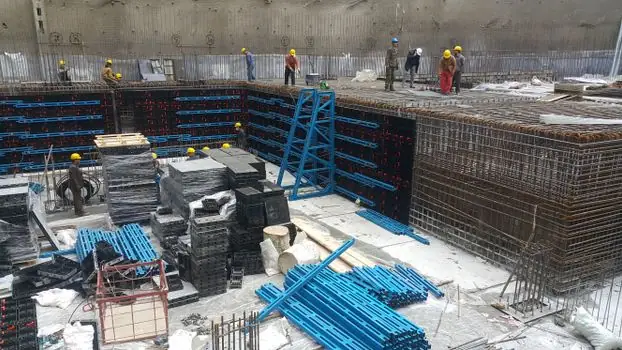
External mould vibrators are the right tool when the geometry blocks an internal poker: dense reinforcement cages, narrow walls, deep box culverts, silos, double-T or hollow-core beds, and any precast element where surface finish on the closed face is critical [S2]. They also fit cast-in-place sections too heavily reinforced for immersion vibration [S1][S2].
They are the wrong tool when an internal poker can reach the mix, when the mould wall is not stiff enough to transmit vibration without fatigue cracking, or when the concrete is so stiff that the 0.9–1.5 m radius per unit cannot cover the pour [S2]. For very high-kN consolidation duty above roughly 100 kN per station, a multi-vibrator clustered table or a centrifugal spinning machine, not a clamp-on, is the engineering choice [S4][S9].
Selection Criteria: Sizing Centrifugal Force to the Mould
Four numbers drive the kN choice: total moving mass (mould plus fresh concrete plus reinforcement), concrete slump and aggregate size, mould face stiffness, and the geometry of the part [S2][S4]. The literature recommends distributing several lower-kN units along the ribs of the formwork rather than one oversized unit, because cover radius is fixed at about 0.9–1.5 m and rib mounting avoids cracking the face plate [S2].
Mounting discipline is part of sizing: clamps must land on the ribbing where the mould is structurally stiffest, and eccentric adjustments must be matched on both sides of the shaft to keep the rotating mass balanced, since unbalanced force is what damages bearings and stators on these continuous-duty three-phase motors [S2][S4]. Vibration time of 2–3 minutes per lift is the working envelope, with the operator watching for air-bubble disappearance and a glossy surface as the stop criterion [S2].
Failure Modes and Field-Tested Behaviour on Steel Moulds

The IOSR-JMCE time-history study on a precast box steel mould under external vibration (Aktas, 2025) measured transverse deflections at multiple points on the mould face for empty and full conditions, then matched them against finite-element mode-superposition and Ritz-vector results, concluding that vibrator placement is what controls whether compaction is uniform, not raw kN [S1].
Real failure modes are predictable: bearing and stator burnout from continuous duty in dusty precast halls, face-plate fatigue at clamped ribs when the kN is mis-sized to the panel, and unbalanced rotation when the eccentric discs are not matched on both sides of the shaft [S2][S4]. High-frequency units also need a frequency converter and a vibration-proof power cable rated for the thermal and mechanical load of continuous mounting on a moving form [S2][S4].
Standards, Sourcing, and Trackable Signals
No single ISO or EN standard prescribes a specific kN figure for a given mould size; sizing is a manufacturer-and-process engineering judgement based on the four inputs above, and the published ranges from OLI, ENAR, Mooser, Brecon, and Haiyu are the working references [S2][S4][S5][S7][S9]. Mooser positions its high-frequency external vibrator line specifically at 6,000 rpm for precast elements on steel moulds, which matches the 100 Hz compromise cited in the IOSR experimental paper [S1][S7].
Trackable signals to watch over the next planning cycle: variable-frequency 80–210 Hz drives moving from premium to standard option lists, pneumatic 20,000 VPM fine-granule units gaining share on architectural panels, and mould-side FEM placement studies (Ritz-vector type) replacing rule-of-thumb clamp positions on complex box moulds [S1][S5][S6]. For related process-engineering reads, the spec-driven comparison of drum ladle vs bucket ladle for molten iron and the excavator bucket breakout vs arm crowd force breakdown use the same kN-driven selection logic, while the concrete vibrator working-principles reference and the mold-base selection guide anchor the mould-side design choices that the kN figure has to satisfy.
For the relevant spec sheets and selection criteria, see centrifugal pump.