
Half-round dump bodies unload cleaner, weigh less, and resist impact better than square/rectangular bodies because the curved sidewall acts as a structural member, removing the need for internal cross-members [S3][S8]. Square and rectangular dump bodies win where a flat floor matters, such as spreading aggregate or carrying pallets and equipment in the bed [S3].
Three body styles dominate North American dump truck and trailer specs: traditional rectangle, half-round, and semi-elliptical (bathtub/tub) [S3]. The half-round is essentially a half cylinder rolled from a single sheet, so the body acts as a stressed skin, while the rectangular body relies on sidewalls, floors, and cross-members to carry load [S3][S4].
Structural Geometry and Why It Matters
Half-round bodies are roll-formed into a semi-circle, so the steel shell carries impact loads as a curved membrane rather than as a flat plate on cross-members [S3][S4]. That geometry eliminates most internal bracing, which is the single biggest source of tare-weight savings in this comparison [S3].
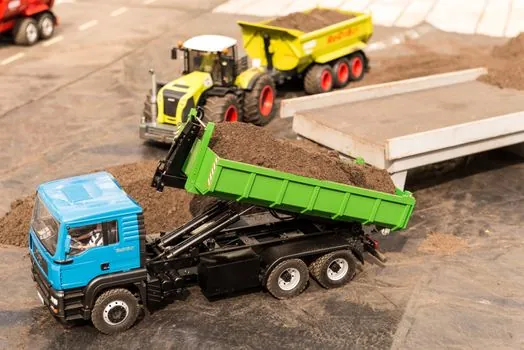
Rectangular/square bodies keep flat floors and vertical sidewalls, which means more floor area for material spread and a usable surface for pallets, equipment, and small tools [S3]. That flat floor needs longitudinal cross-members underneath, and those members are what catches sticky material in cold or wet conditions and adds tare weight to the chassis [S3][S9]. Semi-elliptical (tub) bodies sit between the two: a flat floor like a rectangle, with a curved front and rear haul like a half-round [S3][S6].
Payload, Tare Weight, and Legal Axle Limits
Payload is governed by gross vehicle weight rating (GVWR), the legally permitted maximum including chassis, body, engine, fuel, operator, and cargo [S3]. Federal bridge-formula weight laws in the U.S. scale the legal load by axle count, so a lower tare body directly raises the payload a truck can legally carry on public roads [S3].
Custom Truck and Pull-Tarps both state the half-round is lighter than the rectangular version, which is why it is often specified for highway dump trailers that need every kilogram of payload they can get [S3][S8]. The MAC Trailer half-round design is also documented as keeping the load centered and lowering the body's center of gravity relative to a tall rectangular body of the same struck capacity [S2]. Operators on TruckersReport have echoed the lighter-weight claim in long-running thread discussions, with one 2012 user noting the half-round also seemed to empty cleaner and faster than a square body [S1].
Unloading Behavior and Carryback

Half-round bodies shed sticky loads more completely because there are no internal cross-members or sharp floor seams for material to lock onto, and the curved floor feeds material toward the tailgate as the body rises [S3][S4][S9]. MAC Trailer describes this as quick-release functionality, with loads sliding out faster and fewer unloading slowdowns per cycle [S2].
Square and rectangular bodies have higher carryback in cold or wet service because material packs against floor seams, cross-member tops, and the corner where the floor meets the sidewall [S3][S9]. A 2013 AgTalk thread on frameless round-bottom trailers reports the same: round bottoms clean out better, with the historical Fruehauf frameless design cited as a reference point [S9]. Where asphalt, hot mix, or tacky clay is hauled, that carryback difference is a real operating cost in lost payload and in extra washout time at the end of the shift.
Body Material: Steel vs Aluminum in Either Shape
Either shape can be built in steel or aluminum, and the material choice has more impact on long-term cost than the shape choice for many fleets [S3][S5]. For Construction Pros quotes Ox Bodies' Bob Miller on a 36,000 psi yield mild-steel floor on the low end, up to abrasion-resistant (AR) plate approaching 200,000 psi yield at the high end, with Hardox 450 cited by JMH Trailers as a premium wear option [S5]. Custom Truck confirms the steel grade range used across the industry runs from A-36 up through AR-450 or AR-500, with steel preferred for abrasive loads like asphalt, gravel, and recycled concrete [S3].
Aluminum bodies trade higher unit cost and harder repair for lower tare weight and better corrosion resistance on non-abrasive payloads like grain, fertilizer, and clean aggregate [S3][S5]. The MAC Trailer half-round is built in aluminum specifically to maximize payload within road weight limits on bulk-haul routes [S2]. Crysteel's Joe Paulsen, quoted in For Construction Pros, warns that over-spec'ing the floor is also expensive: a 99-in-100 application sees the floor heavier than the sides or the ends, so floor grade should match the actual abrasion severity rather than the worst case [S5].
Side-by-Side Spec Comparison
The four criteria that actually drive a buying decision, scored on what the source material supports: [S3]
1. Payload capacity per axle: half-round wins. Lighter body, centered load, no cross-members to add tare weight [S2][S3][S8]. 2. Floor flatness / ability to carry pallets and equipment: square/rectangular wins. Flat floor spans the full bed length, half-round has a curved bottom that is not usable as a deck [S3]. 3. Cleanout and unloading speed on sticky loads: half-round wins. Curved floor, no cross-members, faster slide-out [S2][S3][S4][S9]. 4. Center of gravity for the same struck capacity: half-round wins at equal side height, but a square body can be built with shorter side heights for the same capacity, which also drops the CoG [S5].
A practical reading: pick half-round for bulk commodity haul where every kilogram of payload and every minute of unload cycle matters; pick square/rectangular for mixed service that includes equipment, pallets, or chunks of demolition debris; pick semi-elliptical/tub as a compromise that keeps a flat floor and sheds material at the front and rear of the body [S3][S6].
Use-Case Recommendations
Agricultural bulk haul (grain, lime, fertilizer): the original TruckersReport thread was opened in 2012 by a mixed-service operator pulling agricultural products, and the consensus in the half-round camp is that the lighter body pays back fast on every load [S1]. Aluminum half-round is the mainstream spec here because corrosion resistance matters as much as tare weight [S2][S3].
Construction aggregate and asphalt: steel is the default for abrasive loads, and either body shape works, but the half-round still wins on unload time and carryback in cold weather [S3][S5][S9]. For mixed contractor service that hauls a mini-excavator or pallets of bagged product, a square or semi-elliptical body keeps the floor usable as a deck [S3].
Demolition and scrap: stick with steel, AR-450 or Hardox 450 floor minimum, and favor the square or semi-elliptical body for impact resistance from dropped steel and concrete [S3][S5]. Reference points for dump truck body geometry in spec sheets can be cross-checked against the mining dump truck page when scaling the same half-round logic up to off-highway haul packs. Specialty side-dump and end-dump trailers in tub versus square-box form are covered in the side-by-side write-up at Maxim, where the tub-shape end dump is compared directly against the square-box end dump for the same payload class [S6].
Limitations, Failure Modes, and Sourcing Standards
The half-round's curved floor is not a flat working surface, so it cannot carry pallets, small equipment, or anything that needs to sit level inside the bed [S3]. If a fleet needs to use the dump body as a flatdeck occasionally, the rectangular body is the only honest answer; the semi-elliptical is a partial compromise but still has a curved haul at the front and rear [S3].
Welds are a documented weak point. Crysteel's Paulsen, quoted in For Construction Pros, treats weld count as a quality proxy: fewer welds on a body usually means a more premium build, because the OEM has the tooling to form steel rather than shear and stitch it [S5]. On aluminum bodies, Miller of Ox Bodies warns that aluminum cracks more easily than steel when abused and costs more to repair, so the operator discipline has to match the material [S5]. UHMW poly half-round liners are an option from builders like Wink Trailer for sticky or corrosive payloads, with the vendor claiming multi-year field service under heavy daily cycles [S7].
There is no single U.S. federal standard that mandates body shape for dump trucks; body geometry is a buyer specification, while the legally binding constraints sit on GVWR, axle spacing under the Federal Bridge Formula, and material-handling rules under DOT 406 / DOT 407 for any tanker-adjacent service [S3]. Steel grade selection should be checked against the actual yield and tensile data on the bodybuilder's cut sheet, since For Construction Pros shows a 36,000 psi to 200,000 psi spread across common options [S5]. Trackable signals going forward: new AR-450 and Hardox 450 floor options on half-round aluminum bodies, and the gradual migration of the turnover box concept from refuse into light-construction aggregate haul.
See also our earlier report, Flush vs Non-Flush Inductive Proximity Sensors: Spec-Based Selection.