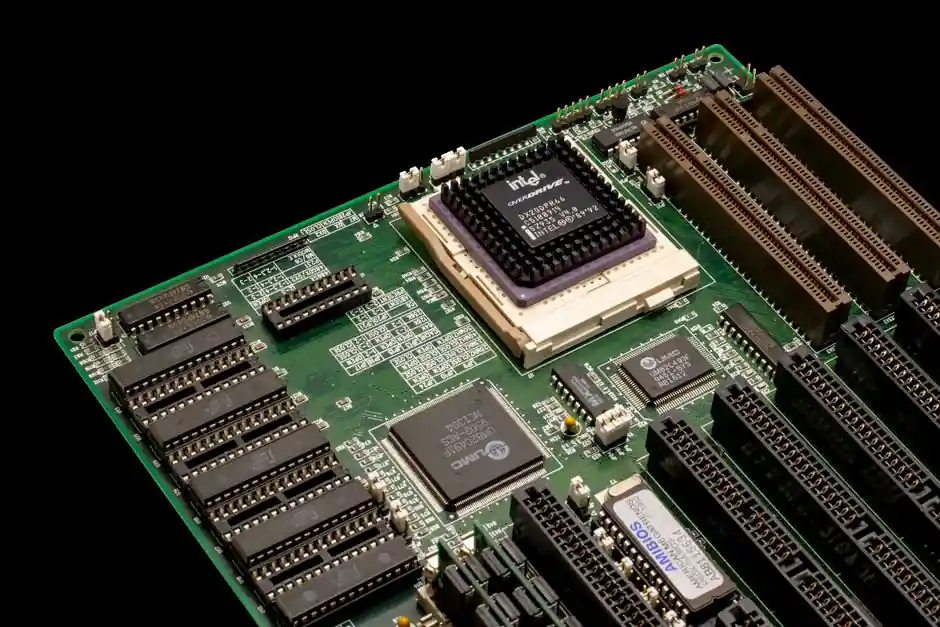
SK Hynix leads the global HBM market with 50-55% revenue share as of August 2026, ahead of Samsung and Micron, the only two other qualified HBM suppliers [S1]. The market reached USD 8.67 billion in 2026 per Straits Research, up from USD 6.96 billion in 2025, and is projected to scale to USD 50.05 billion by 2034 at a 24.51% CAGR [S2].
Demand continues to outrun supply through 2026, with new fab capacity requiring 12-18 months of lead time before ramp [S1]. The transition from HBM3E to HBM4 is the defining event of 2026: JEDEC formally announced the HBM4 standard in April 2025 [S8], and NVIDIA raised the HBM4 specification bar mid-cycle, forcing all three suppliers to resubmit samples before 2026 procurement shares could be finalized [S10].
Three-Supplier Oligopoly and Revenue Split
Only SK Hynix, Samsung, and Micron produce qualified HBM, a concentration that gives the trio significant pricing power, with HBM ASPs running 20-40% higher year-over-year in 2025-2026 [S1]. SK Hynix's 50-55% share is anchored by early HBM3E qualification on NVIDIA's H100, H200, and B200 platforms; Samsung and Micron compete for residual allocation and are now racing to qualify HBM4 stacks for NVIDIA's Vera Rubin generation [S1][S2].
The supply gap is structural rather than cyclical. Each HBM vendor must align stack yield, TSV throughput, and 2.5-D advanced packaging capacity with foundry partner roadmaps, and 2.5-D packaging capacity itself has emerged as a separate bottleneck independent of DRAM wafer output [S4]. HBM pricing has held firm: HBM3 stacks transact near USD 200 each, HBM3E near USD 300, and HBM4 around USD 550 per 36GB 12-high stack as of August 2026 [S1].
Verified Market Reports and Fortune Business Insights put the 2026 base lower (USD 3.7 billion and USD 3.73 billion respectively) than Straits Research (USD 8.67 billion), reflecting different scoping of the addressable market versus end-system revenue [S3][S5]. Readers should pick one definition and stay consistent; for supplier-level share analysis the USD 200-300-550 per-stack price points are the cleanest anchors [S1].
HBM4 Standard: April 2025 Announcement, 2,048-bit Interface, 2.8 TB/s Class
JEDEC's HBM4 standard, announced in April 2025, widens the per-stack interface to 2,048 bits, a step up from HBM3E's 1,024-bit channel width, and raises per-stack bandwidth into the 2.8 TB/s class [S2][S8]. Micron moved to high-volume production of its 36GB 12-high HBM4 in March 2026, targeting NVIDIA's Vera Rubin platform; the part delivers more than 2.8 TB/s of bandwidth, roughly 2.3x its HBM3E [S2].
Per-stack capacity is also climbing. The 16GB tier accounted for 38.20% of 2025 HBM shipments, but 32GB and above configurations are advancing at a 26.56% CAGR through 2031, and 36GB 12-high stacks are now in production across all three suppliers [S4]. HBM3 still led technology mix at 45.70% of 2025 revenue, with HBM3E forecast to grow 26.43% over 2026-2031 as the dominant shipping node before HBM4 fully takes over [S4].
Specifying engineers should treat HBM4 not as a single number but as a band: 2,048-bit interface, 2.8 TB/s per stack, 12-high 36GB capacity points, with custom-base-die logic options to support heterogeneous integration. The same 2.5-D interposer and TSV process chain underpins all three vendors, so qualification risk lives mostly in yield ramp and thermal envelope rather than fundamental architecture [S2][S4].
Application and Regional Mix: 67.8% Servers, Asia-Pacific 41%
Servers captured 67.80% of HBM revenue in 2025, and Asia-Pacific commanded 41.00% of the global market with a 26.66% CAGR projected through 2031, the strongest regional growth rate [S4]. North America was the largest single regional market at 38.42% share in 2025 per Straits Research, driven by hyperscaler procurement of AI training and inference clusters [S2].
Application mix is diversifying. AI/ML workloads are the fastest-growing application at 32.8% CAGR through 2034, and automotive and transportation HBM is the fastest end-application growth pocket at 31.4% CAGR, even though it is small in absolute terms today [S2]. Mordor flags edge-AI inference in automotive ADAS as a long-term driver worth roughly +1.6 percentage points of CAGR impact, modest in isolation but cumulative as 2.5-D packaging matures into AEC-Q100-qualified stacks [S4].
For procurement teams, the practical takeaway is that HBM allocation is locked in 12-18 months ahead of GPU ship dates, so a 2026 GPU platform decision translates into a 2027 HBM supply commitment, not a 2026 spot buy [S1]. Capacity stays supply-constrained through the end of the decade, which keeps vendor pricing power intact and forces second-source qualification work onto every AI accelerator roadmap [S4].
SK Hynix vs Samsung vs Micron: Capability and Qualification Comparison
The three HBM suppliers are differentiated less by spec (all three ship JEDEC-compliant HBM3E and HBM4) and more by qualification status, yield, and packaging partnership. SK Hynix holds the lead on 50-55% revenue share because of early NVIDIA HBM3E qualification and a mature 2.5-D interposer flow with its foundry partner [S1]. Samsung is ramping aggressively after early HBM3E yield issues, and is competitive on HBM4 pricing per bit. Micron entered HBM3E later but secured allocation with several AI chip vendors and shipped the first 36GB 12-high HBM4 to high-volume production in March 2026 [S1][S2].
For an engineer building a procurement shortlist, the criteria matrix below maps the trade-offs:
1) Qualification timing on target platform: SK Hynix earliest on NVIDIA H100/H200/B200; Micron ahead on Vera Rubin HBM4 timing [S1][S2].
2) Yield and ramp maturity: SK Hynix most mature HBM3E; Samsung and Micron closing the gap on HBM4 [S1][S2].
3) Pricing per bit: Samsung historically the most aggressive on HBM3E ASP; HBM4 spot near USD 550 per 36GB 12-high across vendors [S1].
4) Packaging partnership and TSV throughput: all three depend on 2.5-D interposer capacity that is itself bottlenecked, so lead-time risk is similar regardless of vendor [S4].
No second-source vendor outside this trio exists in 2026, so any HBM procurement strategy is a two-out-of-three redundancy calculation, not a four-vendor portfolio.
Standards, Sourcing, and Limits to Market-Share Data

Market-share numbers should be read with a definition pinned down: SK Hynix's 50-55% figure is a revenue estimate, not a unit-volume or bit-shipment figure, and it is sourced from a single editorial dashboard rather than a multi-source consensus [S1]. Fortune Business Insights' 25.8% "semiconductor and chip manufacturers" share from Straits Research refers to the share of the HBM customer base that is chip makers, not the share of any one supplier [S2]. Mixing those two slices is a common error in HBM write-ups.
Standards to anchor to: JEDEC HBM3 (announced 27 January 2022) and JEDEC HBM4 (announced April 2025) define the electrical and packaging envelope; 2.5-D integration via silicon interposers is the dominant packaging approach, with 5D IC interposer-based HBM holding 48.6% of 2025 integration-type revenue per Straits Research [S2][S8]. Government subsidies above USD 100 billion across Asia-Pacific and North America are underwriting fab expansion, but export-control regimes are bifurcating supply chains and slowing the cross-border flow of advanced packaging tooling [S4].
For data center and AI accelerator procurement, the practical limit to share-shift in 2026 is that NVIDIA raised HBM4 specifications after the initial sampling round, and the 2026 procurement split among SK Hynix, Samsung, and Micron remains uncertain pending post-resubmission qualification [S10]. Engineers who need a firmer supply commitment before the end of 2026 should lock in SK Hynix or Micron HBM4 now, and treat Samsung HBM4 as a qualified-but-ramping second source. Advanced packaging capacity, not DRAM wafer output, is the binding constraint through 2027, which keeps the three-supplier structure intact and limits the upside of any new entrant [S4].
Watch the Q4 2026 NVIDIA Vera Rubin volume ramp and Micron's 36GB 12-high HBM4 yield curve for the next share-shift signal, and track the HBM-P (photonics-ready) roadmap as a 2027+ vector that could reset packaging assumptions.
Spec-level background on the components involved: pressure transmitter, flow meter, and industrial valve.
For related coverage, see Cathode Material Process Control: Instrumentation Map for 2026 Co-precipitation.