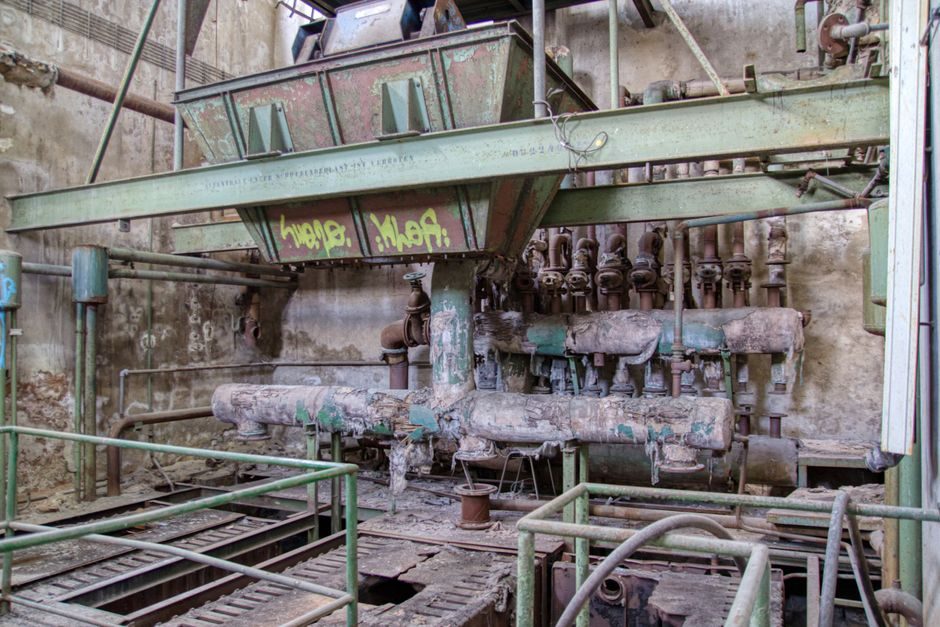
Selecting an industrial blower comes down to four numbers: required CFM, static pressure in inches water gauge (WG), maximum gas temperature, and the dust, moisture, or corrosiveness of the airstream. Modern OEM catalogues from Canada Blower and Oleg Systems span small panel fans in the low hundreds of CFM to mechanical-draft units rated up to 1,000,000 CFM at static pressures from 0 in. WG to 150 in. WG [S2].
The wrong match wastes energy; the right one is invisible. The selection logic below walks through family choice, the standards that govern testing and rating, and the failure modes that kill a blower before its bearing L10 life is reached. Expect concrete duty ranges, family-by-family trade-offs, and one or two places where the cheap option is the wrong option.
Centrifugal vs. Axial: The Family Decision Before Everything Else
Centrifugal fans and axial fans cover different ends of the pressure-flow curve, and conflating them is the most expensive mistake in the early spec stage. Per current OEM product statements, axial fans are the workhorse for high-flow, low-pressure ventilation — typically 0.5 in. WG to 6 in. WG at the highest volumes — while centrifugal blowers pick up the heavy-pressure and high-temperature duties, with industrial pressure blowers regularly specified from 20 in. WG up to 150 in. WG and beyond [S2][S3].
Radial-blade and backward-inclined centrifugal wheels are the default for clean or mildly dusty air, with backward-curved wheels offering non-overloading power curves and forward-curved wheels delivering higher pressure per stage at the cost of an overloading power characteristic. Plug fans (a free-shaft centrifugal wheel mounted inside a cabinet) are increasingly common in built-up air-handling units, as listed in the Industrial Blower Co. product index [S3]. Multistage and regenerative blowers push static pressure higher still, and rotary-lobe positive-displacement blowers enter the picture once the duty crosses into pulsation-sensitive or true positive-pressure territory [S3].
Operating Envelope: Temperature, Pressure, and Gas Composition
High-temperature industrial fans are engineered for gas temperatures where standard cast-aluminium or cold-rolled-steel housings lose creep strength, and OEM descriptions reference design and material options for "high temperature ventilators" specifically [S3][S4]. Canada Fans publishes heavy-duty lines that target erosive/corrosive gas streams, large capacities, high pressures, and temperature extremes, with belt-drive and direct-drive options across the same family [S4].
Corrosion and erosion drive the material call. Fiberglass Reinforced Plastic (FRP) construction appears as a stock option in both Oleg Systems and Canada Blower catalogues for acid mist and humid exhaust duties [S2][S3]. For abrasive particulate — baghouse outlets, grain handling, cement kilns — hard-faced impellers and replaceable liners are the standard mitigation. Explosion-proof blower and fan models also appear in the Industrial Blower Co. product line, addressing ATEX-classified and NEC Class I Div 1 environments where a standard TEFC motor will not do [S3].
Sizing Math: Reading a Fan Curve Without Lying to Yourself
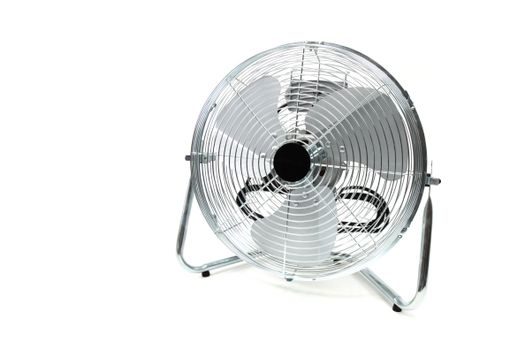
Every selection starts with two numbers: the system curve (resistance vs. CFM, dominated by duct friction, fittings, and process equipment) and the required operating point (design CFM at design static pressure). The fan must run near its best efficiency point (BEP) — typically between 70% and 110% of BEP for non-overloading wheel types — and never at shutoff (zero CFM) for more than the start transient, or motor nameplate amps will be exceeded. [S2]
Fan laws are unforgiving: flow scales linearly with RPM, static pressure with the square of RPM, and brake horsepower with the cube. Doubling speed roughly doubles flow at 4× pressure and 8× power — which is why variable-frequency drives are the cheapest capacity-control option for a process whose demand swings more than 30%. Density corrections matter whenever the gas is not standard air (70°F / 0.075 lb/ft³); a 500°F gas stream at the same volumetric CFM demands a fan rated for the correspondingly heavier mass flow.
Standards and Ratings: What the Datasheet Should Already Show
Fan performance should be catalogued against AMCA (Air Movement and Control Association) test standards for sound, performance, and feI classifications, with ISO 5801 covering industrial fan performance testing under code. Certified ratings give the buyer a real curve, not a marketing one — and the difference shows up on the electricity bill. [S1]
For hazardous-area duty, ATEX 2014/34/EU (European equipment for explosive atmospheres) and IECEx certification schemes define the equipment-protection-level vocabulary, with motor and blower matched to the gas group and temperature class. Material standards for corrosion service reference ASTM-grade stainless steels and alloys, while ductwork and casing gauges follow SMACNA HVAC construction where applicable. Buyers should expect nameplate data to include CFM, total static pressure in in. WG, outlet velocity, RPM, and BHP at the design point, all tied to an AMCA-certified test report [S3][S4].
Selection Criteria Mapped Across the Four Main Families

Comparing the families on decision criteria gives a shortlist rather than a guess:
Axial fans (vane-axial and tube-axial) suit duties up to roughly 6 in. WG with CFM into the hundreds of thousands; they are compact and efficient at high flow, but limited on pressure and more sensitive to inlet swirl and dust.
Centrifugal fans (forward-curved, backward-inclined, backward-curved, radial) span the full industrial pressure range; backward-curved wheels give a non-overloading power curve and are the cleanest fit for clean-air and HVAC duty, while radial-blade wheels are specified for dust and high-temperature service.
High-pressure centrifugal blowers and regenerative blowers cover 20-150 in. WG and beyond, used for combustion air, pneumatic conveying, and process gas boosting, at the cost of higher RPM, higher noise, and tighter bearing life budgets.
Rotary-lobe positive-displacement blowers deliver pulsation-free flow at fixed RPM and are the default for aerobic digester air, fish-farm oxygenation, and material-handling vacuum duty; their mechanical limit is temperature rise across the lobes and discharge pulsation, not static pressure ceiling.
Cross-reference notes that may help a process engineer's wider spec work: Industrial Router Selection, Industrial Filter Manufacturing Process, and Smart Manufacturing Reshapes Industrial Filter Production all sit in the same plant-engineering spec ecosystem this blower map feeds into.
Failure Modes and Constraints: What Kills a Blower
Bearings are the number-one replacement item, and the L10 life rating on the bearing datasheet is the floor, not the ceiling — heat, dust ingestion, and belt tension all cut it. Belt drive requires periodic tension checks; direct-drive eliminates the maintenance but couples motor failure modes directly to impeller imbalance. [S3]
Abrasive wear on the impeller and housing is the second silent killer; backward-inclined and backward-curved wheels with their smoother blade-entry geometry resist build-up better than radial blades but still suffer at high dust loading. Thermal growth on high-temperature fans warps shafts and cracks casings if expansion joints and shaft-cooling provisions are skipped. Surging — the aerodynamic stall of a fan running far left of BEP — is a centrifugal fan issue that shows up as cyclic noise, vibration, and eventual bearing damage; the cure is to throttle the system or trim the impeller back toward the duty point.
Where a centrifugal is wrong: very high CFM at low pressure where an axial fan is more efficient, true pulsation-free positive pressure where a rotary lobe is mandated, and any gas containing large particulate or stringy material that will foul a centrifugal wheel faster than a simple axial blade.
Shortlist Logic: From Duty Statement to a Three-Line Quotation Request
Turn the spec into a one-page RFQ: required CFM, required static pressure in in. WG, gas density or temperature, allowable noise level, dust or corrosiveness, and the motor standard (NEMA, IEC, hazardous-area class). Add duty cycle — continuous, intermittent, VFD-controlled — and any redundancy requirement. A 1,000,000 CFM mechanical-draft unit is not the same product line as a 5,000 CFM roof ventilator, and OEM catalogues reflect that segmentation [S2][S4].
Send the same RFQ to three vendors covering three families: one axial specialist, one centrifugal OEM, and one regenerative or rotary-lobe supplier for high-pressure / pulsation-sensitive duty. Compare nameplate data at the same inlet density, ask for AMCA-certified curves, and read the noise data in dBA at 3 m rather than dB. A buyer who does that exercise on three bids will normally save 10-20% on the installed price and end up with a fan that runs near BEP rather than one sized by the seat-of-the-pants rule of "bigger is safer." The next spec event to track is the AMCA/ASHRAE fan-efficiency update, which continues to push minimum total-efficiency limits higher across the catalogue. Also worth monitoring is the Industrial Mixer Price Map 2026 for adjacent rotating-equipment cost behaviour.
Spec-level background on the components involved: linear guide, crossed roller guide, and industrial adhesive.