Heat exchanger selection is a four-axis decision: duty type (liquid/liquid, condensing, evaporation, two-phase), material compatibility, allowable pressure and temperature, and fouling tolerance — each axis must be locked before browsing catalog pages, because the same kW rating can shift unit cost by a factor of 3-5x across plate, brazed-plate, and shell-and-tube geometries [S1][S8].
Process engineers in oil & gas, chemical, HVAC, and district heating routinely shortlist three to four families: gasketed plate, brazed plate (BPHE), welded plate, and shell-and-tube — and the choice between them is driven less by heat duty and more by the worst-case combination of ΔT, allowable pressure drop, fluid aggressiveness, and maintenance access [S1][S7]. Reference data for shell-and-tube sizing consolidates in Nitsche & Gbadamosi's "Heat Exchanger Design Guide" (1st ed., Elsevier), still the de-facto shop-floor reference for TEMA-class selections [S4].
Heat Exchanger Families and the Duty Each One Owns
Gasketed plate heat exchangers (GPHE) hold the largest share of new liquid-to-liquid installations in HVAC, district heating, and light-chemical service because they deliver the highest heat-transfer area per m³ of any compact geometry and can be expanded by adding plates — Alfa Laval's selection guide segments GPHE into "standard duties" (heating, cooling, heat recovery, condensation, evaporation) versus hygienic and heavy-duty variants, with the cut-over driven by gasket chemistry and plate pattern [S8]. Plate units typically cap at the 25-30 bar / 200-225 °C envelope for standard EPDM or NBR gaskets; the Armstrong ABX plate-and-frame line, for example, is published at 435 psi (≈30 bar) and 435 °F (224 °C) with stainless, nickel-alloy, and titanium plate materials, covering 0.5-160 USgpm in-stock and up to 600 USgpm on engineered builds [S2].
Shell-and-tube exchangers remain the default for high-pressure hydrocarbon, refinery, and steam duties where mechanical integrity over 30 bar and proven TEMA-class maintainability outweigh the compactness penalty — they accept the widest range of tube materials (carbon steel, copper-nickel, stainless, titanium) and tolerate fouling streams that would plug plate channels [S1][S7]. Welded, semi-welded, and brazed plate heat exchangers (BPHE) sit between the two: BPHE units eliminate gaskets on the process side and survive refrigerant and aggressive-glycol loops, while semi-welded plates handle ammonia and corrosive chemicals where full GPHE gasket attack is a risk [S1][S8].
Selection Criteria: the Four Numbers You Lock Before the Quote
Engineers should commit four primary numbers before vendor selection: (1) heat duty Q in kW or MMBtu/h, (2) both side inlet/outlet temperatures to fix LMTD, (3) maximum allowable pressure drop on each stream, and (4) maximum allowable working pressure and temperature at the design condition — these are the inputs the OEM thermal-rating software (e.g. Alfa Laval's GPHE selection tool, HEXONIC's configurator, or Heatex Select) requires for a first-pass plate-count or shell-bundle sizing [S3][S5][S8]. Secondary inputs that move the recommendation decisively are fluid aggressiveness (chloride content for stainless vs titanium), fouling factor (clean water vs refinery hydrocarbon), and cleaning access — the last of which is the single largest reason a process unit will accept the higher ΔP of a GPHE over a shell-and-tube [S1][S7].
The shell-and-tube design discipline, codified for process engineers in Nitsche & Gbadamosi, walks the selector through TEMA classifications (BEM, AEL, AES, etc.), tube layout (triangular vs square pitch), and baffle cut before the geometric envelope is fixed — this is the workflow that drives the ~$50k-$500k heavy-refinery units that GPHE cannot serve [S4]. For duties under ~1 MW in clean liquid service, plate geometries are almost always the lower-cost answer; for two-phase, high-pressure, or solid-bearing streams, shell-and-tube remains the engineered default [S1][S7].
Material Selection: Stainless, Nickel Alloy, Titanium, Copper
Plate material is governed by chloride concentration, pH, and temperature rather than by pressure — 304/316 stainless dominates clean water and glycol service, while chloride contents above ~200-300 ppm in hot water push the spec to 904L, SMO, or titanium, and strongly oxidising or reducing chemicals push it to nickel alloys (Alloy 276, C-276, C-22) [S1][S2]. The Armstrong ABX plate-and-frame line publishes plates in stainless, nickel alloys, and titanium as standard options, with gaskets in elastomer, "sigma coat," and compressed non-asbestos fibre — material pick therefore becomes a 2-axis decision (plate alloy × gasket chemistry) rather than a single call [S2].
Titanium Grade 1/Grade 2 tube and plate exchangers are the de-facto spec for seawater, brackish cooling, and chlorinated pool heating where stainless would pit within a season — Chinese manufacturers (e.g. ET Heat Exchanger) routinely quote titanium tube and coaxial geometries for pool, marine, and HVAC-refrigeration duties where the cost premium over 316L is recovered inside 2-3 years of avoided downtime [S6]. Copper and copper-nickel (90/10, 70/30) remain standard for freshwater HVAC and marine condensers because of their high thermal conductivity (~330-350 W/m·K vs ~16 for 304L stainless), but are chemically incompatible with ammonia, amines, and low-pH condensate [S1].
Compactness, ΔP, and Fouling: the Trade-off Triangle
Plate geometries deliver 3-7× the heat transfer area per m³ of a shell-and-tube at the cost of higher pressure drop per kW transferred — typically 20-50 kPa on the hot side of a clean water-to-water GPHE versus 5-15 kPa across a comparable shell-and-tube, which is the engineering reason process engineers cap plate usage at clean or mildly fouling services and route fouling streams to shell-and-tube where the larger channel cross-section survives longer between cleanings [S1][S7][S8]. Fouling factor is therefore the silent selector: a refinery hydrocracker stream at 0.0005 m²·K/W fouling immediately disqualifies a standard plate geometry and pushes the spec to a wide-gap plate or a removable-bundle shell-and-tube [S1][S7].
Brazed plate heat exchangers (BPHE) remove the gasket failure mode and tolerate higher pressure/temperature than gasketed plate — typically up to 45 bar / 200 °C in copper-brazed stainless — making them the standard for refrigeration evaporators, condenser loops, and district-heating sub-stations where zero-gasket-leak is a contractual requirement [S1][S8]. The trade-off: BPHEs cannot be mechanically cleaned, so the upstream strainer and water-quality discipline become the operational constraint instead of the gasket.
Who Plate Is NOT For — and When to Walk Away
Gasketed plate heat exchangers are the wrong answer when the service includes fibre-bearing pulp slurries, polymerising hydrocarbons, or solids that plate out below 80 °C — these services plug plate channels inside weeks and force weekly strip-downs that wipe out the OPEX saving against a shell-and-tube [S1][S7]. They are also the wrong answer for hydrocarbon service above ~25 bar or 250 °C, where gasket creep and plate fatigue set hard ceilings, and where ASME B&PVC or PED Category IV stamping of a welded shell is required by code rather than preferred [S1][S4].
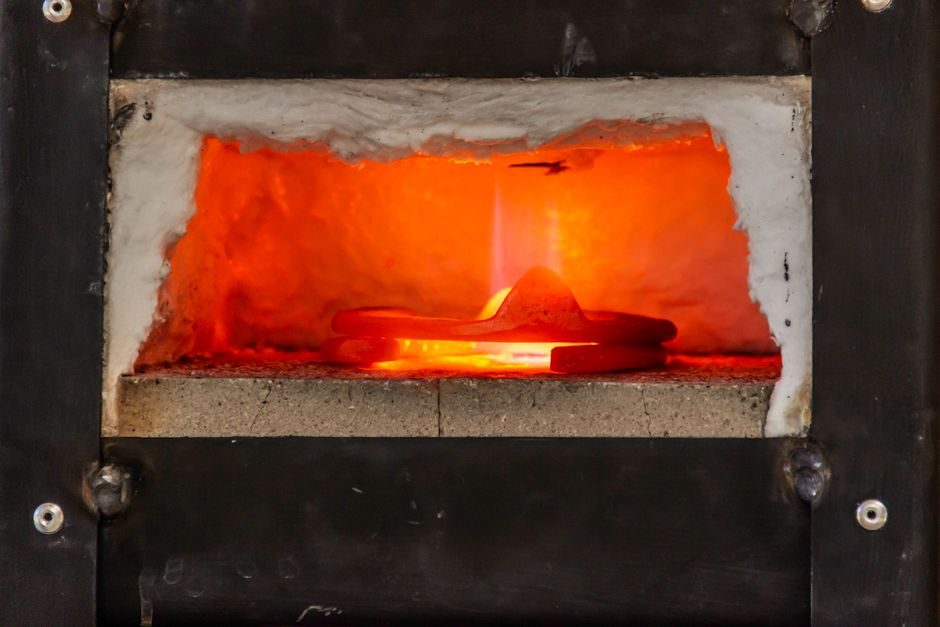
A related selection tool is the basket strainer upstream of any compact exchanger — mesh and basket geometry are locked before the heat exchanger OEM will accept a thermal guarantee, and the basket strainer selection spec axes are the upstream gating decision. For high-pressure hydrocarbon and steam relief downstream, pressure relief valve sizing and code anchors drive the relief-stream branch. On the process control side, plate exchanger outlet temperature loops pair with pressure transmitter selection for ΔP and head measurement, and the flow meter on each side is the primary input to the heat-duty calculation. For furnace-heated upstream streams, the heat treatment furnace reference covers radiant-section design that often feeds the hot side of a process exchanger.
Standards, Codes, and What to Ask the Vendor
Three code families cover most process heat exchanger specs: ASME B&PVC Section VIII Div 1 (stamping for unfired pressure vessels in North America), the Pressure Equipment Directive (PED 2014/68/EU) for European CE-marked builds, and TEMA (Tubular Exchanger Manufacturers Association) for shell-and-tube mechanical standards — every engineered quote should reference which class applies, and the OEM should publish the TEMA designation (e.g. BEM, AEL) for shell-and-tube builds or the PED category for plate units [S1][S4]. For refinery and sour service, NACE MR0175 / ISO 15156 compliance on wetted parts is a hard requirement and must appear on the datasheet, not just the commercial proposal [S1].
A short buyer checklist that filters the quote list: (a) stamped maximum allowable working pressure at design temperature, (b) plate/tube material with mill certificate reference, (c) gasket material with published pH and temperature envelope, (d) thermal guarantee with stated fouling factor (typically 0.0001 m²·K/W for clean water, 0.0002-0.0005 for cooling-tower water, 0.001+ for process streams), (e) ΔP at rated flow on both sides, and (f) CE/ASME/NACE marking as applicable [S1][S4][S8]. A vendor that cannot return all six inside a week is not yet a serious bidder.
Close-out signal to track over the next quarter: Heatex Select and OEM configurators (Alfa Laval, HEXONIC, ET, Armstrong) continue to add digital twin and performance-degradation modules that re-rate exchangers against live operating data — the practical effect is that the 2026-vintage quote carries a 5-10 year thermal-performance warranty where 2020-vintage quotes carried only a mechanical warranty [S3][S5][S8]. Watch the OEM datasheet revision dates and the connected-service availability before locking the supplier.