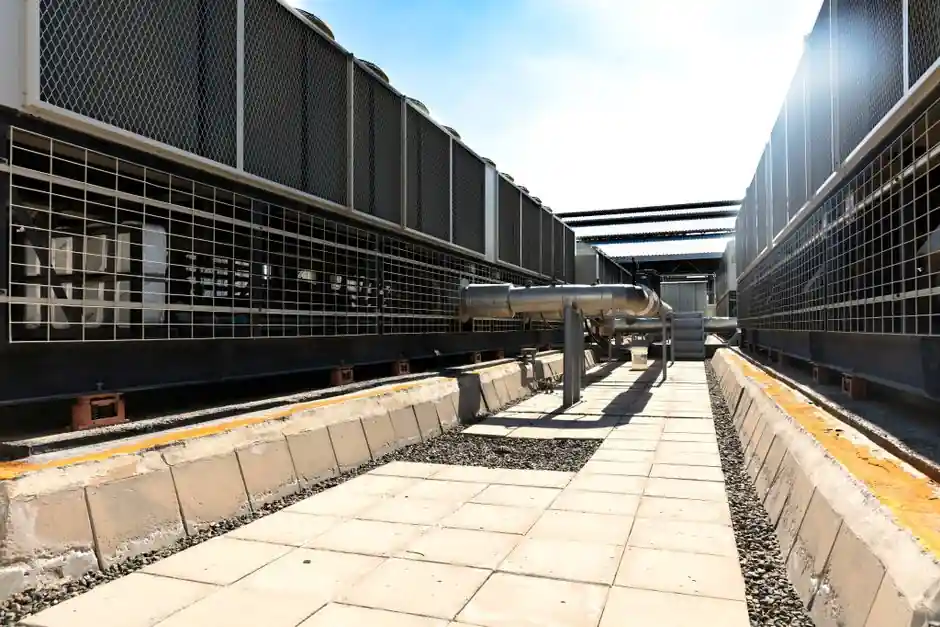
Midea Building Technologies (MBT) has deployed more than 700 upgraded shop-in-shop displays across Europe in the past two years and committed over 60 million euros to new production and R&D facilities, making it the most documented reference point for Industry 4.0 adoption inside the heat pump OEM base [S3].
The OEM/ODM cluster concentrated in Guangdong lists air-source, air-to-water, swimming-pool and hot-water heat pumps as its core export SKUs, with R&D capacity structured around customised product runs rather than proprietary platforms [S1]. A separate technology-trends forecast frames the sector as moving from mechanical-only assemblies into software-defined, inverter-driven units tied to photovoltaic and home-storage ecosystems [S5].
Industry 4.0 stack inside a modern heat pump line
A heat pump on an Industry 4.0 cell is no longer a sealed refrigerant loop; it is a node on the factory MES, with inverter compressor test data, vacuum leak-down results, and refrigerant charge values written to a per-unit record before the unit leaves the line [S4]. Midea's Super Advisor software, launched with France's Trace Software at Chillventa 2024, integrates photovoltaic inverters, home storage batteries, and heat pumps into a single energy-management layer, with published self-sufficiency figures of 80–90% in residential configurations [S3].
For process engineers, the practical implication is that field service now depends on the firmware build, not just the compressor serial. MBT operates 32 installer training centres across Italy, Germany, Hungary and Poland precisely because the service scope has shifted from brazing copper to flashing control boards and reading error logs from the iEasyEnergy platform [S3]. This is the same OEM that committed over 60 million euros to new European production and R&D facilities following its 2016 Clivet acquisition [S3].
Capacity tiers and where Industry 4.0 pays back fastest
The 2026 market segmentation splits capacity into discrete brackets: up to 10 kW, the 10–1000 kW mid-band, and above 1000 kW for district and process heat, with each tier demanding a different automation density [S2]. Residential air-to-water units below 10 kW are produced in the highest volumes and absorb the bulk of robotic brazing, inverter end-of-line testing, and barcode-traced component reels; above 1000 kW, units are typically engineered-to-order and Industry 4.0 value sits in configuration management rather than throughput [S2].
For buyers specifying new lines, the payback ranking is consistent: end-of-line inverter performance testing first, then vacuum and leak-down data capture, then traceability of refrigerant charge mass, and only then upstream coil forming. The reason is data: a heat pump's seasonal coefficient of performance (SCOP) cannot be guaranteed unless the inverter map and charge are recorded per unit, which is exactly the data Midea's iEasyEnergy stack consumes at the household edge [S3].
Decision criteria: air-source vs water-source vs hybrid

Three options dominate 2026 procurement: air-source, water-source, and hybrid (electric plus a fossil backup). On four decision criteria they line up as follows. (1) Installation cost: air-source is lowest because it needs no borehole or ground loop; water-source carries the civil cost of the loop; hybrid inherits the air-source bill plus a small auxiliary boiler. (2) Seasonal efficiency in cold climates: water-source holds SCOP advantage where ground temperature is stable; air-source units above 10 kW increasingly use vapor-injection cycles to recover part of that gap. (3) Process-heat suitability: water-source and high-temperature air-source split the above-1000 kW tier used in food, dairy and district heating. (4) Digital integration: hybrid systems score highest because the Super Advisor pattern already proves a heat pump, PV inverter and battery can be dispatched as one virtual asset, with field self-sufficiency of 80–90% [S3].
Operationally, electric-only air-source units remain the default for new European residential builds because subsidy frameworks in Germany, France and Poland are written around the air-to-water (ATW) format and reward the EU Net Zero Industry Act's streamlined approval path [S3]. Water-source is preferred where the building already has a ground loop, a river-water intake, or a waste-heat source above 10 °C year-round [S2]. Hybrid only makes sense where grid capacity is constrained or where a legacy boiler must remain in the tariff mix.
Standards, refrigerants, and the R290 transition
Two regulatory vectors are reshaping the BOM. The European Union's Net Zero Industry Act shortens approval timelines and pairs financial support with workforce training, while the European Heat Pump Association's Heat Pump Accelerator Programme targets nearly 10 million installed heat pumps by 2029, of which over 5 million units are air-to-water [S3]. Refrigerant choice is the second vector: Midea has publicly shown an R290 (propane) commercial heat pump, which carries a GWP of 3 versus the GWP of 2088 for R410A and 675 for R32, and pushes the design toward lower charge sizes and tighter leak-detection on every station of the Industry 4.0 line [S3].
For process engineers, the practical checklist is: confirm ATW or water-source classification on the nameplate, verify inverter firmware version against the service tool, record the refrigerant type and factory-charged mass from the unit's digital twin, and check whether the controller speaks the same protocol as the site's photovoltaic and storage assets before commissioning. A heat treatment furnace, similarly, now expects a digital commissioning record rather than a paper logbook. Industrial buyers cross-referencing boiler-room equipment should treat the heat pump's MES export as a deliverable in the same way they treat the heat treatment furnace refractory data sheet.
Who benefits, and where the model breaks
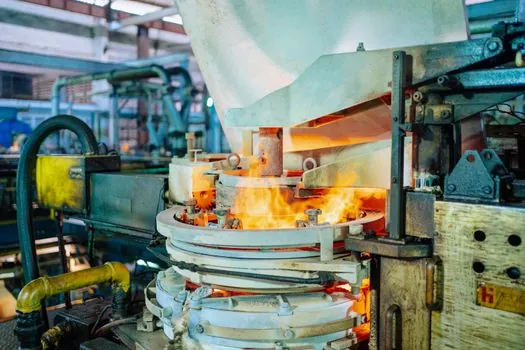
Industry 4.0 in heat pumps rewards buyers who already run a structured service operation. A housing association with 5,000 ATW units, a district operator with a 50 MW water-source array, and a process plant converting steam wash-down loops to 70 °C hot water all gain from per-unit digital records, remote firmware updates, and SCOP-verified warranty terms. The model breaks for one-off custom builds, for installers who cannot read an inverter log, and for sites where the electrical supply is single-phase and cannot support the inrush of an inverter compressor cluster above 10 kW without a soft-starter [S1][S2].
OEM/ODM partners in Guangdong continue to absorb the long tail of low-volume customisation, which is why the Made-in-China supplier base lists OEM/ODM R&D capacity as a primary differentiator rather than proprietary platforms [S1]. For an engineer weighing whether to standardise on a Tier-1 brand with an installed European training network, or to commission a regional OEM on a private-label build, the trade-off is data sovereignty versus unit cost: the Tier-1 path inherits a software ecosystem such as iEasyEnergy, the OEM path buys hardware at lower cost but requires the buyer to own the firmware and data layer themselves [S1][S3].
Trackable signals to watch over the next two quarters
Three verifiable signals will indicate whether Industry 4.0 adoption in heat pumps is accelerating or stalling. (1) Midea MBT's commercial heat pump revenue trajectory toward the published 1.15 billion euros by 2028 target, with a stated CAGR of 12% [S3]. (2) The installed base of air-to-water units in Europe, which the Heat Pump Accelerator Programme has pegged at over 5 million by 2029 against a 10 million total heat pump target [S3]. (3) The share of R290-equipped commercial units on the Guangdong OEM line, since propane's GWP of 3 versus the GWP of 2088 for legacy R410A is the strongest regulatory driver behind the next wave of factory retooling [S3].
A fourth, quieter signal is the European training-centre footprint: MBT's 32 centres across Italy, Germany, Hungary and Poland are the leading indicator of installer capacity, and any move to expand or contract that network will telegraph the next 12 months of field commissioning throughput [S3]. For process engineers specifying new centrifugal pump skids alongside a heat pump upgrade, the data plumbing is identical: per-unit commissioning records, remote firmware visibility, and a service toolchain the maintenance crew can actually operate.
For component-level specifications, see heat detector.
Related analysis: Sludge pump sourcing map: 2026 supplier landscape, price bands, and type selection.