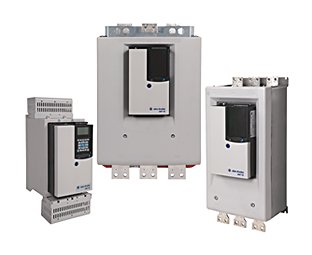
A soft starter is a solid-state motor controller that gradually ramps the voltage applied to a three-phase induction motor during startup, limiting the inrush current and the mechanical torque shock that a direct-on-line connection would otherwise impose. It uses back-to-back silicon-controlled rectifiers (SCRs, or thyristors) to phase-control the supply voltage from a reduced initial level up to full line voltage over a settable ramp time, then holds the motor at fixed line frequency for normal running.
Unlike a variable frequency drive, a soft starter does not change running speed: it controls only the start and stop transients. This makes it the economical choice for fixed-speed loads such as centrifugal pumps, fans, conveyors, and compressors where the goal is to protect the motor, the gearbox, and the supply network from the stresses of an uncontrolled start, not to regulate process speed.
Photo: ZianMan, CC BY-SA 4.0, via Wikimedia Commons
This guide is aimed at procurement engineers and design engineers selecting reduced-voltage starting equipment. It covers 6 chapters from working principle, starter types, control technologies, ratings and standards, spec-sheet decoding, to selection decisions, with 7 selection FAQs and manufacturer comparisons. All parameters reference the IEC 60947-4-2 standard for AC semiconductor motor controllers, its AC-53a and AC-53b utilization categories, and IEC 60947-4-1 contactor duty definitions.
Chapter 1 / 06
What is a Soft Starter
A soft starter, also called a reduced-voltage solid-state starter, is an electronic device that sits between the supply line and a three-phase induction motor to manage the starting transient. When an induction motor is connected directly to the line (direct-on-line, or DOL), it draws a locked-rotor inrush current of roughly 6 to 8 times its full-load current (FLA) and applies a sudden full-torque jolt to the driven machine. The soft starter suppresses both effects by feeding the motor a controlled, rising voltage instead of an abrupt full-voltage connection.
The physical basis is a single relationship: in an induction motor, electromagnetic torque is proportional to the square of the applied voltage, and the stator current is proportional to the applied voltage. By holding the voltage below nominal during acceleration, the soft starter reduces the starting torque and clamps the current draw. Reducing the voltage to 50 percent of nominal, for example, cuts the produced torque to roughly 25 percent. This is why the voltage ramp cannot be set arbitrarily slow or low: the motor must still develop enough torque to break the load away and accelerate it to full speed before the thermal limit of the windings or the thyristors is reached.
The active element is a set of three pairs of SCRs, with two thyristors connected back to back in each phase so that current can be controlled in both half-cycles of the AC waveform. An SCR latches into conduction only after it receives a gate trigger pulse, and it stops conducting at the next current zero crossing. By delaying the trigger angle within each half-cycle, the control electronics chop the voltage waveform and deliver a reduced root-mean-square voltage to the motor. As the start progresses, the firing angle advances toward zero delay, the conduction angle widens, and the effective voltage climbs from the set initial level up to full line voltage, at which point the motor is at or near full speed.
Industrially, the soft starter occupies the middle ground in the motor-starting hierarchy. Below it sit the cheap electromechanical methods: the DOL contactor and the star-delta (wye-delta) starter, which step voltage in one discrete transition. Above it sits the variable frequency drive, which converts the supply to DC and re-synthesizes a variable-frequency output for full speed control. The soft starter was commercialized as thyristor technology matured through the 1970s and 1980s, and remains the preferred tool wherever a smooth, current-limited start and a controlled stop are required on a fixed-speed load, without the cost, panel space, harmonics, and motor-cable constraints that come with a drive.
Four engineering quantities define a soft starter for a given duty: the rated operational current (frame current), the start current limit and ramp time it can sustain, the permitted number of starts per hour, and the supply and ambient envelope. These four, encoded in the IEC 60947-4-2 utilization category, determine whether a unit will start a particular machine reliably over its service life or trip on overload. The remainder of this guide decodes each of them.
Chapter 2 / 06
Starter Types and Alternatives
Selecting a soft starter begins with confirming that reduced-voltage solid-state starting is the right method at all. Five mainstream starting methods compete for the same fixed-speed motor loads, and each makes a different trade between starting current, starting torque, smoothness, and cost. Choosing the wrong category is the most expensive mistake in the whole selection chain, because it is locked in at the panel-design stage. The table below compares the five methods on the parameters that matter at selection.
Method
Start Current (× FLA)
Start Torque
Speed Control
Relative Cost
Direct-on-line (DOL)
6 to 8
Full, abrupt
None
Lowest
Star-delta (wye-delta)
2 to 3
~33%, with transition dip
None
Low
Autotransformer
1.5 to 4
Tap-selectable, stepped
None
Medium
Soft starter
2.5 to 5.5
Smooth, adjustable ramp
None
Medium
Variable frequency drive
1 to 1.5
Full at low current
Continuous
Highest
Direct-on-line connects the motor to full line voltage through a single contactor. It is the cheapest and simplest method and delivers full breakaway torque, but the 6 to 8 times inrush stresses the supply (voltage dip), the motor windings, and the mechanical transmission. DOL is acceptable for small motors on stiff supplies, typically below 7.5 kW, where the inrush is tolerable and no soft mechanical behavior is required.
Star-delta starts the motor with its windings in a star (wye) connection, applying the phase voltage of 58 percent of line, then switches to delta for running. It cuts the start current to about one third of DOL, but starting torque also drops to roughly one third, and the open transition between star and delta produces a current and torque transient that can be as severe as a partial DOL start. It suits light, low-inertia loads that can accelerate at reduced torque.
Autotransformer starting taps a transformer to apply a reduced voltage, commonly 50, 65, or 80 percent, then switches to full voltage. Because the line current is reduced by the square of the tap ratio while the motor still sees the tap voltage directly, it delivers more torque per ampere of line current than star-delta and offers selectable taps. It remains common for large motors but is bulky and still produces a switching transition.
The soft starter replaces all stepped transitions with a continuous voltage ramp, eliminating the transition dip entirely and adding adjustable current limit, soft stop, and integrated motor protection that the electromechanical methods cannot provide. It does not control running speed, so it is not an energy-saving device for variable-torque loads. The variable frequency drive is the only method that controls speed continuously; it offers the lowest start current and full torque from zero speed, but at the highest cost, with harmonic, cable-length, and motor-insulation considerations that a soft starter avoids.
Chapter 3 / 06
Control Technologies and Features
Soft starters differ in how they regulate the ramp and in what protection and process features they layer on top. The control method determines start smoothness and the ability to handle awkward loads, while the feature set determines suitability for pumps, conveyors, and high-breakaway machines. The table below summarizes the main control technologies and the load profiles they target.
Control Method
What It Regulates
Best For
Limitation
Voltage ramp (open loop)
Firing angle vs. time
Fans, simple loads
No current feedback
Current limit (closed loop)
Holds start current to set value
Supply-constrained sites
May stall if set too low
Torque control
Linearizes motor torque
Pumps, water-hammer control
Needs motor model
Polarity balancing
Cancels DC half-wave offset
Two-phase controlled units
Vendor-specific
Voltage ramp is the baseline method: the user sets an initial voltage (or initial torque) and a ramp time, and the firing angle advances linearly to deliver a rising voltage. It is open loop, with no measurement of actual current, so it is simple and well suited to fans and unloaded starts but cannot guarantee a current ceiling. Current limit closes the loop by measuring motor current and holding the firing angle so that the start current does not exceed a set multiple of FLA, typically 250 to 350 percent for general loads and up to 400 to 550 percent for high-inertia machines. This protects supply-constrained sites from voltage dips, but the limit must stay above the current needed to develop breakaway torque, or the motor stalls and trips on locked rotor.
Torque control is the most sophisticated mode, used by units such as the ABB PSTX and Schneider ATS480. The starter models the motor and regulates the firing angle to produce a linear torque profile rather than a linear voltage profile, which is the most effective way to eliminate water hammer in pump systems: a linear voltage ramp still produces a non-linear torque curve that can surge a pump, whereas torque control smooths the fluid acceleration and deceleration. Polarity balancing, used in two-phase-controlled Siemens SIRIUS designs, dynamically aligns the positive and negative current half-waves during the ramp to cancel the DC component that asymmetric firing would otherwise inject, reducing motor heating and supply disturbance.
Beyond the ramp, practical soft starters add a layer of process and protection features. A kick-start (or pedestal) function applies a brief pulse of high torque, on the order of 200 ms, to break loose high-static-friction loads such as a loaded conveyor or a sticky packing gland before the normal ramp begins. A soft stop ramps the voltage down over a set time to decelerate the load gently, preventing the water hammer that an abrupt power-off causes when a pump check valve slams shut. Some units add DC injection braking to stop high-inertia loads quickly without a mechanical brake, and a pump-cleaning (de-rag) sequence that reverses and pulses the motor to clear debris from wastewater impellers.
On the protection side, an industrial soft starter typically integrates the functions that would otherwise require separate relays: thermal overload modeling of the motor, locked-rotor and stall detection, underload detection (to catch a dry-running pump or a broken belt), phase-loss and phase-imbalance detection, phase-sequence checking, undervoltage and overvoltage trips, SCR over-temperature monitoring, and short-circuit shoot-through detection. Communication is provided over Modbus RTU as a near-universal baseline, with optional fieldbus modules for Profibus DP, PROFINET, EtherNet/IP, Modbus TCP, and DeviceNet on the advanced ranges, allowing the starter to report current, status, and trip codes to a PLC or DCS.
Chapter 4 / 06
Ratings, Duty Cycles and Standards
The governing standard for low-voltage soft starters is IEC 60947-4-2, "AC semiconductor motor controllers and starters," part of the IEC 60947 low-voltage switchgear and controlgear family, covering circuits rated up to 1,000 V AC. It defines how a manufacturer must declare the starting duty a unit can sustain, through the AC-53 utilization categories. Reading these categories correctly is the single most important skill in soft starter sizing, because two units with the same headline current can have very different start capability.
The AC-53a category applies to non-bypassed (continuously rated) soft starters, where the thyristors carry the run current as well as the start current. The rating is a four-part code. Take the example 100 A : AC-53a : 3.0-15 : 50-6. The leading figure is the rated operational current Ie, here 100 A. The 3.0 is the start current as a multiple of Ie, so 300 percent or 300 A. The 15 is the start ramp time in seconds. The 50 is the on-load duty factor, the percentage of each operating cycle during which the starter carries load. The final 6 is the maximum number of starts per hour. A unit rated 3.5-30:99-1 can deliver 350 percent for 30 seconds but only once per hour at near-continuous load, a markedly heavier single start than the first example.
The AC-53b category applies to bypassed soft starters, where a contactor closes after run-up so the thyristors only have to survive the start itself. Its code replaces the duty factor and starts-per-hour with a single minimum OFF (cooling) time. The example AC-53b : 4-6 : 354 means the starter can deliver 400 percent of Ie for 6 seconds, after which it requires a 354 second OFF interval before the next start. AC-53b ratings look more conservative on paper because the bypass removes the run-current thermal load, but for a given motor the bypassed unit is typically smaller and cheaper than a continuously rated AC-53a unit of equal start capability.
Rating Code
Start Current
Start Time
Duty / OFF Time
Starts/Hour
AC-53a : 3.0-15 : 50-6
3.0 × Ie
15 s
50% on-load
6
AC-53a : 3.5-10 : 99-2
3.5 × Ie
10 s
99% on-load
2
AC-53a : 3.5-30 : 99-1
3.5 × Ie
30 s
99% on-load
1
AC-53b : 4-6 : 354
4.0 × Ie
6 s
354 s OFF
n/a
Load severity classes map onto these ratings. Light starting (Class 10), covering centrifugal pumps and unloaded fans, accelerates within about 10 seconds at a modest current multiple. Medium starting (Class 20), covering loaded conveyors and reciprocating compressors, needs longer ramps. Heavy starting (Class 30), covering crushers, shredders, and ball mills, may need 30 seconds at a high current multiple, and such high-inertia loads should be derated by 20 to 25 percent or moved up a frame size. Beyond the duty code, a soft starter datasheet declares conformity to IEC 60947-4-2 (or its CSA/UL 60947-4-2 equivalent), an SCCR or short-circuit coordination rating with the upstream fuse or breaker, an ingress protection rating (commonly IP00 or IP20 for chassis units, IP54 and above for enclosed versions), and where applicable functional-safety and hazardous-area certifications. Standard ratings assume a reference ambient of 40 degrees Celsius and altitudes up to 1,000 m; higher temperatures and altitudes require current derating per the manufacturer curves.
Chapter 5 / 06
Key Specification Parameters
A soft starter datasheet lists many figures, but only a handful drive the selection. The eight parameters below are the ones to extract and compare across vendor sheets before requesting a quote, because each maps directly to either a sizing constraint or a commissioning setting.
Rated operational current (Ie) and motor power. The frame is defined by its rated current in amperes at a stated voltage and AC-53 duty, not by a single horsepower figure. The same frame covers different motor powers at 400 V, 480 V, and 690 V. Always size from current at the actual supply voltage and the real start duty, never from the nameplate kW alone. For inside-delta connection the frame can be sized to the phase current, about 58 percent of line current, allowing a smaller unit.
Rated insulation and operational voltage. Mainstream low-voltage ranges span roughly 208 to 690 V AC three-phase. The Schneider Altistart ATS480, for example, covers 208 to 690 V across its 17 to 1200 A frames. Confirm the unit's voltage band brackets the site supply, including the 690 V class for marine and mining loads. Medium-voltage soft starters, supplied by Benshaw, ABB, and WEG among others, extend from 3.3 to 11 kV for large pumps, fans, and mills.
Control supply voltage. The electronics and the internal bypass coil are powered separately from the main circuit, commonly 110 to 230 V AC or 24 V DC. Mismatched control supply is a frequent commissioning error. Verify the control voltage independently of the power voltage.
Start current limit and ramp time. The adjustable current limit, set as a multiple of motor FLA (typically 250 to 550 percent), and the ramp time (commonly 1 to 30 seconds, longer for heavy loads) must together fall inside the unit's AC-53 envelope and still develop enough torque to accelerate the load. These are the primary commissioning parameters.
Number of starts per hour and duty cycle. Encoded in the AC-53 code, this thermal limit caps how frequently the unit can start. General-purpose ratings allow 3 to 10 starts per hour; heavy-duty crusher and mill applications may be limited to 1 to 2. Underrating this figure causes thermal trips in service.
Bypass arrangement. Whether the bypass contactor is internal (integrated, as in ABB PSTX and Siemens 3RW with bypass) or external affects panel design, run-time heat dissipation, and frame size. Internally bypassed units run cooler and need less ventilation but cost more per frame.
Connection topology. In-line (three-wire) connection is universal and simplest; inside-delta (six-wire) connection lets the starter conduct only phase current and use a smaller frame, but requires all six motor leads and firmware support. Confirm inside-delta capability on the datasheet if a smaller frame is desired.
Protection, communication, and environment. The integrated protection set (overload, locked rotor, underload, phase loss and imbalance, SCR over-temperature), the communication interface (Modbus RTU baseline, optional Profibus, PROFINET, EtherNet/IP), the ingress protection rating, and the short-circuit coordination rating with the upstream device round out the comparison and should be checked against the site's control and safety requirements.
Chapter 6 / 06
Selection Decision Factors
To turn the preceding chapters into a specific model, follow the decision sequence below. The most common selection failures come not from a single wrong figure but from skipping the duty-cycle and connection steps, then discovering the unit trips thermally or will not fit the panel. These eight steps double as a fixed RFQ template.
Confirm the method: Verify a soft starter is correct, not a VFD (needed only if running speed must vary) or a cheaper DOL or star-delta (acceptable for small or light loads). A soft starter fits fixed-speed loads that need a smooth, current-limited start and stop.
Define the load and start duty: Classify the load severity (light Class 10, medium Class 20, heavy Class 30), and record the worst-case start current multiple, the required ramp time, and the maximum starts per hour the process can demand.
Size from current and the AC-53 envelope: Take the motor FLA at the actual supply voltage, then choose a frame whose AC-53a or AC-53b rating contains your application point. Derate 20 to 25 percent or step up a frame for high-inertia loads and for ambient above 40 degrees Celsius or altitude above 1,000 m.
Choose the connection and bypass: Decide in-line versus inside-delta (the latter allows a smaller frame if all six motor leads are available), and internal versus external bypass, which sets panel heat dissipation and footprint.
Match voltage and control supply: Confirm the operational voltage band (for example 208 to 690 V) brackets the site supply, and specify the control supply voltage (110 to 230 V AC or 24 V DC) separately.
Specify protection and process features: List the required protection functions and any process features (kick-start for high breakaway, torque control or soft stop for water hammer, pump cleaning, DC braking) the application needs.
Specify communication and certifications: State the fieldbus interface (Modbus RTU, Profibus, PROFINET, EtherNet/IP), the ingress protection rating, the short-circuit coordination rating with the upstream fuse or breaker, and any functional-safety or hazardous-area certification.
Evaluate total cost of ownership: Compare purchase price, panel space, run-time energy loss (lower with internal bypass), commissioning effort, and spare-parts and service availability across candidate vendors, not headline price alone.
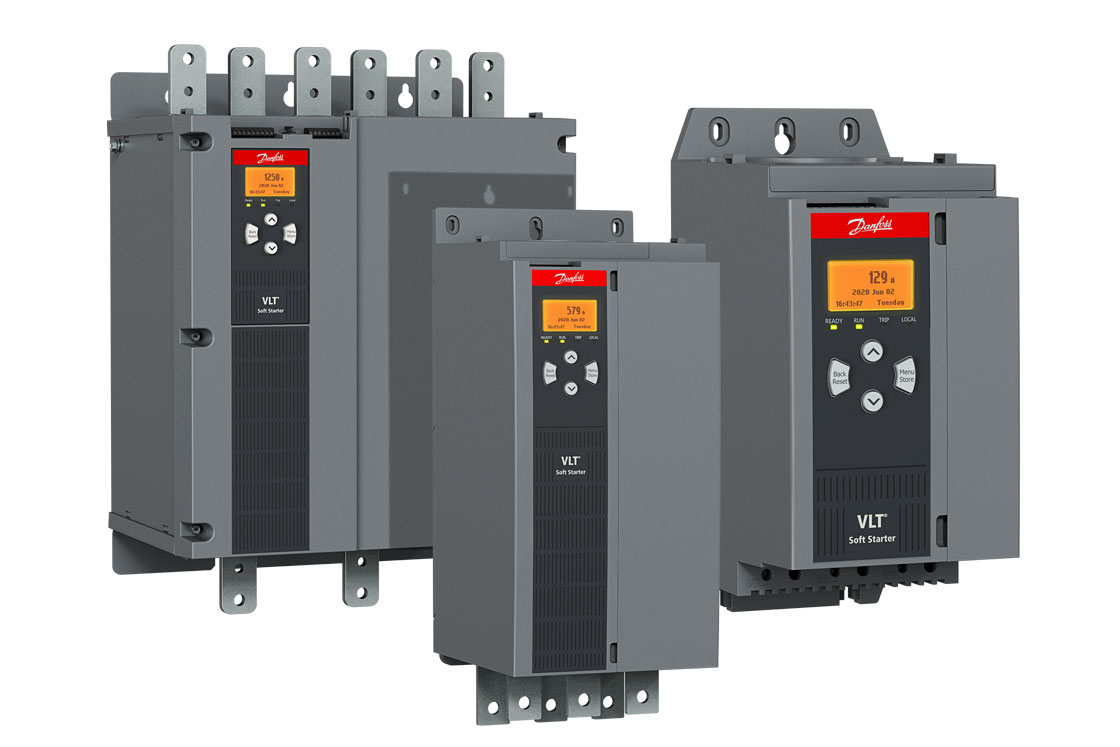
One dimension that buyers routinely overlook is serviceability and support: local spare-frame availability, replacement SCR and bypass-contactor stock, field commissioning support, firmware and parameter-backup tooling, and the responsiveness of the vendor's technical line years after purchase. ABB (PSTX), Schneider Electric (Altistart ATS480), Siemens (SIRIUS 3RW), Rockwell Automation (Allen-Bradley SMC), Eaton (DS7), and Danfoss (VLT MCD) all maintain spare-parts and service networks in major industrial regions, which makes them dependable choices for large or critical projects where a failed starter means a stopped production line.
FAQ
What is the difference between a soft starter and a variable frequency drive (VFD)?
A soft starter controls voltage only, using back-to-back thyristors to ramp the motor up to full line frequency during the start, then a bypass contactor carries the run current at fixed 50 or 60 Hz. It reduces inrush current and mechanical shock but cannot vary running speed. A VFD rectifies the AC line to DC and re-synthesizes a variable-frequency, variable-voltage output, so it controls speed and torque continuously across the full operating range. Choose a soft starter when you only need a smooth start and stop on a fixed-speed load such as a centrifugal pump or fan. Choose a VFD when the process needs continuous speed regulation or sustained energy savings on variable-torque loads. Soft starters cost roughly one third to one half of a comparable VFD and occupy far less panel space.
How does the AC-53a soft starter rating work?
IEC 60947-4-2 expresses a non-bypassed soft starter rating as a four-part code, for example 100 A : AC-53a : 3.0-15 : 50-6. The first figure is the rated operational current Ie (100 A). The 3.0 is the start current as a multiple of Ie (300 percent). The 15 is the start ramp time in seconds. The 50 is the on-load duty factor as a percentage of each cycle. The 6 is the number of starts per hour. The AC-53b variant applies to bypassed starters and replaces the duty factor and starts-per-hour pair with a minimum OFF time, for example AC-53b : 4-6 : 354 means 400 percent start current for 6 seconds followed by a 354 second cooling interval. Always confirm that your application point sits inside the rated envelope, because a 3x for 10 second rating is not interchangeable with a 5x for 30 second rating.
Why is a bypass contactor used in a soft starter?
During the start ramp the thyristors phase-control the voltage and dissipate heat, roughly 1 to 1.5 W per ampere across each conducting SCR pair. Once the motor reaches full speed the thyristors are no longer needed, so a bypass contactor closes in parallel and carries the run current directly, eliminating the conduction loss and the associated heatsink temperature rise. This lets the enclosure run cooler, removes the need for forced-air cooling at run, and allows a smaller frame. Many modern units such as the ABB PSTX and Schneider ATS480 integrate the bypass contactor internally, while continuous-rated AC-53a designs keep the thyristors in circuit and must be sized for full-load thermal duty. A bypassed AC-53b unit is generally smaller and cheaper for the same motor.
How much does a soft starter reduce starting current?
A direct-on-line start draws roughly 6 to 8 times motor full-load current (FLA). A soft starter with voltage ramp and current limit typically holds the start current to 250 to 350 percent of FLA for ordinary loads, and 400 to 550 percent for high-inertia loads that need extra accelerating torque. Because motor torque is proportional to the square of applied voltage, halving the voltage to 50 percent reduces both starting torque and current contribution accordingly, so the current limit cannot be set arbitrarily low without stalling the load. The practical floor is the current that still produces enough torque to break the load away and accelerate it to full speed within the rated ramp time. Setting the limit too low causes a failed start and a locked-rotor trip.
Can a soft starter be wired in inside-delta connection?
Yes, units that support it can be connected inside the motor delta loop, in series with each winding, rather than in-line ahead of the motor. In inside-delta the starter conducts only the phase current, which is the line current divided by the square root of three, about 58 percent. That allows a smaller, cheaper starter frame for a given motor, roughly one frame size down. The trade-off is that inside-delta requires all six motor leads brought out to the terminal box, the motor must be wound for delta at line voltage, and the firmware must run a six-wire control algorithm. Not every soft starter supports inside-delta, so verify the connection option on the datasheet before sizing. In-line (three-wire) connection is simpler and universally supported.
How many starts per hour can a soft starter handle?
The limit is set by thermal duty, not by the motor alone. Each start heats the thyristors and, on AC-53a continuous units, the run current keeps heating them. Typical general-purpose ratings allow 3 to 10 starts per hour at the rated start current and ramp time, which is encoded in the last digit of the AC-53a code. Heavy-duty applications such as crushers and ball mills may be limited to 1 to 2 starts per hour and demand the next frame size up, or a derate of 20 to 25 percent. Bypassed AC-53b units quote a minimum OFF cooling interval instead. If the duty cycle is unknown, size from the worst-case start current, the longest ramp time, and the highest starts-per-hour figure the process can produce, then add margin for ambient temperature above 40 degrees Celsius.
Which manufacturers make industrial soft starters?
The established low-voltage range includes ABB (PSTX advanced series, roughly 30 to 1250 A with built-in bypass and torque control), Schneider Electric (Altistart ATS480, about 17 to 1200 A, 208 to 690 V), Siemens (SIRIUS 3RW30/3RW40 for standard duty and 3RW55 for difficult starts, using polarity balancing to cut DC components), Rockwell Automation (Allen-Bradley SMC-50 and SMC Flex), Eaton (DS7, up to about 200 A for pump, fan, and small conveyor duty), and Danfoss (VLT MCD 500/600). For medium-voltage motors above 1 kV, Benshaw, ABB, and WEG supply 3.3 to 11 kV soft starters. Verify the exact series rating, AC-53 class, and certification on the manufacturer datasheet before committing, because frame current and start duty vary by model within each family.
Soft Starter Manufacturers
Source-backed product routes. Open a company dossier for procurement scope and cited evidence.