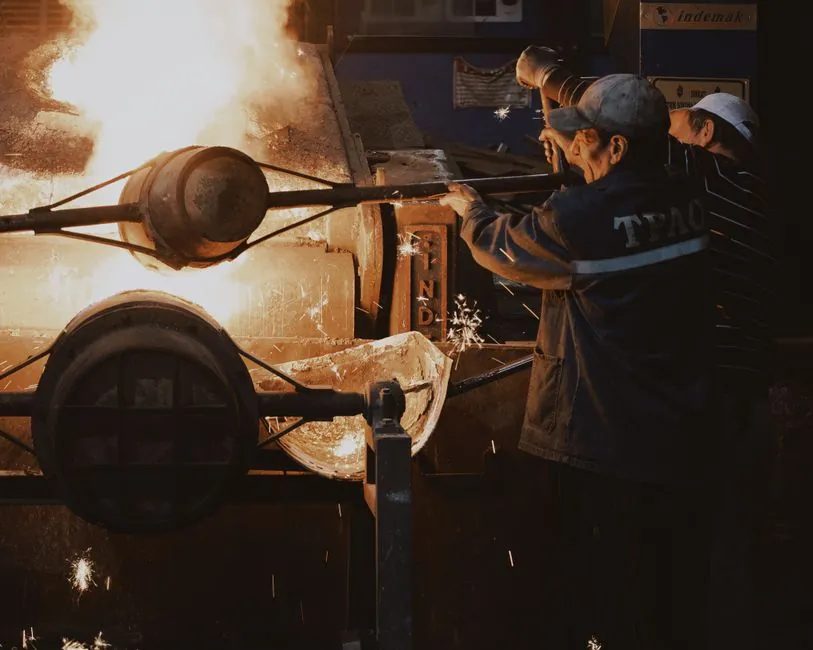
HFC-134a appears viable for most existing magnesium protection duties, while fluoroketone offers a lower-global-warming-potential path than SF6 [S1][S2].
The decision depends on melt protection, die compatibility, regulatory status, gas consumption and total operating cost, not protection performance alone [S3][S4].
Magnesium cover-gas selection criteria
Molten magnesium burns when the surrounding oxygen content exceeds 4%, because its oxide film has a Pilling-Bedworth ratio below 1 and does not form a dense barrier against oxygen [S3].
Cover gas therefore has three jobs: exclude oxygen, suppress magnesium evaporation and manage the combustion risk of fine magnesium dust around the furnace and casting area [S3].
For a new magnesium die casting machine, evaluate each gas across seven criteria: demonstrated protection, melt-surface cleanliness, corrosion of steel tooling, worker exposure, regulatory constraints, consumable cost and conversion effort [S1][S3].
Gas options compared
No option wins every category: HFC-134a has an established protection path, fluoroketone has the strongest stated climate profile, and SF6 combines proven protection with the largest regulatory obstacle [S1][S3][S4].
Where HFC-134a fits
HFC-134a, also identified in magnesium applications under the name AMCover, has been proposed alongside Novec 612 and sulfur dioxide as a non-SF6 protective gas [S3].
A technical assessment concluded that HFC-134a appears viable for most existing magnesium protection duties [S1].
HFC-134a is the pragmatic conversion candidate when an operation wants a relatively direct route away from SF6 and can qualify the gas through furnace trials. Confirm melt appearance, oxide removal, inclusion formation, burn-rate control and tooling exposure under the actual alloy, holding temperature and dosing arrangement.
This gas is not automatically suitable for every installation. The available magnesium literature also flags European discussions affecting fluorinated hydrocarbons, so procurement and emissions obligations must be checked for the operating jurisdiction rather than inferred from technical performance [S3].
Where fluoroketone fits
Fluoroketone is the strongest option when the specification is driven by avoiding SF6 without accepting HFC-134a's regulatory uncertainty [S2][S3].
The fluoroketone identified in the research is Novec 612 fluid, presented as a substitute for SF6 cover gas used to prevent molten magnesium from burning during casting [S2]. A 2008 UNFCCC presentation also identifies Novec 612 among alternative cover gases for magnesium production and casting [S4].
For atmospheric impact, the research cites a fluoroketone atmospheric lifetime of 10 days and a 100-year GWP slightly below 0.7 [S4]. Those figures support the low-climate-impact case, but they do not establish magnesium-process compatibility, gas cost, occupational exposure limits or long-term equipment life.
Qualify fluoroketone with the complete gas path, including dosing hardware, storage vessels, transfer lines, seals, furnace contact surfaces and downstream casting equipment. The decision belongs in a die-casting die qualification plan because cover gas can affect surface condition, tooling exposure and the required maintenance interval.
Where SF6 remains defensible
SF6 remains technically credible as a magnesium cover gas because it was predominantly used during primary production and processing of magnesium and its alloys, but its environmental burden is decisive for long-term asset planning [S3].
The same assessment gives SF6 a GWP more than 23,000 times that of CO2 and identifies it as a potent greenhouse gas [S3].
SF6 is therefore reasonable for short transition periods, controlled trials or jurisdictions where its use remains lawful. It is a poor default for a new installation because equipment renewal, process qualification and regulatory exposure can outlast the useful life of the cover-gas system.
Any SF6 service plan should include leak control, recovery or destruction, operator exposure controls and a dated substitution plan. The review date must be checked against the jurisdiction’s in-force fluorinated-gas rules, because the technical literature establishes the environmental concern but cannot prove present legal status in every country.
Failure modes and operating constraints
Every candidate introduces a material failure mode: HFC-134a requires validation against the specific delivery system and applicable fluorinated-hydrocarbon controls, fluoroketone requires compatibility work, and SF6 requires emissions containment plus a regulatory exit strategy [S2][S3][S4].
Do not judge protection from a flame photograph alone. Record oxygen exposure at the melt surface, magnesium oxide formation, visible burning, off-gas condensate, dross behavior, inclusion rate, casting surface quality and post-cast corrosion at defined intervals [S3].
Fluxes are not a free substitute for cover gas. Although salts can protect and refine molten magnesium, they may enter cast components and adversely affect mechanical properties and corrosion behavior [S3]. Evaluate any flux-plus-gas combination as a combined process, with residues and product contamination included in the acceptance criteria.
The cover-gas specification must also address local extraction. Molten magnesium evaporates readily, and fine powder deposited in colder areas can ignite, so closed handling and housekeeping around the melt are part of the gas-selection decision [S3].
Qualification and procurement sequence
Run a controlled comparison at the production alloy and holding condition: one established baseline, one HFC-134a condition and one fluoroketone condition, with gas concentration and dosing fixed for each test [S1][S2].
Measure protection performance over repeated heats rather than a single demonstration. Use the casting ladle transfer step, furnace hold, dosing system and interruption cases as part of the trial because local handling can defeat an otherwise effective cover-gas specification.
Commercial evaluation should convert measured consumption into cost per tonne of magnesium. The UNFCCC presentation quantified alternative-cover-gas economics on a per-tonne magnesium basis, including capital and incremental operating cost, which is the correct structure for an investment comparison rather than comparing cylinder prices alone [S4].
The recommended sequence is straightforward: trial HFC-134a for the lowest conversion barrier, trial fluoroketone where long-term environmental performance governs, retain SF6 only as a legally controlled bridge, and approve the final gas only after measured protection, tooling condition, regulatory review and total operating cost meet the plant specification [S1][S2][S3][S4].