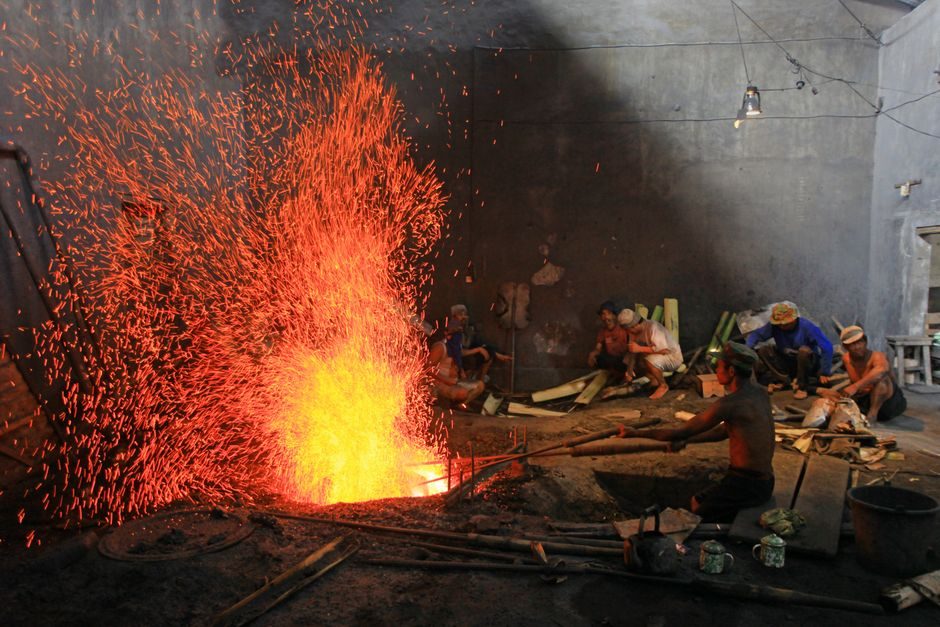
A holding furnace is a stationary, refractory-lined vessel that holds molten metal at a controlled temperature between melting and pouring; a casting ladle is a refractory-lined transfer vessel that moves a metered volume of melt from the furnace to a casting mold [S3][S5].
The two are routinely confused on RFQs because both contain molten metal at temperature, but the spec levers that drive selection — mass held, residence time, temperature delta, and metallurgical duty — are fundamentally different. A foundry running 0.5–3 t batch iron or aluminum drips melt into a holding furnace for 30 min to 4 h, while a 30–300 t steel shop runs a ladle furnace (LF) for 20–40 min of arc-heated ladle metallurgy between a BOF/EAF and a continuous caster [S1][S2][S6].
Definition and Operating Envelope
A holding furnace is sized in tonnes of net melt capacity, with typical industrial ratings of 0.3 t (small non-ferrous), 1–10 t (aluminum die-casting cells), 5–60 t (cast iron and copper alloy), and up to 200+ t (large iron or steel buffer) [S3][S4]. Power input scales with holding loss compensation: a 5 t aluminum holding furnace is commonly rated 150–400 kW electric resistance or 200–600 kW induction to offset 0.5–1.5 %/h radiative loss through the lid and walls [S4].
A casting ladle is sized in pour weight per heat, with crane-handled steel teapots from 1–25 t for iron foundries, 30–250 t ladles for EAF/BOF shops, and 1–10 t self-tilting or geared ladles for non-ferrous die casting. Refractory lining is the dominant spec: alumina-silica (60–90 % Al2O3) for cast iron, magnesia-carbon (MgO-C, 8–18 % residual C) for steel ladles, and silicon carbide or fused silica for non-ferrous [S2][S6].
Process Role and Temperature Delta
Foundries specify a holding furnace when the process needs a stable thermal buffer between a batch melter and a continuous or semi-continuous pour, or when metallurgical conditioning (inoculation, alloy trim, deslagging) must be held at temperature for tens of minutes. Cast iron holding furnaces commonly hold at 1280–1450 °C with a control band of ±10–20 °C, and the slag chemistry interacts with the melt to manage sulfur and oxygen at the iron–slag interface [S1].
Casting ladles are specified when the requirement is a discrete, metered transfer — pour weight per mold, per ingot, or per tundish, with a controlled pour stream, slag retention, and minimal reoxidation. A steel ladle furnace cycle targets a 20–40 min arc-heated window with electrode ratings of 8–60 MVA on 30–300 t ladles, plus argon stirring through a porous plug at 0.1–0.5 Nm3/min per ton to homogenize temperature and composition [S2][S6].
Selection Criteria: When to Use Each
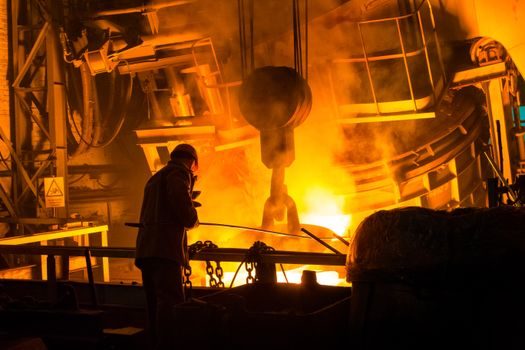
Hold-melt when the pour rate is uneven or the cycle time of the casting line exceeds the cycle time of the melter. Common triggers: a die-casting cell with 8–120 s cycle time fed by a 2–4 h gas or induction melter, or a sand-casting line fed by a cupola plus a 5–20 t iron holding furnace [S4].
Use a ladle when the metallurgical step requires heating or chemistry adjustment away from the primary melter (LF duty), or when the transfer path is long enough that a dedicated refractory-lined vessel is cheaper than a trough or launder. LF processes in steelmaking reached wide industrial scale in Japan in the 1970s and remain the default secondary-refining step before continuous casting [S6].
Foundry engineers comparing both options against the same job typically weigh four gates: melt mass, temperature delta tolerance, metallurgical duty, and refractory life. A 1–5 t iron shop running ductile iron at ±15 °C into a green-sand line usually picks a channel-induction or resistance holding furnace with 1500–3500 kW power and a 3–6 t/h tap rate; a 100 t EAF shop running low-alloy steel into a billet caster usually picks a 100–150 t ladle furnace with a 20–30 MVA transformer and 30–40 min arc time [S1][S2][S6].
Refractory, Energy, and Throughput Comparison
Refractory consumption is the dominant operating cost on both vessels, but the failure mode differs. Cast iron holding furnaces typically run 6–18 months of campaign life on alumina-silica brick, with the failure mode being slag-line corrosion and thermal cycling. Steel ladles on MgO-C linings target 40–120 heats per campaign, with the failure mode being slag-zone wear at 0.5–1.5 mm per heat, and LF slag itself creates a polymorphic dusting problem that requires stabilizer additions such as B2O3 or TiO2 [S2].
Energy intensity also separates the two. A holding furnace running near steady state spends most of its input on radiation and wall loss compensation; a well-controlled 10 t aluminum holding furnace holds with under 30 kWh/t of standby loss. A ladle furnace, by contrast, is a process reactor: 20–40 MVA electrodes and 200–600 kWh/t of arc-heated trim on a 100–200 t steel heat, plus argon, alloy, and flux consumables [S2][S6].
For non-ferrous die casting, a useful spec frame is: stationary holding furnace with immersion or channel induction heating for 0.5–10 t cells, paired with a small casting ladle of 50–500 kg that scoops and pours under a robotic arm. Engineers weighing gas-fired versus induction melting can compare cost and emission profiles in this foundry spec cut [S4].
Failure Modes and Common Mis-specifications
Mis-spec #1: buying a ladle when a holding furnace is required. Symptom is melt temperature dropping 30–80 °C during transfer to a slow pour line, leading to misruns or cold shuts; fix is a heated holding vessel sized to the pour cycle, not a larger transfer ladle. [S1]
Mis-spec #2: buying a holding furnace when an LF is required. Symptom is inability to hit chemistry and temperature targets simultaneously on a steel heat that needs desulfurization and trim alloying; fix is a ladle furnace with electrode heating, argon stirring, and a separate slag door [S2][S6].
Mis-spec #3: choosing the wrong refractory family. Alumina-silica linings fail in 5–20 heats on basic steel slag; MgO-C with 8–18 % residual carbon is the standard ladle lining for that duty. On the iron side, SiC and high-alumina bricks survive FeO-rich slag at 1400–1500 °C for 6–18 months [S1][S2].
Sourcing, Standards, and 2026 Buyer Watch-points
Chinese OEM catalogs list induction electric holding furnaces for copper, bronze and brass continuous casting machines alongside aluminum and iron variants, with quoted pricing tiers scaling with capacity and refractory class [S4]. Japanese and Korean technical term registries define the holding furnace as holding furnace / holding furnace, used for molten metal thermal conditioning upstream of die casting or continuous casting [S3][S5].
Trackable signals for buyers in mid-2026: LF slag stabilizer adoption (B2O3, TiO2) continues to expand as foundries comply with stricter dust-emission limits on ladle slag dumps; cast iron holding furnace slag chemistry research published in 2023 documents the iron-slag oxygen and sulfur partition that drives holding loss and inoculant fade, and remains the most-cited reference for 2026 holding-furnace slag control [S1][S2].
Trackable signals to watch in the next quarter: refractory lifetime claims on Al2O3-MgO-C castables for iron holding furnaces, and electrode regulation compliance on ladle furnace fume-extraction retrofits in EU steel plants. Engineers who want a deeper selection framework for a single new holding furnace can read the Holding Furnace Selection Criteria 2026 spec guide or the Holding Furnace 2026 Buying Guide on type, capacity, refractory and burner for gate-by-gate numbers.
Closing: a holding furnace is a thermal buffer, a casting ladle is a transfer and process vessel; match the spec to the pour cycle, slag chemistry, and metallurgical duty, then audit refractory class and energy intensity per ton before the PO, not after the first campaign.