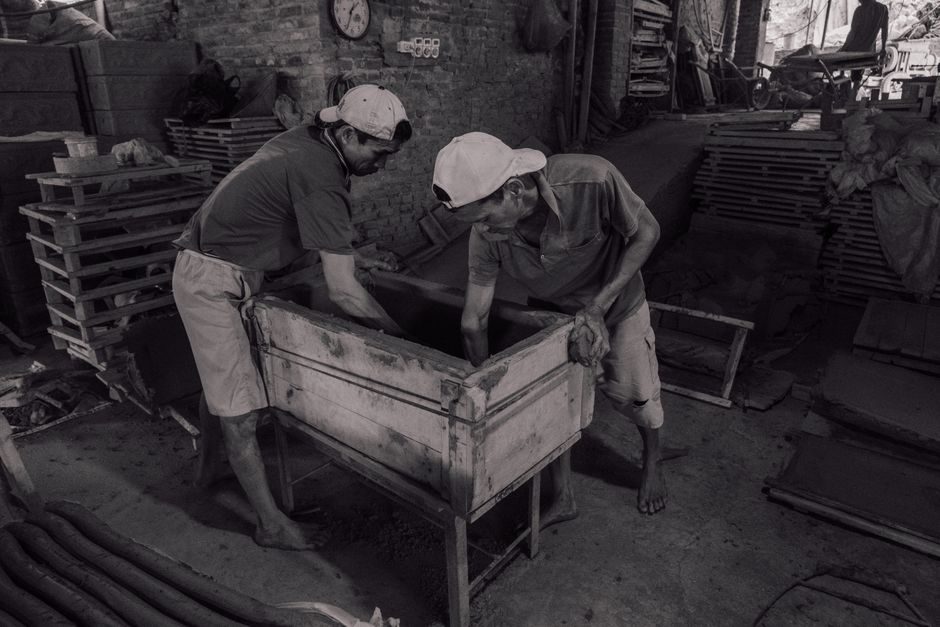
Hot box core shooters use heated tooling (typically 200–260 °C) and a thermosetting resin-coated sand to produce cores in 10–60 second cycles, with shot weights commonly in the 0.5–50 kg range per cycle depending on machine class [S6]. The process forces sand into a heated core box where the resin cures on contact, then ejects a rigid, dimensionally stable core ready for immediate assembly into a mold.
The technology sits in the middle of the core machine family — slower than cold-box amine-cured systems on cycle time, but faster than traditional oven-cured oil-sand cores, and consistently tighter on dimensional tolerance than hand-rammed cores [S10]. Chinese OEM pricing on a basic single-position vertical-parting unit lands between USD 2,000 and USD 20,000 per set at FOB terms, with a 1-set minimum order and stated supply capacity around 100 sets per month [S3].
Process Window: Temperature, Cure Time, and Sand-to-Binder Ratio
The hot box process demands a tightly controlled thermal window: core box surface temperature is normally held in the 200–260 °C band, with a sand mix temperature ramp of 8–12 °C per second at the box wall to drive the thermosetting furan or phenolic resin to full cure [S6]. Below roughly 180 °C the resin under-cures and the core loses tensile strength; above 280 °C the resin burns and surface peel appears within 2–3 shots.
Sand-to-binder ratio is the other dial that defines core quality: 100 parts AFS 50–70 silica or chromite sand carry 1.0–2.5 parts resin by weight, with a hardener ratio of 0.2–0.5 parts (typically ammonium chloride or a latent acid catalyst) [S6]. Shot pressures for sand compaction sit in the 0.4–0.6 MPa range on standard pneumatic shooters, with an air consumption roughly 0.05–0.15 m³ per kilogram of shot sand depending on core complexity.
Cycle time directly tracks core volume and wall thickness: a 2 kg water-jacketed core typically cures in 18–25 seconds, while a 25 kg cylinder-head core can run 45–90 seconds including the cure hold [S6]. Vertical-parting single-position units (HBS-954, HBS-955 class) are the entry tier; double-position units add a second heating station and roughly double throughput at the cost of a larger footprint and higher gas or electric heating load [S6].
Advantages: Where Hot Box Earns Its Slot
Cold-to-cure cycle time is the headline advantage: a hot box cell can produce 30–80 cores per hour on a single station, against 6–12 per hour for hand-rammed, oven-cured oil-sand cores [S10]. Surface finish is consistently Ra 6.3–12.5 µm off the tool, with no subsequent baking required, so cores feed directly into the molding line.
Dimensional accuracy runs ±0.3–0.8 mm on a 100 mm critical dimension for properly vented tooling, tight enough for most engine-block water-jacket and hydraulic-valve body cores without secondary machining [S6]. Compared to a shell core machine, the hot box produces fully solid cores (no hollow shell), which gives it a real edge on cores that need to resist molten-metal buoyancy in the mold — intake manifolds, gearbox housings, and pump bodies.
Energy use is concentrated at the box itself rather than a 200 °C walk-in oven: a single-position hot box station draws roughly 6–15 kW of heating power (electric) or 4–10 kg/h of natural gas through a burner ring, with no continuous oven idling loss between shots [S6]. For jobbing foundries running 4–8 hours per day rather than three shifts, that thermal on-demand profile beats shell or oil-sand on operating cost per ton of finished core.
Disadvantages: The Honest Failure Modes
Tooling cost is the first wall. A hardened tool-steel hot box core box with integral heating channels, beryllium-copper inserts, and ejector pins lands in the USD 8,000–60,000 range per cavity set, against USD 2,000–10,000 for a comparable cold-box tooling package. For low-volume work below roughly 5,000 cores per year, that amortization alone disqualifies hot box. [S3]
Fume control is non-negotiable: the furan or phenolic resin releases formaldehyde, phenol, ammonia, and isocyanate traces during cure, and a hot box cell needs local exhaust ventilation rated at 0.5–1.0 m/s capture velocity at the box parting line, plus an afterburner or wet scrubber in jurisdictions enforcing strict VOC limits [S6]. Plants that skip the afterburner commonly see operator exposure complaints within 6–12 months and trip regulatory inspections in the EU under the IED directive.
Core geometry has hard limits: hot box cannot reliably produce undercuts or deep narrow slots because the sand must flow into the cavity under 0.4–0.6 MPa air pressure, and any draft under 1.5° traps sand and causes blowholes in the cast part. Compared to a cold box core machine, the hot box is also locked into relatively short cure times per shot — very large cores above 50 kg push cure times past 2 minutes and the thermal economics collapse.
Comparison: Hot Box vs Shell Core vs Cold Box vs Hand-Rammed
Across the four mainstream core-making routes, the decision matrix on four criteria — cycle time, dimensional accuracy, tooling cost, and capital cost — looks like this on a per-station basis [S6][S10]:
Hot box scores well on cycle time (30–80 cores/h) and accuracy (±0.3–0.8 mm), mid-pack on tooling cost (USD 8k–60k per cavity), and low on capital cost (USD 2k–20k for the shooter itself) [S3][S6]. Shell core is similar on accuracy and tooling cost but is limited to thin shell geometries under 30 mm wall, so it cannot match hot box for solid cores. Cold box amine-cured systems win on cycle time (40–100 cores/h) and undercut flexibility, but add amine gassing systems, amine scrubbers, and a higher regulatory burden for operators.
Hand-rammed oil-sand or sodium-silicate-CO₂ cores sit at the bottom on every criterion except tooling cost, and they remain in use only for prototype or one-off cores where lead time beats any automation. For a deeper side-by-side on machine class boundaries, the Hot Box Core Shooter Types, Class Boundaries, and Spec Selection Map lays out the same comparison in cavity-count and shot-weight terms.
Selection Criteria: When Hot Box Fits and When It Doesn't
Hot box fits when the foundry runs 5,000–200,000 cores per year of the same part family, with core weights in the 0.5–30 kg range, wall thicknesses above 8 mm, and draft angles of at least 1.5° on all internal surfaces. Typical fits include valve bodies, gearbox housings, pump casings, and small-to-medium engine blocks where the cure-on-demand thermal profile matches a 1–2 shift operation. [S3]
Hot box does not fit when core volumes fall below 5,000/year (tooling amortization kills the unit economics), when cores need undercuts or deep pockets beyond 4:1 depth-to-width (sand flow fails), or when the foundry lacks a fume-extraction budget. Plants in EU Tier-1 industrial air-quality zones, or any plant within 500 m of a residential boundary, should pre-budget an afterburner skid (USD 15,000–40,000) before specifying the core shooter.
Standards and regulatory anchors to track: OSHA PEL on formaldehyde sits at 0.75 ppm (8-h TWA) and STEL 2 ppm; EU indicative limit under Directive 2017/164 is 0.3 ppm (8-h) and 0.6 ppm (STEL) — both of which a poorly vented hot box cell will exceed within minutes. Foundries specifying hot box in 2026 should also confirm the resin supplier's REACH SVHC declaration, since several legacy furan formulations now carry labelling obligations above 0.1% w/w of free formaldehyde.
Sourcing Signals and What to Verify on a Vendor Quote
Chinese OEM listings on B2B portals show vertical-parting hot box core shooters at USD 2,000–20,000 FOB per set with 1-set MOQ and stated monthly capacity near 100 sets [S3]. A serious quote should include the rated shot weight per cycle, the heating method (electric cartridge vs gas burner ring), the maximum core box dimensions in mm, the rated air pressure range, and the PLC/HMI platform — generic "core shooter" listings without those five data points are red flags.
For plants evaluating a shell core shooter against a hot box, the same five data points plus the resin brand and grade on the vendor's letterhead separate a quote from a price card. Track these two signals over the next quarter: a sustained rise in phenolic resin spot price (currently volatile around the USD 1,500–2,200/t band as of mid-2026) and any tightening of EU formaldehyde indicative limits, both of which directly reshape the hot box cost-per-core math against cold box alternatives.