
A factory compressed air system is a chain of four process blocks — compression, treatment (drying and filtration), storage (receiver), and distribution (piping, valves, condensate drains) — and the wrong match in any one block wastes the kW you paid for in the compressor room. The same source line notes that up to 70% of all industries use compressed air for some aspect of their operations, which is why system architecture decisions matter far more than the nameplate on the machine [S6].
The compression block itself is split between positive-displacement machines (screw, reciprocating) and dynamic machines (centrifugal, turbo), and the cutover is mostly about pressure level and airflow: oil-injected rotary screw dominates 7–13 bar shop-air service, two-stage reciprocating fills 30–350 bar high-pressure niches, and centrifugal takes over above roughly 250 m³/min at 7–10 bar [S3][S6].
Compression block: positive-displacement vs dynamic machines
Rotary screw compressors are the default for 5–500 kW continuous-duty industrial service because their pulse-free output suits downstream filtration and they tolerate wide load swings when paired with VSD (variable speed drive) control. Two-stage oil-injected units typically achieve discharge pressures of 7–13 bar in a single package, with specific power around 6–7 kW per m³/min at full load [S3].
Reciprocating (piston) compressors split into single- and two-stage configurations, oil-lubricated or oil-free, and remain the workhorse for high-pressure applications above 30 bar — Unical's product line explicitly covers medium- and high-pressure reciprocating units in skid form, alongside medium- and low-pressure screw packages [S3]. Centrifugal compressors, in contrast, are the economic answer above ~250 m³/min at moderate pressure: oil-free by construction, they deliver ISO 8573-1 Class 0 air without filtration tricks and are specified in electronics, food, and pharmaceutical plants where oil carryover is non-negotiable.
For an end-of-line spec view, the industrial mixer selection guide walks through the same duty-vs-machine-type match, and the same logic — match the machine envelope to the duty, not the other way round — applies directly to picking a compressor frame.
Air treatment block: dryers, filters, and condensate management
Treatment is where the air-quality class is set, and the standard reference is ISO 8573-1, which classifies solid particulate, water, and total oil content separately. A refrigerated air dryer typically delivers a pressure dew point of +3 °C, adequate for general shop air; a desiccant (adsorption) dryer is required to reach −40 °C PDP for outdoor piping, instrumentation, or painting, and −70 °C PDP for pharmaceutical or electronics dry rooms [S3].
Filtration is staged: a particulate pre-filter (typically 3 µm) protects the dryer, a coalescing filter (0.1–1 µm) follows the dryer to remove oil aerosol to 0.01–0.1 mg/m³, and an activated-carbon stage polishes to 0.003 mg/m³ total oil for Class 1 oil carryover. Skid builders like Unical bundle compressor, receiver, dryer, and filtration into one package, which is the standard delivery for medium- and high-pressure custom skids and is documented as a core product line [S3].
Storage and distribution: receiver sizing, pressure drop, and the sequencer
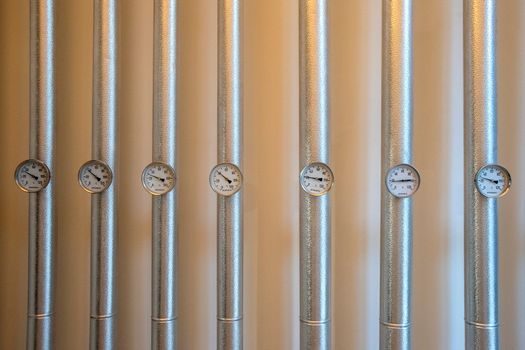
The receiver's job is to buffer pulsation, decouple compressor control from demand spikes, and provide head for short peak events; the rule of thumb is roughly 1 gallon (≈3.8 L) of receiver volume per CFM (≈1.7 m³/h) of compressor capacity, scaled up when demand is highly cyclic. The CompAir SmartAir Master sequencer handles the load-sharing side, calculating demand and selecting the most efficient combination of machines to meet site requirement when multiple compressors feed a common header [S4].
Distribution design lives or dies on pressure drop: keep total loop drop under ~0.3 bar (about 3–5% of nominal pressure) by sizing main headers for 6 m/s or less and branch lines for 9 m/s or less, and use ring-loops over dead-end branches wherever the plant layout allows. The leak cost on a typical 7 bar plant is roughly 5–10% of generated volume, which is why on-site evaluations and audits — explicitly listed as a service by both CAS and Elevated Industrial — are a standard pre-spec step [S1][S2].
Selection map: screw vs reciprocating vs centrifugal
Three decision criteria cover most specs: pressure tier, flow tier, and air-quality requirement. Below 13 bar and below 30 m³/min, oil-injected screw wins on footprint, noise (typically 65–75 dB(A) at 1 m with enclosure), and total cost. Between 13 and 40 bar, two-stage reciprocating remains competitive and is the standard for PET bottling, CNG stations, and starting-air systems. Above 30 bar or where oil-free air is mandated, oil-free screw or centrifugal takes over, and centrifugal dominates above 250 m³/min because its isentropic efficiency climbs with flow [S3][S6].
Duty cycle matters as much as the nameplate: VSD screw is the right pick when demand swings between 30% and 100% of nameplate, because part-load specific power is roughly halved versus a fixed-speed unit running in blow-off. Constant full-load applications near 90–100% are where fixed-speed screw or centrifugal wins, and the air impact wrench selection map applies the same duty-cycle logic at the end-use tool side.
System integration: skids, certifications, and end-use fit
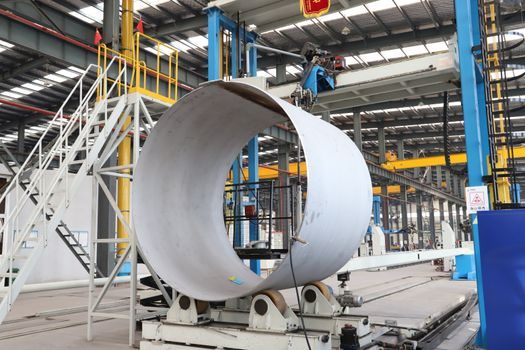
A compressed air skid is not just a packaging convenience — it is a documented process package with flow, pressure, dew point, and noise data on a single nameplate, which is what EPCs and skid buyers actually spec against. Unical's compressed air system container and Unikor line ships with that documentation, supported by ISO 9001, ISO 14001, ISO 45001, CE, and CCS certifications, and is fielded in petrochemical, offshore platform, power generation, metallurgy, automotive, textile, electronics, paper, food, and tobacco plants [S3].
End-use matching is the step most specs skip, and it is the most expensive to fix later: pneumatic tools and air pick systems tolerate Class 5–6 air; process instrumentation and lab air need Class 2–3; direct food-contact or pharmaceutical contact needs Class 1 or Class 0. The same source observes that compressed air is treated as an essential energy source across the listed industries, which means a Class 5 plant running Class 1 applications is paying for downtime, warranty claims, and filter changeouts it did not budget for [S6].
Sourcing, audits, and aftermarket support
Distributor networks carry the major brands — Kaeser, Atlas Copco, Ingersoll Rand, Quincy, Gardner Denver, CompAir, Sullair — alongside a long aftermarket tail, and the distributor's value is usually the audit, the rental fleet, and the PM plan rather than the box itself. Compressed Air Systems (now OTC Industrial Technologies) explicitly lists rentals of Quincy electric compressors and Hankison dryers on weekly/monthly contracts, plus repairs, evaluations/audits, and tiered PM plans built on running hours or calendar days, all independent of the original compressor brand [S1]. Elevated Industrial Solutions sells Kaeser as its primary line while servicing Atlas Copco, Ingersoll Rand, Gardner Denver, and Quincy on the aftermarket side, and runs an air-quality and leak audit program on top [S2].
Spec engineers should treat the compressed air system as a multifunction process calibrator of the utility room — every downstream instrument is reading the quality the air-treatment block produced, and a drift in dew point or oil carryover shows up as a drift on every pressure transmitter on the loop. Two trackable signals to watch are the wider VSD retrofit wave in the 30–75 kW segment and the consolidation of regional distributors into national industrial-supply platforms; both reshape lead times, service coverage, and rental availability in 2026 and 2027 builds.