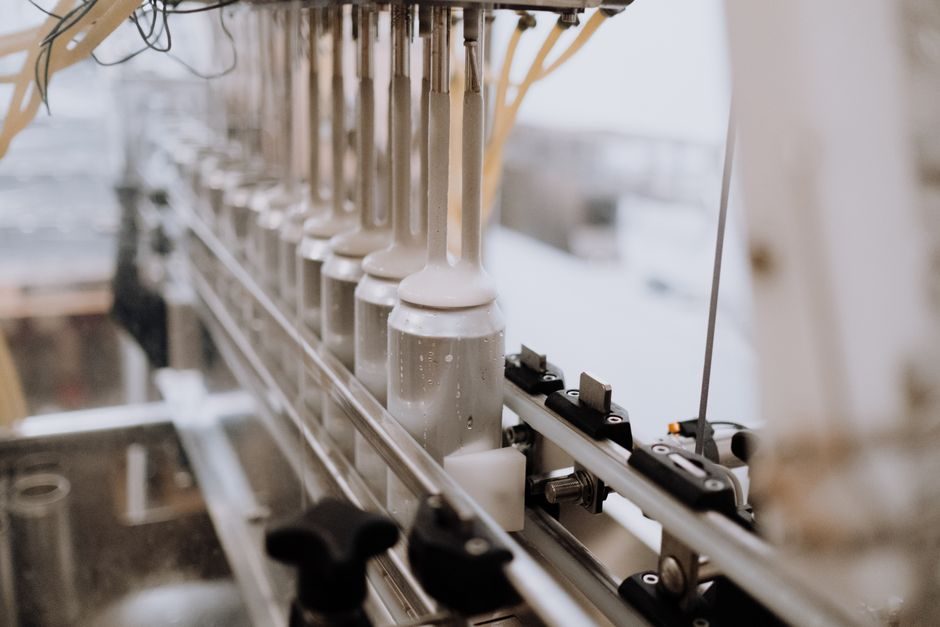
Industrial filter production is a multi-stage workflow that begins with media selection (membrane, depth, or woven cloth) and ends with a bubble-point or differential-pressure integrity test on every cartridge; 0.2 µm absolute ratings are the pharmaceutical benchmark for sterile fluids, validated against organisms such as Brevundimonas diminuta [S3].
The five process families covered here — membrane pleated, high-flow, bag, depth, and air panel/cartridge — account for the bulk of cartridges, housings, and filter presses used across pharmaceutical, microelectronics, food-and-beverage, and wastewater plants [S3][S5]. For the broader system context, see the industrial filter overview.
Step 1 — Media Selection and Micron-Rating Definition
Media choice is locked in before any hardware is cut: a 0.2 µm membrane pleated cartridge is specified for sterile water for injection (WFI) and critical solvents, while a 1–10 µm depth or bag filter is typical for cooling-water and CIP pre-filtration [S3]. The micron rating is the smallest particle the filter will reliably remove, and for sterile fluids it is benchmarked to the retention of Brevundimonas diminuta per pharmaceutical validation protocols [S3]. Pullner Filter's membrane pleated cartridges are commonly specified for sterile water and critical solvent purification, while depth filters handle the broader particle spectrum upstream as prefilters [S3]. Selection here is not a marketing decision — it is a regulatory one once the line carries GMP or FDA-inspected product.
Step 2 — Pleating, Corrugation, and Cartridge Assembly
Membrane pleating is the defining sub-step of the high-end cartridge class: the filter medium is folded into a pleat pack that multiplies the effective surface area inside a given cartridge OD, which is what lets a single 10-inch element hold enough area to flow process water at industrial rates without collapsing [S3][S5]. Standard Filter's bag-manufacturing workflow applies the same assembly discipline to sewn felt or woven media — needle-punching, calendaring, and stitch-bonding under documented lot control — so each bag meets a repeatable permeability and burst target [S4]. Pall Corporation's industrial filter lines are built around the same surface-area-per-volume logic, with separation systems designed to streamline process efficiency across chemical, refining, and power-generation customers [S5]. Cartridge assembly is typically performed under cleanroom conditions: Pullner Filter runs its cartridge lines out of a 10,000 m² ISO-classified cleanroom in Shanghai, with the ISO classification itself driving particulate and microbial limits during construction [S3].
Step 3 — Housing Machining and Plate Press Fabrication
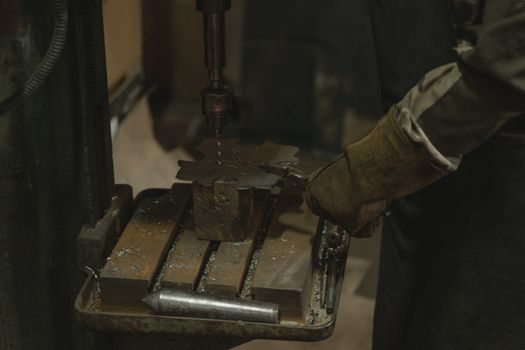
For cartridge and bag systems, the housing is usually a stainless or carbon-steel vessel with a swing-bolt or clamp closure, machined to ASME-style pressure-vessel tolerances; the goal is a leak-tight seal at the cartridge O-ring interface so bypass flow cannot skirt the media. For sludge and dewatering lines, the equivalent "housing" is a recessed-chamber filter press: M.W. Watermark builds the plates, filter cloths, hydraulic closure, and control package as one integrated press, with the Pro-X™ line positioned as the higher-pressure / higher-cycle member of that OEM's product set [S1]. The plate pack is what defines the effective filtration area, and the cloth (woven monofilament, multifilament, or felt) is what defines the cake release and clarity — the two are designed together, not separately [S1]. The same plate-and-frame geometry scales from bench units up to multi-ton mining presses, with hydraulic pressure, plate count, and cloth spec as the three main sizing levers [S1].
Step 4 — Filtration Mechanism: Surface vs Depth
Surface and depth are the two physical mechanisms an industrial filter can use, and a process line typically stacks both [S3]. Surface filtration — membranes and woven cloths — captures particles on the media face, which gives a sharp cutoff but a finite cake-holding capacity before differential pressure spikes. Depth filtration — fibrous, sintered, or granular beds — captures particles throughout the matrix, trading a less precise cutoff for higher dirt-holding capacity and longer life as a prefilter [S3]. High-flow cartridges are the bulk-process compromise: pleated geometry for surface area, depth-style gradient media for capacity, aimed at cooling water, process liquids, and CIP skids where change-out cost dominates over absolute retention [S3]. Pall's industrial framing — monitoring, separation, and filtration at multiple points along the line — is built on this staged surface/depth logic, not on a single element doing the whole job [S5].
Step 5 — Integrity Testing, Validation, and Maintenance Loop
Every pleated membrane cartridge is integrity-tested before shipment, with bubble-point, diffusion, or pressure-hold tests confirming the rated micron cutoff has not been damaged during pleating or assembly [S3]. In service, the running signal is differential pressure across the element: a rising ΔP tells the operator the cake is building and change-out is approaching, while a step drop in ΔP is a flag for media breach or bypass at the seal [S3]. Pall positions its industrial line around three lifecycle points — monitoring, separation, and filtration — explicitly to reduce costly downtime and extend equipment life across the production cycle [S5]. Bag filters follow a similar ΔP-based change-out rule, and Standard Filter's continuous-improvement programme treats lot traceability, seam strength, and permeability as recurring audit items rather than one-off checks [S4]. For an adjacent process-engineering view, the melting-furnace type map covers the upstream heat-side decisions that determine which particulate load the filter will see, and the PTFE total-cost-of-ownership piece walks through the long-life media cost lines that a filter-press cloth spec has to sit inside.
Selection Criteria: Cartridge vs Bag vs Filter Press
Three criteria usually drive the choice: required absolute retention (µm), solids loading (% by volume), and batch vs continuous duty. Membrane pleated cartridges win on retention (down to 0.2 µm absolute for sterile fluids) and on footprint per unit flow, but lose on solids capacity versus depth or bag media [S3]. Bag filters and depth cartridges win on change-out cost for dirty streams and are commonly used as prefilters ahead of a final membrane stage [S3][S4]. Recessed-chamber filter presses — the M.W. Watermark product family — win on dewatering duty, producing a handleable cake at 30–70 % dry solids depending on feed, but they are batch, not continuous, and need floor space, hydraulics, and a cloth-wash routine [S1]. The trade-off is rarely a single spec; it is retention × capacity × duty cycle × cleanroom or wash-water requirement, all evaluated against the cost of a downstream failure.
Limits, Failure Modes, and Sourcing Signals
The dominant failure modes are media breach (a pinhole or crease that lets particles through), bypass at the O-ring or gasket, and blinding (the cake loads past the ΔP trip before the rated life is reached) [S3]. Each one shows up differently: breach as a sudden step in particle counts downstream, bypass as a flat ΔP that never rises, blinding as a ΔP that climbs early [S3]. M.W. Watermark addresses the press side with remanufactured/rebuilt equipment, rental units, and a filter-plate shifter retrofit line, which is itself a signal that plate handling is a measurable maintenance cost in heavy-cycle plants [S1]. Pall's industrial framing — three lifecycle points, monitoring / separation / filtration — is the OEM signal that suppliers expect customers to instrument differential pressure, not just change cartridges on a calendar [S5]. Track those three signals (ΔP trend, integrity-test pass rate, and cloth or cartridge life per batch) over the next two quarters; any one moving against trend is a lead on either a media spec change or a feed-side process drift.
For the relevant spec sheets and selection criteria, see additive manufacturing material, and multifunction process calibrator.