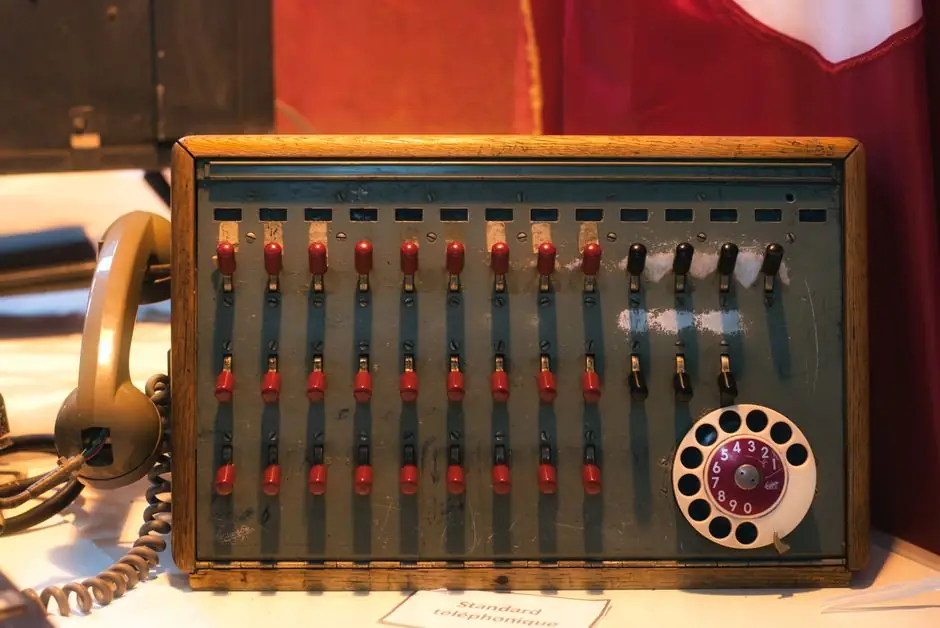
A decade resistance box is a passive switching instrument that produces a selectable resistance by tapping a rotary switch through a series string of ten precision resistors; position 0 shorts input to output, each successive position adds one more equal-value resistor to the chain, so the switch steps resistance in increments of one resistor at a time [S3].
The architecture is modular: each "decade" is an independent 1-2-3-...-10 string, and 4 to 6 such decades are cascaded in series, giving a total resistance equal to the sum of the contributions from each rotary switch and a continuous range from 1 ohm to 1 Mohm or beyond [S1][S5][S6].
Internal Switch Topology: One Rotary, Ten Equal Resistors
Inside a single decade, ten resistors of identical value are wired in series; the rotary switch's wiper selects how many of those resistors sit between the input and output terminals [S3][S4]. With 1 ohm resistors in the string, dial position 5 places 5 ohms in circuit; with 10 ohm resistors, the same dial position yields 50 ohms; with 1 Mohm resistors, it yields 5 Mohm [S3]. The VPG Foil Resistors product family describes this as precision resistors connected to each rotary switch so the user dials combinations in series or parallel depending on design [S1].
Position 0 is special: the switch bypasses the resistor chain entirely and shorts the input directly to the output, contributing zero ohms from that decade [S3]. Position 9 places all ten resistors in circuit, contributing 10x the per-step resistor value. The resistance contribution of each decade is therefore 0 to 9 times its unit resistor, never 10x, which is why higher ranges always need the next decade [S3][S7].
Cascading Decades to Cover 1 Ohm to 10 Megohm
Because one switch alone tops out at 9x its unit value, real instruments stack 4 to 6 decades: for example, 1 ohm, 10 ohm, 100 ohm, 1 kohm, 10 kohm, 100 kohm, 1 Mohm, giving 0-9 in each digit and a combined range of 0 to 9,999,999 ohms in 1 ohm steps [S2][S7]. A custom build by Osborne Engineering demonstrates a 1 ohm to 10 Mohm range assembled from a 1 ohm wire-wound decade through a 10 Mohm decade, with a separable link at 10 kohm so the low-resistance half can be used in series while the high-resistance half is used in parallel for resistor trimming [S2].
The decades are wired in series: the output of the units decade feeds the input of the tens decade, whose output feeds the hundreds decade, and so on, so total resistance is the arithmetic sum of every decade's contribution [S3]. Tescaglobal and Transformer Tester both describe the same principle: each decade handles one decimal digit of the final value, and ten resistors of equal value per decade, switchable in or out of circuit, build the output [S5][S6].
Switch Contact Construction and Resistor Selection
The rotary switch itself is a make-before-break or break-before-make wafer with one pole per position; commercial units such as the SparkFun hookup box use switches rated to 300 mA continuous current, and 1/4 W per resistor in the chain [S3]. Higher-end boxes swap metal-film for foil or wire-wound elements: VPG Foil Resistors builds decade boxes from bulk-metal foil resistors, the Osborne Engineering build uses 1% 50 ppm/degC metal-film resistors for the decades and 12.5 W wire-wound power resistors bolted to a cast aluminum chassis for the 1 ohm and 10 ohm low-resistance decades [S1][S2].
Resistor type is dictated by the decade's value and current duty. Low decades (1Ω, 10Ω) need wire-wound power parts because the same current flows through them at much higher dissipation [S2]. The SparkFun table quantifies this: at 5 V across the box, any resistance below 100 ohm is already at the 1/4 W limit, and at 30 V (a +/-15 V supply) the limit drops to 3.6 kohm, so the front-panel resistance must be checked against the applied voltage, not just the desired value [S3].
Series-String vs Binary-Weighted Alternatives
The series-string design with 10 equal resistors per decade is the dominant topology, but a binary-weighted alternative exists for programmable builds: 1-2-4-8 resistor networks switched by 4 SPST switches per decade give 0 to 15 in 16 steps with 4 resistors instead of 10, at the cost of more switch contacts and stricter resistor tolerance [S4]. For a 0.1 ohm to 1 Mohm range in 1% steps, the forum discussion notes an 11x5 grid where each column is one decade and 10 resistors are wired in series letting you select between 1x and 9x multiplication, and 5 such decades in series reach 1 Mohm [S4].
The series-string approach wins on switch simplicity and parts count: 5 rotary switches, 50 resistors, 5 solder nodes per decade versus 20 SPST switches and 20 resistors for binary. The trade-off is that every resistor must be the same value, so a wide range box still needs one string per decade rather than one shared resistor pool, and 1% steps require the per-decade resistor to be 1% tolerance or better [S4][S7].
Known Limitations: Inductance, Power, and Contact Resistance

Decade boxes have three persistent limitations that affect where they can be used. First, the rotary switch and internal wiring add parasitic inductance, on the order of microhenries for a multi-decade string, so a decade box is unsuitable for high-frequency filter or feedback networks where the box's own L and C will dominate the loop response [S2]. Second, the per-resistor power rating, typically 1/4 W for small metal-film decades, is the hard ceiling: at 12 V across a 576 ohm setting, the box already dissipates 1/4 W and 20 mA flows; below that resistance at the same voltage, smoke and fire are the next outcome [S3].
Third, switch contact resistance, typically 10 to 50 milliohms per pole, adds directly to the low-resistance decades and corrupts the 1 ohm and 10 ohm settings, which is why the low decades in precision boxes use 4-terminal (Kelvin) connections or separate heavy-duty switches [S2][S3]. Current rating compounds the contact-resistance problem: the SparkFun box is rated 300 mA through the switch, and pushing past that accelerates contact wear and resistance drift [S3]. For applications that need more current or higher voltage, the same series-string topology is rebuilt with high-power wire-wound resistors and a larger switch, as the Osborne 1 ohm/10 ohm decade shows, with 12.5 W resistors and a separate banana-jack front panel for power sinking [S2].
Typical Use Cases and Where a Decade Box Beats a Potentiometer
A decade box is the right tool when you need a known, repeatable, low-TC resistance that can be set, read off the front panel, and reset exactly the same way tomorrow, which is the bread-and-butter use case for calibrating insulation resistance testers, emulating RTD simulation for transmitter loops, trimming reference dividers, and prototyping filter or pull-up networks [S5][S6]. Transformer Tester describes the typical use as substituting the box for an unknown resistor in a live circuit so the operator can dial in the value that makes the downstream instrument read correctly, then read that value off the dials [S6].
For dynamic adjustment under power, a decade resistance box is the wrong tool and a potentiometer or digital resistance simulator is correct; the box is for static, calibrated substitution. Conversely, for trimming tasks where you need to nudge a 3 kohm reference by 0.03%, the Osborne build's split architecture (series below 10 kohm, parallel above 10 kohm) lets one instrument trim up and trim down simultaneously, which a single-ended pot cannot do [S2].
Standards, Calibration, and Sourcing Notes
Commercial decade boxes from VPG Foil Resistors target metrology, military, and ATE applications where the internal resistors are foil elements with sub-ppm/degC TCR and long-term stability rated in years, and the rotary switches are silver-alloy wipers for low and stable contact resistance [S1]. Tescaglobal, Transformer Tester, and SparkFun all describe the same topology and same decade-cascading math, which is a strong signal that the design is settled and not changing [S3][S5][S6].
For a 1 amp, 1 kohm build (1 kW dissipation), the AllAboutCircuits discussion thread concludes the resistors themselves become the limit: a 1 Mohm resistor at 1 A would have to dissipate 1 MW, so the box is practical only up to a few hundred mA, and 1 A is achievable only in the 0.1 to 10 ohm decade with appropriately rated wire-wound parts [S4]. Always size the lowest decade for the actual current the load will draw, then cascade higher decades with 1/4 W to 1 W metal-film parts for the kiloohm and megohm positions. The 1/4 W per-resistor ceiling in low-cost boxes and the 300 mA switch ceiling in the SparkFun design are reasonable baselines, and any box specced above those numbers should publish per-decade power and per-switch current separately [S3].
Track the per-decade resistor tolerance and TCR as separate specs, because a 1% decade with 50 ppm/degC drift will pull a 1 Mohm setting by 50 ohms per degree, which is more error than the 1% initial tolerance over any reasonable workshop temperature swing [S2]. Foil-resistor boxes (VPG Alpha) hold ppm/degC rather than ppm/degC x 10 and are the right choice when the insulation resistance tester downstream of the box will resolve sub-percent differences.
For the relevant spec sheets and selection criteria, see limit switch box.
Background reading: Triplex vs Quintuplex Plunger Pump: Spec Decision Guide.