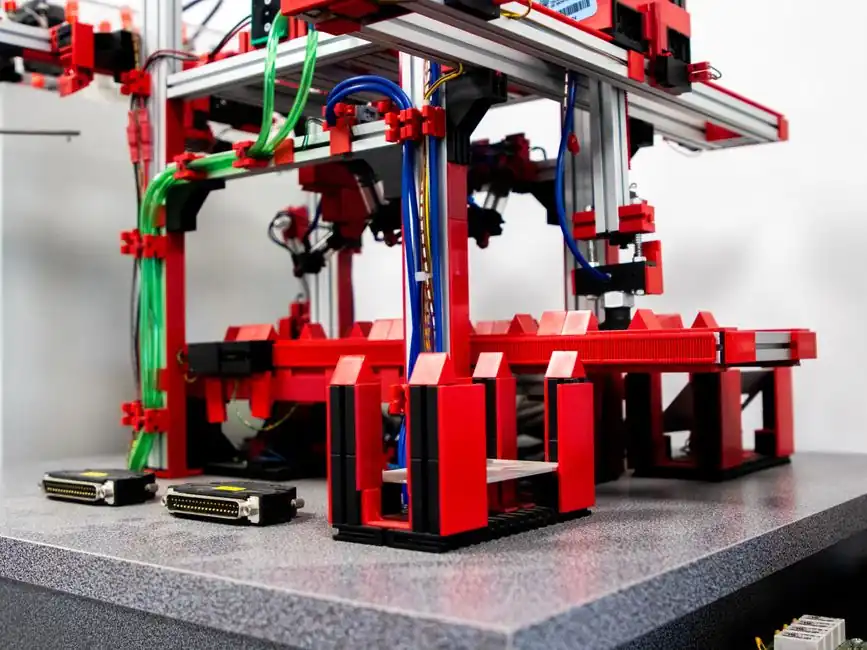
Industrial 3D printer fleets are most often integrated to MES and QMS through a three-layer pattern: an edge gateway on the OT network that speaks the printer's native protocol, a normalized data layer that converts machine state into a vendor-neutral format such as MTConnect, and a middleware tier that pushes that data to MES, ERP and QMS via REST APIs, webhooks, or message queues [S4][S2].
The pattern is not new, but the pressure is: additive manufacturing has moved from prototyping to end-use parts that demand full traceability, repeatability and quality control, and most plant MES suites were designed around CNC and assembly cells, not 3D printers [S4].
The four barriers every integration project hits first
Fragmented data collection is the first barrier: each 3D printer vendor exposes its own API, file format and telemetry schema, and most plant MES connectors do not understand any of them out of the box, which is why teams rebuild the same bridges for each new machine class [S4].
Limited visibility follows directly: without a normalized schema, support teams see only what the vendor portal exposes, so reactive ticket handling replaces proactive OEE work and unplanned downtime cascades into missed delivery dates [S4]. OT/IT segmentation is the third barrier, because industrial sites require strict separation between the printer's control network and the corporate IT fabric that hosts MES, ERP and QMS, and any bridge has to honor that boundary, often with on-premises or hybrid deployment [S4]. The fourth barrier is enterprise integration itself: MES and ERP expect work orders, routings, part numbers, lot IDs and quality dispositions in their own format, and raw printer telemetry rarely maps cleanly to any of those fields [S4][S1].
Three reference architectures in production today
Architecture 1, the vendor IoT cloud: Stratasys's GrabCAD IoT Platform uses AWS IoT Core and AWS IoT Greengrass to land MTConnect-normalized data at the edge, then exposes insights through GrabCAD Streamline Pro while keeping the MES and ERP as the systems of record for production orders [S4]. Architecture 2, the on-prem broker: plants that cannot send data to a vendor cloud run a self-hosted broker (for example a Klipper/Moonraker endpoint such as port 7125 inside the LAN, with a Printago Fuse LAN client in front of it) that connects to MES, ERP, PLM and QMS over the enterprise REST API and webhook tier [S2][S3]. Architecture 3, the MES-native connector: large MES suites such as Siemens Opcenter, Dassault DELMIA Apriso and AVEVA MES now expose additive manufacturing modules or partner connectors that pull from a normalized broker and write work-order, genealogy and quality records back into the MES database [S1][S5][S7].
The three patterns are not mutually exclusive, and a typical plant with fifty FDM machines, ten SLS machines and one metal-powder cell usually runs at least two of them side by side, with the MES as the single pane of glass for operations and quality [S1][S2].
What data crosses the bridge, and what must not
Across every architecture the data set splits the same way: the printer workflow owns queues, slicing profiles, live monitoring, maintenance, usage and cost records, while MES, ERP, PLM and QMS own production orders, released parts, routings, BOMs, lot genealogy and quality dispositions [S2].
In practice the printer-control layer pushes four payloads to MES: job start and job end events with the work-order and part ID, layer-by-layer or build-chamber telemetry tagged with the same IDs, material lot and serial numbers consumed or produced, and exception or non-conformance signals that the QMS can convert into a hold or CAPA record [S1][S2][S4]. MES pushes back three payloads: the released work order, the routing step that names this printer cell, and the disposition (release, rework, scrap) that closes the build in the quality record [S1][S7]. Identity, access, evidence and contractual records stay in the IT-controlled layer; temperature traces, motion telemetry and firmware logs stay in the OT layer, and the bridge is the only place both meet [S2][S4].
Standards and protocols that make it work
MTConnect is the dominant shop-floor protocol for normalized additive data, and Stratasys uses it as the ingestion schema for the GrabCAD IoT Platform so that downstream MES, ERP and analytics consumers see one consistent structure regardless of which printer model produced the data [S4].
On the LAN side, open-source 3D printer firmwares expose their own REST/JSON APIs: Klipper's Moonraker component serves on TCP port 7125 by default, and a LAN client such as Printago Fuse uses that endpoint to discover printers, push jobs, poll temperatures and status, and forward events to MES, ERP and QMS over a managed-cloud REST API plus webhooks [S3][S2]. Where IT policy forbids the cloud, the same client can be self-hosted, and SSO is federated through the customer's SAML or OIDC identity provider so that user provisioning still flows from the enterprise directory [S2]. At the MES level, OPC UA and ISA-95 work-order and personnel models are the most common integration points for new deployments, with quality data landing in the QMS through the MES, not directly from the printer, so that the MES keeps its single source of truth for in-process quality [S1][S7].
Comparing the three integration patterns

On time-to-first-signal, the vendor IoT cloud is fastest because the edge client and the cloud broker are pre-integrated and only the MES/ERP adapter is custom, while on-prem broker and MES-native connector projects typically run 8-16 weeks longer because the broker and the MES adapter are both custom work [S2][S4]. On data sovereignty, on-prem broker scores best because no telemetry leaves the plant network, vendor IoT cloud scores worst unless a hybrid or on-prem variant is purchased, and MES-native connector sits in the middle because data still crosses the OT/IT boundary into the MES database [S2][S4]. On coverage of non-supported processes, on-prem broker wins because any machine with a scriptable interface can be wrapped, vendor IoT cloud only covers the vendor's own models, and MES-native connector inherits the broker's coverage plus the MES's own coverage of CNC, assembly and test cells [S1][S2][S4]. On total cost of ownership at a fifty-printer fleet, vendor IoT cloud is usually lowest in year one, MES-native connector is highest in year one but converges as additive volume grows, and on-prem broker is mid-range with a one-time capex spike for the server and ongoing integration labour [S2][S5].
Who this pattern fits, and where it breaks
The pattern fits plants that already run a modern MES such as Opcenter, DELMIA Apriso or AVEVA, hold an ISA-95 work-order model, and have an OT/IT segmentation policy that lets an edge gateway sit on the printer network [S1][S5][S7].
It also fits plants that want a single pane of glass across FDM, SLS, SLA and metal-powder cells, because the broker hides the per-vendor differences and the MES presents one operator view, one quality record and one cost rollup [S1][S4][S7]. The pattern breaks in three places: first, plants whose MES is a legacy on-prem stack with no REST or webhook surface, where a custom adapter is the only path and budget doubles; second, plants that need closed-loop process control at millisecond cadence, because the bridge through MES adds latency that the printer's own controller must absorb; third, plants that want the 3D printer workflow itself to be the system of record, which is explicitly out of scope for the integration platforms and is the wrong choice for any regulated end-use part [S2]. Quality teams that try to skip MES and pull build telemetry directly into the QMS will see delayed issue detection and a mismatch between the lot ID in the QMS and the genealogy in the MES, so the MES has to stay in the middle of the quality loop [S1][S8].
Two operational signals to watch in 2026
Signal 1: the percentage of new MES deployments that ship with a published additive manufacturing connector and an MTConnect or OPC UA adapter as standard rather than as a custom integration, which is the clearest indicator that MES vendors have accepted 3D printing as a first-class cell type rather than a CNC lookalike [S1][S4].
Signal 2: the number of plants that complete a lot-genealogy audit by pulling every layer, every material change and every exception for a single part number from MES plus the printer broker without a manual data merge, because that audit pass is the practical proof that the bridge is doing its job and not just moving bytes [S2][S4]. For teams building a new additive cell, the cheapest first step is to confirm the printer's native API and a vendor-neutral protocol (MTConnect or OPC UA), then choose the broker, then wire MES and QMS last so that the MES keeps its role as the system of record for work orders and the QMS keeps its role as the system of record for quality [S1][S2][S4]. The same additive data that the plant already needs for end-use part qualification is exactly the data a collaborative manufacturing network uses to share capacity between plants, so getting the bridge right pays back inside the plant first and across the network next.
Spec-level background on the components involved: 3d scanner, air quality monitor, and power quality analyzer.
