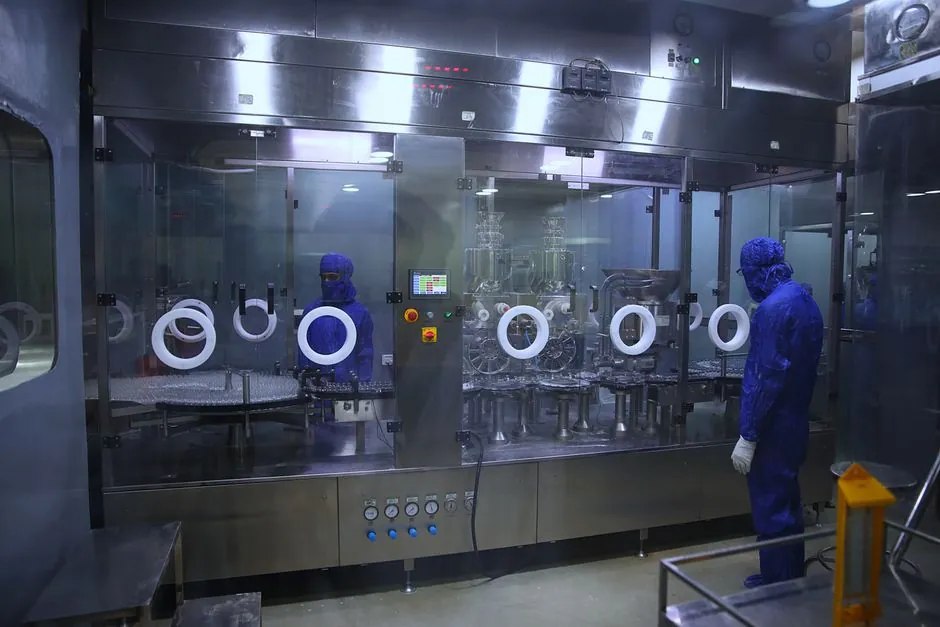
Comau's end-to-end hairpin stator portfolio, unveiled 2024-07-17, covers wire forming, insertion, widening, twisting, cutting, laser welding, and inline quality testing in a single configurable cell, with real-time process monitoring embedded at each station [S3]. The same release confirms the line was engineered inside the company's Shanghai E-Motor Center of Excellence, with the key stations produced in-house by Comau China [S3].
The market backdrop justifies that scale: the global hairpin stator market was valued at $4.8 billion in 2025 and is forecast to reach $14.2 billion by 2034, with automated testing equipment called out as a primary growth vector [S5]. Hairpin windings have become the dominant stator topology for high-power-density EV traction motors because rectangular cross-section copper packs more tightly into slots than round wire, lifting slot fill above 60% in production designs [S6].
Process chain and where automation now lives
A continuous hairpin stator line runs six sequential stations: rectangular wire forming, slot insertion, end-cap widening, twisting, laser welding of the interconnections, and final electrical plus dimensional test [S1][S3]. Comau's reference design allows the same line to step from semi-manual to fully automated without retooling, which is the lever most Tier-1 suppliers use to ramp from pilot to 200,000+ unit annual volume on the same footprint [S1].
Wire forming tolerance is the first gate: a single hairpin's cross-section is typically 4-6 mm wide by 1-3 mm thick, and the bend radius is dictated by the stator lamination geometry. Insertion station forces are monitored per slot, and any pin that exceeds the force window is flagged before twisting, which prevents downstream weld defects [S1]. Laser welding then fuses the twisted pair into a continuous electrical path, and the same station carries a vision system that checks weld bead geometry at line speed [S3].
In-process metrology: from tactile CMM to 3D scan
Traditional coordinate measuring machine tactile probing of a complete hairpin stator can run several hours per part, and the narrow inter-pin gap makes contact with the probe shaft a recurring risk that biases the result [S4]. Non-contact 3D scanning has therefore displaced tactile methods for production release, with optical fringe or laser triangulation systems digitising every pin in seconds [S2][S4].
ZEISS's eMotor Stator Inspection app, running on the ZEISS ScanBox 4105 for eMotors, extracts pin height, pin position, pin torsion, creepage distance, and air gap distance automatically from the scan, then flags each value against the nominal CAD tolerance window in a single table view [S4]. Hexagon's dimensional-inspection workflow applies the same idea at line integration level, treating the stator as a coordinate-feature assembly rather than a series of isolated pin measurements [S2]. The economic effect is that 100% inline inspection is now feasible at EV traction-motor takt, rather than sampling a few stators per shift [S2][S4].
What 3D inspection actually checks
Five feature families dominate the release ticket on every hairpin stator: pin height (Z-axis protrusion after twisting), pin position (X-Y placement versus CAD), pin torsion (twist angle), creepage distance (dielectric clearance between adjacent conductors), and the stator-to-rotor air gap that defines magnetic performance [S4]. Out-of-tolerance values are written to a per-stator report and exported for SPC trending, which is the data layer most OEM PPAP submissions now expect [S2].
For winding and insulation engineers, the more subtle checks are creepage and air gap. A hairpin twisted too far can reduce creepage below the dielectric limit and trigger a high-voltage hipot failure at end-of-line, while a twisted pair sitting proud by even 0.2 mm can interfere with rotor insertion and cause an air-gap eccentricity alarm [S4]. Reading the trend across a batch usually points back to either the twisting-station servo or the paper insulation placement, both of which sit upstream of the laser weld [S1][S4].
Selection criteria for a new hairpin line
Four numbers drive a hairpin line purchase decision: target annual volume, takt time per stator, achievable first-pass yield, and floor footprint per station. Comau's reference cell advertises semi-manual to fully automated scalability on a single footprint, which lets a buyer start at low-volume pilot and migrate to lights-out without changing the upstream electrical infrastructure [S1][S3].
Buyers also need to weigh three architecture choices. A continuous-flow line with inline 3D scanning maximises throughput but locks inspection behind the welding station, so a weld defect can waste downstream insert cost. A cell-based layout with offline metrology islands separates takt from inspection and lets the metrology stack be upgraded independently, at the cost of a finished-goods buffer. A hybrid line, with inline optical inspection at the welding exit and an offline 3D scan on a sampled subset, is the common compromise for ramp phases [S2][S3].
Limits, failure modes, and what still breaks
Three failure modes still escape current automation: copper-work hardening that shifts pin shape after twisting, paper-insulation slip that changes creepage before welding, and sub-surface weld porosity that 3D surface scans cannot see [S1][S4]. Copper grade selection and pre-anneal temper are the first levers, but porosity drives most suppliers to retain a periodic cross-section coupon cut for metallography, even on lines that are otherwise 100% optically inspected [S7].
Hairpin lines also concentrate risk in the laser welding cell: any drift in beam alignment or shielding-gas flow shows up as a weld-bead geometry excursion that the inline vision will catch, but not always before the next six pins are welded. The corrective lever is to feed the vision system into a closed-loop weld-parameter offset, rather than only into a stop-and-alarm signal, and this is where the metrology vendors (Hexagon, ZEISS) overlap with the automation vendors (Comau) at the cell-control layer [S2][S3][S4]. For broader plant-floor context on how these inline inspection stacks compare to the analog measurement loops still used in adjacent process industries, the inline green-sand control architecture in inline green sand testing: properties, sensors, control loops is a useful cross-reference.
Standards, sourcing, and the audit trail
There is no single hairpin-specific IEC or ISO standard; suppliers instead certify against the OEM's motor-level functional spec (insulation class, partial-discharge inception voltage, hipot level) and against the ISO 9001 quality system that the OEM's PPAP package demands [S6][S7]. For winding shops that also serve non-EV traction or industrial drives, the same equipment can produce continuous hairpin stators for industrial motors, where the trade-off shifts from takt to slot-fill and thermal class [S6][S7].
On the component side, hairpin lines are capital-intensive: a single fully automated cell from Comau-class vendors runs into the tens of millions of euros, and a complete greenfield line including insertion, twisting, laser welding, and inline 3D metrology typically scales with the number of stations rather than throughput, so doubling takt costs less than doubling stations [S1][S3]. The market forecast of $14.2 billion by 2034 from $4.8 billion in 2025 implies a compound annual growth rate near 12.8%, with automated testing equipment identified as the fastest-growing sub-segment inside that envelope [S5].
Trackable signals for the next reporting cycle: Comau Shanghai's localisation rate for key stations (currently 100% in-house per its 2024 release) [S3], and the share of new OEM PPAP submissions that require 100% inline 3D-scan release versus statistical sampling. Both move slowly but predictably, and both reset the cost-per-stator calculation for any greenfield bid. For a parallel decision map on how inline measurement data drives downstream acceptance criteria in copper-heavy electrical assemblies, the Copper vs Aluminum Busway: Price, Conductivity, and the 2026 Spec Decision article lines up the same kind of data-density argument on a different product. The wider plant-electrification context, including how hairpin lines fit into a Tier-1's broader electrical automation stack, is also worth reading for procurement teams weighing turnkey versus best-of-breed cell sourcing.
Spec-level background on the components involved: air quality monitor, and power quality analyzer.