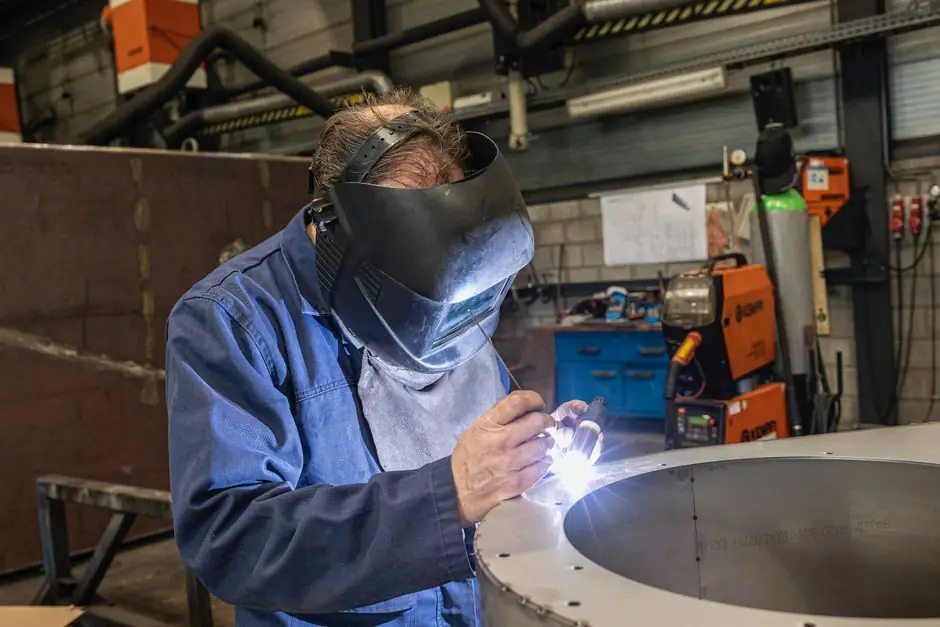
Stud welding parameters are qualified inside a WPS by recording the actual machine settings used to weld a Procedure Qualification Record (PQR) coupon, then proving those settings through one of three mechanical tests, visual acceptance, bend test, or tension/torque test, per AWS B2.1/B2.1M [S2].
The qualified parameter set typically covers current, open-circuit voltage (OCV), weld time in seconds or cycles, polarity, lift, and plunge, all logged to a tolerance of plus or minus 5 percent on current [S2]. The PQR test coupon is then cut up and tested destructively, so the WPS only becomes a "qualified WPS" once those settings survive the chosen test method [S5].
The Essential Variables That Must Be Recorded
A stud welding WPS is a parameter-and-variables sheet, not a generic procedure, and the AWS B2.1/B2.1M form lists exactly which machine data the welder must capture [S2]. Required fields include power supply make and model, stud gun model, weld time in seconds and cycles, current plus or minus 5 percent, OCV, polarity, lift, plunge (protrusion), weld cable size, cable length, and the number of grounds (workpiece leads) [S2]. Stud material, base material specification, alloy and temper, group number, surface condition (HR or CR), coating, cleaning method, and base thickness round out the joint description [S2].
Typical stud welding current scales with stud diameter and falls in the 30 to 200 V open-circuit range, with arc duration measured in milliseconds rather than seconds, making time the most sensitive variable to instrument [S1]. Lift, the gap the stud is drawn away from the base plate to strike the arc, and plunge, the final immersion depth, are unique to stud welding and have no equivalent in standard arc welding WPS, so they are the variables most often mis-recorded in practice [S2][S8].
Three Mechanical Tests Used to Qualify the Parameters
AWS B2.1/B2.1M accepts three mutually exclusive mechanical tests for a stud PQR, and the welder picks one per qualification [S2]. Option 1 is a bend test, where the stud is bent to a target angle and inspected for weld-base failure; Option 2 is a tension test, which loads the stud axially to its specified ultimate; Option 3 is a torque test, optional and applicable only to threaded fasteners [S2]. The pre-start WPQR required at the start of every shift on UK composite floor decks welds 10 test studs and bends them 30 degrees from their original axis, with failed studs forcing an equipment reset and re-test [S4].
For ongoing production surveillance, the same 30-degree pre-start bend is replaced by a 15-degree in-service bend, applied to the greater of 5 percent of studs or at least 2 studs per beam; if any stud fails, three studs on either side must also be tested [S4]. Ferrules are broken away to expose the weld fillet for visual inspection, and a non-resonating ring under hammer tap is the trigger to send a suspect stud to the bend test [S4].
Which Code Governs Which Market
North American structural stud welding is governed by AWS D1.1 and AWS B2.1/B2.1M, with the stud form adapted directly from D1.1 Annex N Form N-9 [S2]. European composite deck and shear stud work sits under BS EN ISO 14555:2014, the European standard specifically for stud welding of metallic materials [S4][S7]. Canadian fabricators working to CSA W47.1, W47.2, or W186 must additionally prepare a Welding Procedure Data Sheet (WPDS) alongside the WPS, broken into eight blocks covering general info through final remarks, and submit both to the CWB Bureau for stamping before production welding [S3].
Process-specific standards also matter: ISO 13918 governs stud geometry and ISO metric threads, while MIL-S-24149 covers US Navy stud welding requirements, and the AWS stud form captures which of these applies in the stud specification line [S2]. Operators must follow the manufacturer's recommended parameter ranges and only trained personnel should measure the live settings, per CWB guidance [S3].
Comparison of the Three Qualification Paths
For a fabricator choosing how to qualify, the three test options trade speed against information. A bend test (Option 1) is the fastest, requires no tensile machine, and matches the WPQR practice used in UK deck work where 10 studs are bent 30 degrees before each shift [S4]. A tension test (Option 2) provides an actual ultimate load value for the stud-base combination and is the preferred option where design calculations reference a specific shear or tension capacity. A torque test (Option 3) is restricted to threaded studs and verifies the stud has not unscrewed under torsional load, not the weld itself [S2].
On equipment cost and turnaround, a prequalified WPS (no PQR required) is only valid if every essential variable sits inside the code's published envelope, which is why most stud welding ends up needing a project-specific PQR [S5]. The AWS B2.1/B2.1M-2014-AMD1 form handles all three roles, WPS, PQR, and Welder Qualification Record (WQR), on a single page, with the user ticking which document it represents at the bottom [S2].
Setting Up the Pre-Start WPQR on a Real Job
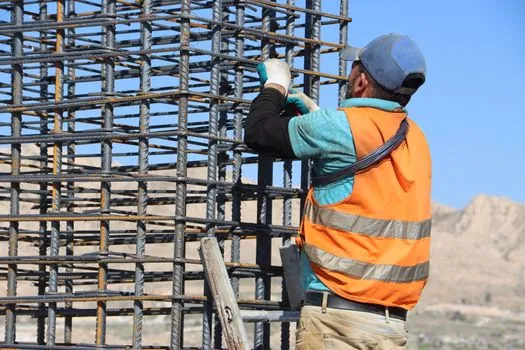
A typical pre-shift sequence runs: confirm power supply and gun model match the qualified WPS, set current to the midpoint of the qualified range, set OCV inside the 30 to 200 V window, set weld time in cycles per the WPS, verify lift and plunge, weld 10 test studs on a sample of the actual production base material, bend to 30 degrees, and only release the line for production if all 10 survive [S2][S4]. Settings drift during the shift because of cable length, ambient temperature, parent steel grade, and atmospheric conditions, so re-test parameters must be re-validated if the welding equipment is moved, the stud diameter changes, or the base material group changes [S4].
Surveillance then continues at the rate of 2 studs per beam or 5 percent of studs, whichever is greater, with failed studs triggering tests on three studs either side and full replacement of any failed stud [S4]. QA records are marked on a drawing that ties WPQR location and settings to beam reference, satisfying BS EN ISO 14555:2014 traceability [S4].
Where Stud WPS Sits Next to Other Joining Decisions
The qualification discipline that stud welding borrows, written WPS plus PQR plus destructive test plus ongoing surveillance, is the same logic used in arc welding and is the reason CWB form 119E and AWS B2.1/B2.1M share field structure with the wider structural welding code family [S2][S3]. Fabricators running both stud welding and other arc processes typically find the stud PQR is the shortest qualification cycle in their shop, because the bend test takes seconds and the test studs are reused as fixings once bent. For shops sourcing studs and pins, the welding and cutting tool category covers the studs themselves plus the ferrules, guns, and ground leads that the WPS references by part number [S2]. Where studs are welded to vessels or process piping monitored by pressure transmitters, the same PQR discipline keeps the heat-input zone documented for downstream NDE planning.
Two signals to watch over the next quarter: AWS B2.1/B2.1M maintenance activity (any amendment to the AMD1 form would change which fields are mandatory on the PQR), and any revision cycle on BS EN ISO 14555, since UK deck work is currently pinned to the 2014 issue [S4].
This topic is covered further in Excavator Haul Envelope: Width, Height, and Trailer Match-Up.