
Minimum right-angle stacking aisle width = Right Angle Stack spec + Load Length + 12 in. clearance, a formula used across OEM and dealer sources to define the narrowest rack-to-rack corridor a lift truck can turn into with a pallet [S1][S2][S4][S7].
The Right Angle Stack value is a manufacturer-published turning dimension: the smallest aisle into which a truck can rack a 48 in. long by 40 in. wide standard pallet at 90 degrees to the racking face, with the load centered on the forks [S1][S2]. Combined with the load length and a 305 mm (12 in.) maneuver cushion, the sum sets the absolute minimum, with a working design aisle typically adding 4-6 in. for operator error and pallet overhang [S2][S3].
The Three-Term Formula: RAS, Load, Clearance
Right Angle Stack (RAS) is published on every forklift spec sheet, for example the Clark ECX30 lists 91.3 in. RAS, the Clark C12C cushion-tire IC truck 90.7 in., and the BYD ECC22 Li-ion cushion truck 87.2 in. [S2]. RAS is a chassis dimension, not a free-space dimension: it is measured with the load on the forks, mast at standard lift height, and the truck executing a 90-degree pivot from straight travel to perpendicular to the rack face [S1][S2].
Load Length is the longest face of the palletized load that enters the rack first. For standard GMA pallets the working value is 48 in., butchers and beverage pallets run 40-44 in., and 48 in. drum pallets with 6-8 in. overhang force designers to add the overhang distance to the term rather than rely on the 12 in. cushion [S2][S5].
Clearance is the 12 in. baseline that absorbs mast deflection, fork swing, steering lock overrun, and operator positioning error [S1][S2][S4][S6][S7]. Many specialists add another 6 in. for routines with overhang or for trucks with high-travel masts, making the practical cushion 18 in. for a 6 in. overhang case [S2]. A worked example: 94.3 in. RAS + 48 in. load + 12 in. clearance = 154.3 in., or 12.86 ft minimum, so a 13 ft. rack-to-rack bay is required [S5].
Aisle Width by Truck Class: Counterbalance vs Reach vs Orderpicker
Counterbalance (Class I electric, Class IV/V IC) sit at the wide end: typical right-angle stacking aisles run 12-13 ft for one-way travel with standard pallet loads, and 13-15 ft for two-way traffic to allow passing clearance [S2][S8]. The Clark NPX20 stand-up narrow-aisle truck, with a 46 in. right-angle stack, drops into a 10 ft. rack-to-rack corridor with margin [S2].
Reach trucks (Class II) and turret trucks collapse the aisle to 8-10 ft because the mast reaches forward rather than the chassis turning, so the RAS number on the spec sheet is closer to the truck length than to a true pivot radius. Double-deep reach and articulated reach configurations push the minimum below 8 ft when matched to the right rack geometry [S2][S8].
Orderpickers and very narrow aisle (VNA) trucks with wire or rail guidance operate in 5-6 ft aisles, sometimes down to 56 in. for a man-up stock picker, but those aisles require guidance, level floors, and rack specifically rated for the truck class, they are not drop-in compatible with counterbalance racking [S2]. For context on the chassis side, the forklift encyclopedia entry covers the truck classes and their turning behavior; for facilities where the floor is uneven or outdoor, the rough terrain forklift entry explains why those chassis add 1-2 ft to every aisle figure.
Worked Example: 5,000 lb Cushion Truck on GMA Pallets
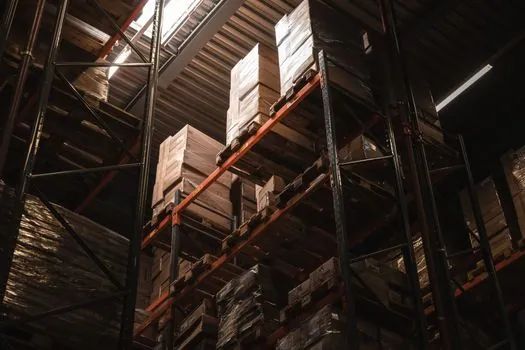
Take a representative 5,000 lb capacity cushion-tire electric counterbalance with a 91.3 in. RAS, moving 48 in. GMA pallets without overhang [S2]. Step 1: RAS = 91.3 in. Step 2: Load = 48 in. Step 3: Clearance = 12 in. Sum = 151.3 in., or 12.61 ft. The minimum rack-to-rack dimension to turn with a flush pallet is therefore 151.3 in., and any real bay should be built to 13 ft. (156 in.) to preserve the 4.7 in. cushion the formula intends [S2].
Now apply the same truck to a 48 in. pallet with a 6 in. load overhang on the load wheels side: RAS 91.3 + Load 48 + Overhang 6 + Clearance 12 = 157.3 in., or 13.1 ft. The bay must grow to 13 ft. 4 in. or the operator will clip the rack upright on every put-away [S2][S3]. A heavier 6,000 lb truck in the same family (Clark ECX30) needs the same 13 ft. minimum; dropping to the 5,000 lb ECX25 buys back 6 in. of cushion at the cost of 1,000 lb. of capacity [S2].
OSHA and Code Constraints That Override the Math
OSHA 1910.176 does not publish a single aisle-width number, it requires "sufficient clearance" for safe operation, with industry practice codified by ANSI/ITSDF B56.1 (the safety standard for low and high lift trucks) and the NFPA fire codes for sprinkler clearance [S8]. Standard straight-travel aisles for one-way traffic settle at 11-13 ft; right-angle stacking aisles at 12-13 ft; two-way traffic aisles at 14-16 ft depending on pallet length and truck width [S8].
Aisle width gains roughly 1 ft per side when the rack is positioned adjacent to a pedestrian walkway, a column, or a wall, because the operator cannot use the rack face as a steering reference and the truck must be straightened before the lift [S9]. voids the formula assumption and forces a re-measure [S9].
Limitations and Failure Modes of the Formula
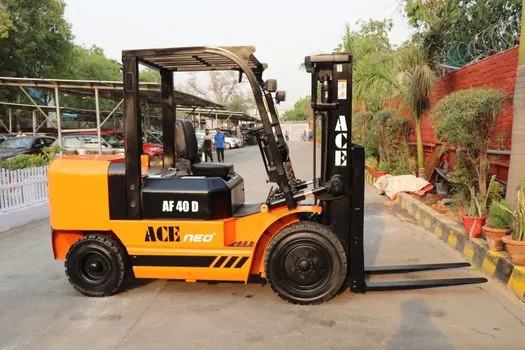
The RAS + Load + 12 in. equation assumes a flat, level floor, a square 90-degree turn, a centered load, and an experienced operator on the standard qualification cycle. Any of those assumptions breaking adds at minimum 2-4 in. to the working aisle, and a miscalculated assumption is the dominant cause of rack impact damage in narrow-aisle facilities [S1][S3][S9].
Common failure modes: (1) load overhang added to Load Length but not removed from Clearance, double-counting the 6 in.; (2) mast tilt or sideshift left extended during the stacking move, adding 2-4 in. to the effective chassis length; (3) specifying a reach truck RAS in a counterbalance truck bay, where reach trucks assume a free-path entry but counterbalance trucks need a 12-18 in. approach straight; (4) ignoring the difference between the manufacturer RAS (often measured with a 48 in. test load) and a real load that is 44 in. or 50 in. long [S2][S3].
For storage projects where the floor-to-rack budget is fixed, designers should spec the truck first, then back-calculate the rack bay, never the other way around. Going from 12 ft. aisles to 8 ft. aisles can add roughly 20% more storage capacity in the same footprint, but only when the lift truck, rack, and floor are spec'd as a system rather than assembled from independent catalogs [S2].
Trackable Signals to Verify the Spec
Before locking a bay width, pull three numbers from the OEM data plate and one from the site survey: (1) RAS at the mast tilt and lift height the operator will actually use, (2) truck width across the widest standard tire, (3) right-angle stack with sideshift centered versus fully extended, and (4) rack upright-to-upright clear dimension measured at floor level, not nominal [S1][S9].
Track the OEM RAS revision in the spec bulletin when the truck is upgraded to a new model year, because a 0.5-1.0 in. RAS change between model years can shift a marginal 12.5 ft. bay into a non-compliant corridor without any change to the rack or floor.
The underlying component specifications are covered under angle grinder.
For related coverage, see 10x12 ft Drop Ceiling Grid: Main Tees, Cross Tees, and Wall Angle Takeoff.